

Read the week's best commentary from bloggers at the Center for American Progress' "ThinkProgress," Huffington Post blogs and more.
ABORTION-RIGHTS MOVEMENT:
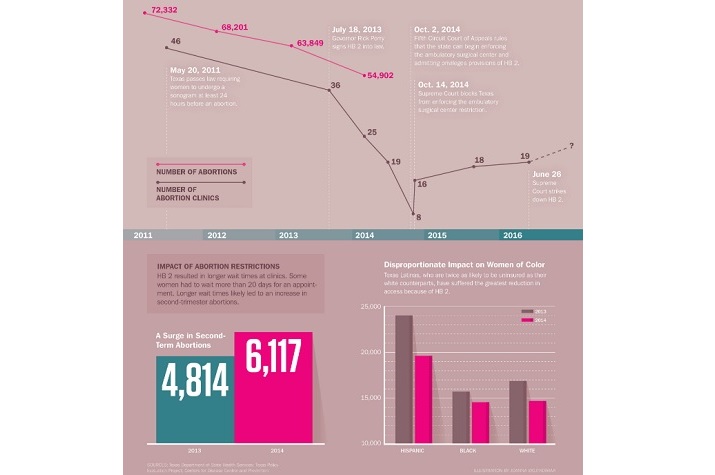
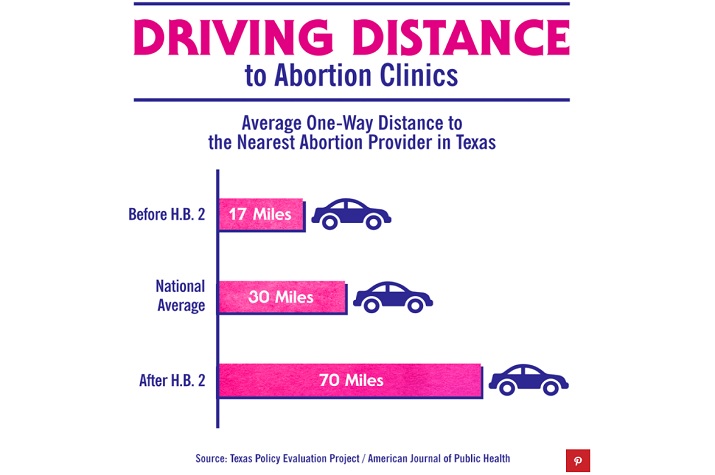
"Pro-choice groups hope abortion victory leads to domino effect in other states," Alex Zielinski, Center for American Progress' "ThinkProgress": The U.S. Supreme Court's decision last week to strike down parts of Texas' "oppressive" omnibus antiabortion-rights law (HB 2) signals that "the steadily rising tide of laws limiting women's access to a legal abortion has reversed -- and pro-choice advocates finally have the legal support to shred legislation based on lies," Zielinski writes. For instance, Zielinski notes that within days of the Supreme Court's ruling on the Texas case, the high court rejected cases seeking to reinstate similar laws in Mississippi and Wisconsin, "bringing an end to major state abortion restrictions." In addition, according to Zielinski, the Center for Reproductive Rights (CRR), which represented abortion providers in the Texas case, has "filed a new lawsuit that challenged every abortion restriction law passed in Louisiana in 2016." Further, citing CRR Litigation Director Julie Rikelman, Zielinski writes CRR "is now working to immediately quash laws held up in pending litigation in at least five more states," many of which "are 'almost identical' to Texas' law." Separately, Zielinski notes that Planned Parenthood last week announced plans to launch a repeal campaign against abortion restrictions in eight states and reopen the Texas clinics closed under HB 2. However, Zielinski writes of the Texas ruling, "this major victory ... does not mean the fight for abortion access is over." She notes that abortion-rights advocates "expect anti-abortion organizations to return with a new strategy to legally make abortions difficult for women to obtain" (Zielinski, "ThinkProgress," Center for American Progress, 7/1).
What others are saying about the abortion-rights movement:
~ "Behind the Supreme Court abortion victory: The amazing lawyers who made it happen," Dorothy Samuels, Huffington Post blogs.
~ "Turning the anti-abortion tide," Deana Rohlinger, American Prospect.
ABORTION RESTRICTIONS:
"Florida's abortion law is grounded," Miles Zaremski, Huffington Post blogs: Zaremski discusses the future of a Florida omnibus antiabortion-rights law (HB 1411) in light of a federal judge's decision to issue a preliminary injunction halting certain provisions of the law, as well as the Supreme Court's recent ruling in Whole Woman's Health v. Hellerstedt. Zaremski explains that in Whole Woman's Health, the high court rejected state efforts "to limit abortions with provisions unrelated to the health and safety of a woman undergoing an abortion," ruling that certain restrictions in Texas' HB 2 "did not further the health and safety of such a woman" but rather imposed "substantial obstacles in the path of a woman's choice not considered to be permissible means of serving legitimate state interests." Although some said the Hellerstedt ruling "would not be influential" in the Florida case, U.S. District Judge Robert Hinkle ruled "otherwise," Zaremski writes, explaining that Hinkle struck down a provision in the law that required the state to inspect a certain number of documents related to abortion care, as well as a provision that cut public funding for abortion providers. Zaremski concludes, "[T]he Florida legislature (and similar state legislative bodies) take note: just because you say provisions of your abortion statutes (a) advance, protect, and ensure the health and safety of a woman undergoing an abortion and (b) therefore advance a legitimate state interest does not, and will not, make it so" (Zaremski, Huffington Post blogs, 7/3).
RELIGIOUS REFUSALS:
"A victory for religious freedom: Mississippi's state endorsed religion struck down," Harvey Fiser, American Constitution Society blog: "As the celebrations of gay pride month came to a close and LGBT Americans herald the major advances in the court of public opinion and honor the anniversaries of the Windsor and Obergefell decisions, Mississippians were facing the prospect of waking up on July 1 with another attack on LGBT rights, HB 1523 -- arguably the most comprehensive and blatantly discriminatory 'religious freedom' bill any state has yet to pass," writes Fiser, an associate professor of business law at Millsaps College. Fiser explains that state residents were waiting to hear "whether a federal court would stop this newest state sanctioned discrimination," which "purports to protect numerous public and private actions based wholly or partially on three, and only three, religious beliefs -- that '(a) Marriage is or should be recognized as the union of one man and one woman; (b) Sexual relations are properly reserved to such a marriage; and (c) Male (man) or female (woman) refer to an individual's immutable biological sex as objectively determined by anatomy and genetics at time of birth.'" On June 27, according to Fiser, District Court Judge Carlton Reeves modified a permanent injunction in his 2014 marriage equality ruling, holding that an HB 1523 provision "'permit(s) the differential treatment' of same-sex couples in obtaining marriage licenses." A few days later, Reeves struck down the law as a whole, noting that "[b]ased in both the Establishment Clause and Equal Protection ... HB 1523 was a blatant and poorly hidden attempt at discrimination against the LGBT community." Fiser concludes, "Judge Carlton Reeves' opinion makes clear that the federal courts of Mississippi respect the lessons of Windsor and Obergefell and will not allow the State of Mississippi to forget them" (Fiser, American Constitution Society blog, 7/1).
ZIKA VIRUS:
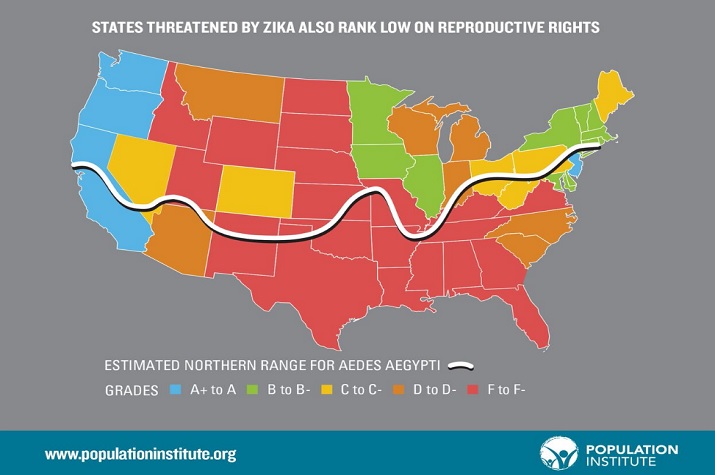
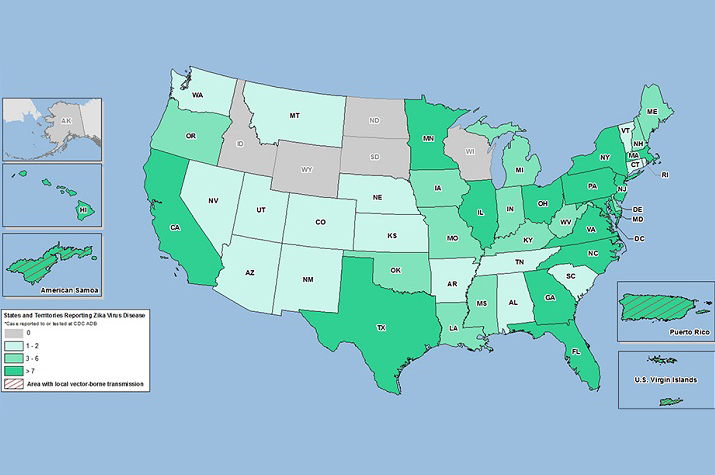
"The list of possible Zika birth defects continues to grow," Diana Fine Maron, Scientific American/Salon: New research shows that birth defects linked to the Zika virus "may extend far beyond" microcephaly, a condition in which an infant is born with an abnormally small head and brain, Maron writes. According to Maron, a study of 83 infants born in Brazil "since August 2015 to mothers believed to have been infected with Zika" indicates "that serious joint problems, seizures, vision impairment, trouble feeding and persistent crying can be added to the list of risks from Zika exposure in the womb." She explains that the study "confirm[s] doctors' concerns that even when Zika-exposed babies are born without microcephaly and appear largely normal at birth they can go on to have health issues including seizures and developmental delays that only become apparent in the weeks and months after birth." Moreover, Maron notes that the study "suggest[s] the type of outcomes the babies experience also varies by what trimester their mothers were in when they were exposed to Zika," with those infected later in pregnancy tending to deliver infants with less serious conditions. Maron writes that while "it remains unclear exactly how many babies born to women infected with Zika during pregnancy will develop birth defects," the findings "do give a better sense of the breadth of obstacles Zika-affected families may face within the first year of their newborns' lives" (Maron, Scientific American/Salon, 7/3).
What others are saying about the Zika virus:
~ "The importance of contraception to the Zika fight," Julie Beck, The Atlantic.