
National Partnership for Women & Families

In the News

Judge temporarily blocks defunding, medical record inspection provisions in Fla. antiabortion-rights omnibus law

A federal judge on Thursday issued a preliminary injunction blocking two parts of a Florida antiabortion-rights law (HB 1411) that is scheduled to take effect July 1, the AP/Sacramento Bee reports.

According to the AP/Bee, the injunction will remain in place until a final ruling is issued on the contested provisions (Fineout, AP/Sacramento Bee, 6/30).

Background on the law

Gov. Rick Scott (R) signed the measure into law in March. The law prohibits local health departments from allocating public funds to organizations affiliated with abortion providers, such as Planned Parenthood, for family planning services and other reproductive care for low-income residents. A ban on allocating public funds for abortion care is already in place.

The legislation also requires clinics that offer abortion care beyond the first trimester to have admitting privileges for their physicians at a local hospital and a transfer agreement with a hospital in the area. Clinics that offer abortion care only in the first trimester are required to have one of these two types of agreements.

Further, under the law, any facility that offers abortion-related counseling to a woman has to register with the state unless it counsels a woman to not have an abortion. The law also bans the sale, purchase or donation of fetal tissue resulting from abortion.

In addition, the law makes clinic inspection requirements more stringent and redefines gestation and pregnancy trimester dates, which affects when providers can offer abortion care.

Lawsuit details

In June, Planned Parenthood filed a lawsuit asking a federal judge to overturn and halt enforcement of the law's defunding provision, the new clinic inspection regulations and the change to pregnancy trimester dates. In the lawsuit, Planned Parenthood said state lawmakers passed the law to "punish, harass, and stigmatize the state's abortion providers for their and their patients' exercise of constitutional rights" (Women's Health Policy Report, 6/6).

The organization argued that the defunding provision would keep clinics from receiving about $500,000 to provide health care screenings and other services (AP/Sacramento Bee, 6/30).

Further, Planned Parenthood contended that a provision of the law requiring the state to inspect at least half of the patient records at abortion clinics violates the clinics' equal protection rights. According to the lawsuit, the patient records requirement also violates the 14th Amendment's due process clause, as well as the state constitution's right to privacy. In addition, Planned Parenthood said the law's redefined gestation dates are unconstitutionally vague (Women's Health Policy Report, 6/6).

Latest developments

In a 25-page order, U.S. District Judge Robert Hinkle blocked the law's defunding and file inspection provisions. He left in place the law's redefinition of gestation and pregnancy trimester dates.

He wrote, "The defunding provision has nothing to do with the state and local spending programs at issue, which address things like testing for sexually transmitted [infections]" (Rosica, Florida Politics, 6/30). According to Hinkle, the provision is "based not on any objection to how the funds are being spent ... but solely because the recipients of the funds choose to provide abortions separate and apart from any public funding."

He added, "The Supreme Court has repeatedly said that a government cannot prohibit indirectly -- by withholding otherwise-available public funds -- conduct that the government could not constitutionally prohibit directly" (AP/Sacramento Bee, 6/30).

In addition, Hinkle likened the law's patient-records requirement to a warrantless search. He noted that while such searches are permitted "when the government makes available an opportunity for pre-enforcement review of the official's demand to see records," in this case, "the state apparently has not made available an opportunity for pre-enforcement review." Hinkle wrote, "This, standing alone, renders the state's system facially unconstitutional" (Florida Politics, 6/30).

Hinkle's preliminary injunction does not apply to the law's provision redefining gestation dates and pregnancy trimesters (AP/Sacramento Bee, 6/30).

Planned Parenthood praises decision

Barbara Zdravecky, President and CEO of Planned Parenthood of Southwest and Central Florida, praised Hinkle's decision, saying, "With today's ruling Planned Parenthood is more committed than ever to both serving our patients and fighting back against politicians who are bent on attacking access to women's health" (AP/Sacramento Bee, 6/30).
Video Round Up

Ryan Braschler of WEHT's "Eyewitness News" covers Indiana University's (IU) lawsuit against fetal tissue restrictions included in an Indiana antiabortion-rights law (HEA 1337).

Video Round Up

WHNT 19 News' Kristen Conner explains what the Supreme Court's ruling striking down two provisions of a Texas omnibus antiabortion-rights law (HB 2) could mean for two antiabortion-rights measures in Alabama.

Video Round Up

KIRO 7's Essex Porter discusses the Supreme Court's decision not to review a 9th U.S. Circuit Court of Appeals ruling that upheld a Washington state regulation requiring pharmacies to dispense emergency contraception (EC).

Video Round Up

In this clip, MSNBC's Rachel Maddow speaks with Nancy Northup, the president and CEO of the Center for Reproductive Rights, about the ramifications of the Supreme Court's ruling in Whole Woman's Health v. Hellerstedt to strike down two contested provisions in Texas' omnibus antiabortion-rights law (HB 2).

Video Round Up

RTV6's Katie Heinz reports on arguments held Tuesday in federal court over an Indiana antiabortion-rights law (HEA 1337) that Planned Parenthood of Indiana and Kentucky has challenged.

Video Round Up

In this short documentary, filmmaker Dawn Porter profiles Yashica Robinson, one of the few physicians in Alabama who provides abortion care.

Video Round Up

In this clip, the New York Times explores the experiences of pregnant women in Brazil during the ongoing Zika outbreak, which "has been blamed for thousands of neurological birth defects across the country."

Video Round Up

The Wichita Eagle spotlights an abortion clinic set to open in Oklahoma City this summer.

Video Round Up

In this clip, 13 WJZ's Alex DeMetrick covers a new Maryland law (SB 848) that aims to help residents access contraception.

Video Round Up

This Fusion clip spotlights medical professionals' experiences providing abortion care to women in the face of harassment and threats of violence from abortion-rights opponents.

See All

Datapoints

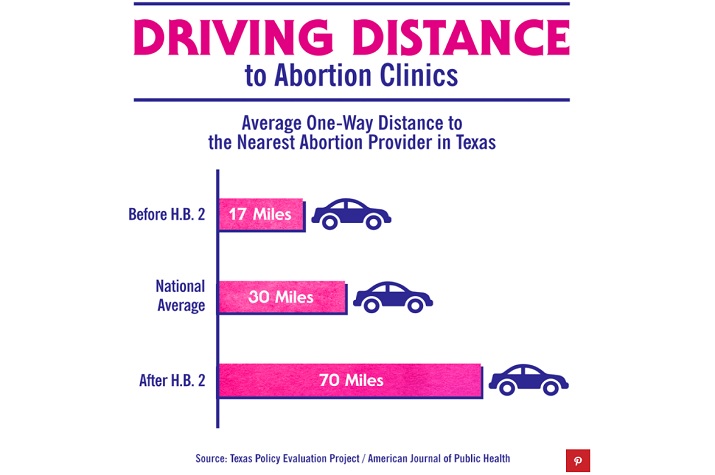
In this gif, Cosmopolitan shares research from the Texas Policy Evaluation Project showing that the average distance a woman in Texas must drive to access the nearest abortion clinic in the state has increased following the implementation of the state's omnibus antiabortion-rights law (HB 2).

Datapoints

In this map, the Kaiser Family Foundation spotlights five states and Washington, D.C., which have each enacted policies designed to facilitate access to contraception.

Datapoints

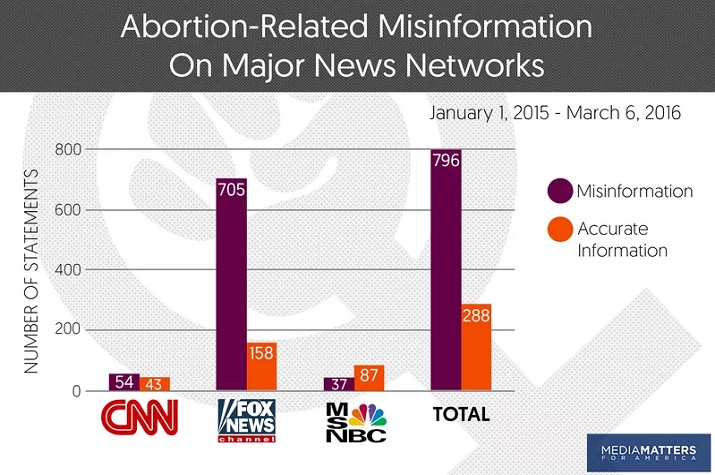
In this chart, Media Matters highlights the findings of a study showing how evening and primetime news programs airing on cable news conveyed more inaccurate than accurate statements about abortion.

Datapoints

In this infographic, the Guttmacher Institute highlights research showing how an increasing proportion of women who obtain abortion care in the United States are lower-income.

Datapoints

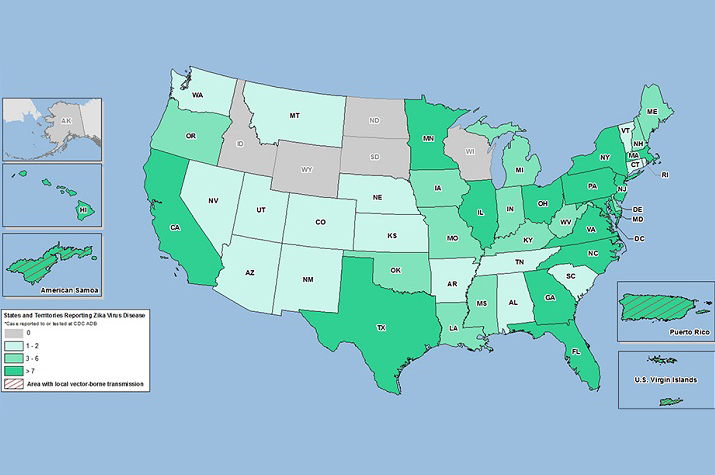
In this map, CDC documents the laboratory-confirmed cases of the Zika virus reported in the United States and U.S. territories.

Datapoints

This map, from the Center for Reproductive Rights (CRR), spotlights abortion laws around the world.

Datapoints

In this map, the New York Times highlights the regions in the United States where mosquitos carrying the Zika virus -- which has been linked to a fetal brain defect -- are most likely to spread during the upcoming spring and summer seasons.

Datapoints

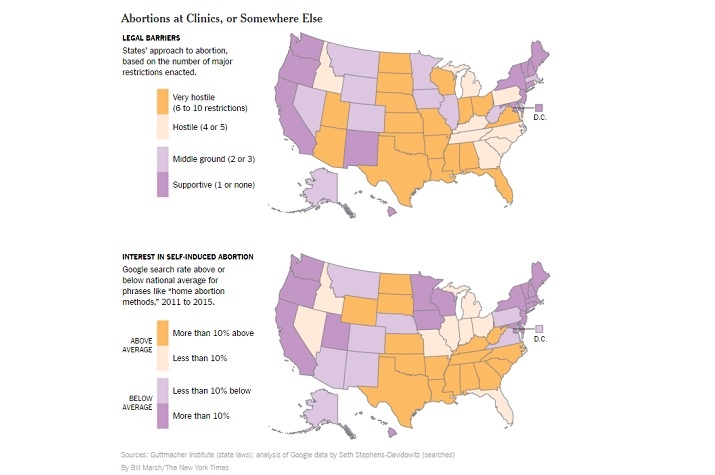
These maps, compiled using data from the New York Times and the Guttmacher Institute, underscore findings from a recent Times investigation, including that there were more than 700,000 searches for how to self-induce an abortion in 2015.

Datapoints

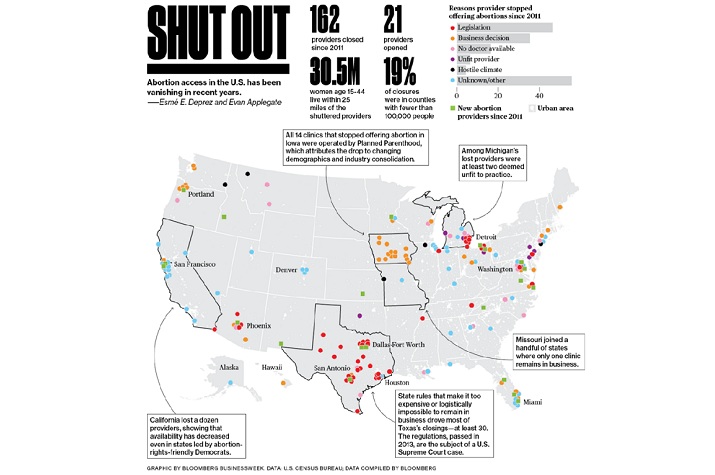
This map, from Bloomberg Business, highlights the rapid decline in abortion access in the United States since 2011.

Datapoints

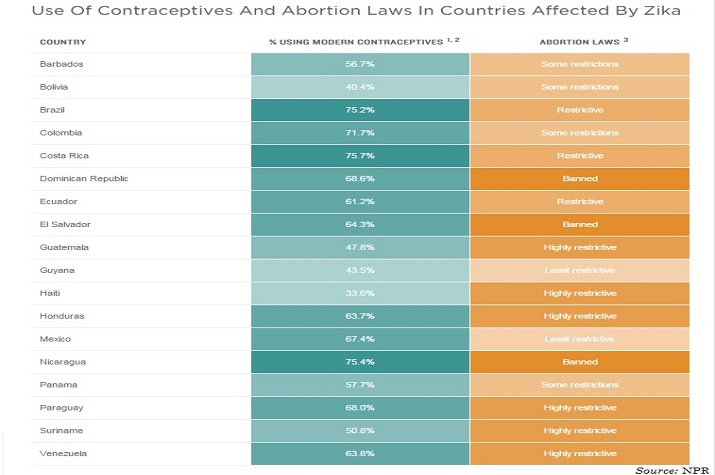
This chart, compiled by NPR, shows how the majority of countries affected by the Zika virus, which might be linked to a severe birth defect, curb access to contraception and abortion care.

See All

At a Glance

"A woman's ability to end her pregnancy too often depends on where she lives, her age and how much money is in her pocket."

— Marcela Howell of In Our Own Voice: National Black Women's Reproductive Justice Agenda, discussing ongoing disparities in women's access to abortion care on the 43rd anniversary of Roe v. Wade.

At a Glance

"If women are not free to make decisions about their own lives and health, they are not free. And if women are not free, none of us are."

— Abortion provider Warren Hern, in a STAT News opinion piece on why he continues to offer abortion care despite receiving harassment and death threats throughout his 42-year career.

At a Glance

"Not since before Roe v. Wade has a law or court decision had the potential to devastate access to reproductive health care on such a sweeping scale."

— Nancy Northup, president and CEO of the Center for Reproductive Rights, on a ruling from the 5th U.S. Circuit Court of Appeals that upheld major portions of a Texas antiabortion-rights law.