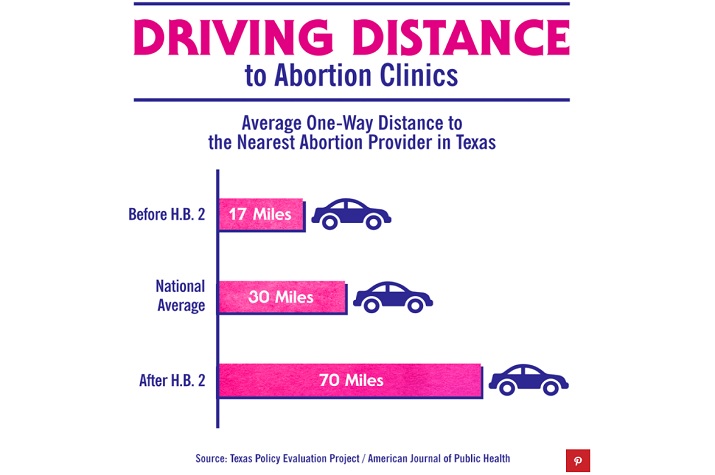


Texas providers who are interested in reopening facilities that closed under the law are determining how to proceed in light of the Supreme Court's ruling, which struck down contested provisions of Texas' omnibus antiabortion-rights law (HB 2), the New York Times reports (Fernandez/Goodnough, New York Times, 6/27).
SCOTUS strikes down TRAP provisions
The case, Whole Woman's Health v. Hellerstedt, centered on two provisions of the law. One required abortion clinics in the state to meet the same building standards as ambulatory surgical centers, and the other required abortion providers to have admitting privileges at local hospitals (Women's Health Policy Report, 6/27).
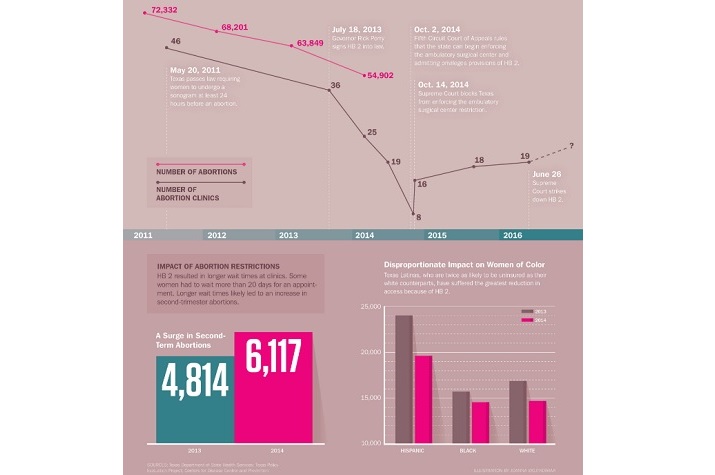
Before the law took effect, there were about 40 abortion clinics in Texas. The number dropped to about 20 in November 2013, once the admitting privileges provision had taken effect (Fernandez/Goodnough, New York Times, 6/27). Under the law, abortion access dwindled dramatically, especially in west Texas, with clinics remaining open in six Texas cities including Austin, Dallas, Fort Worth, El Paso, Houston and McAllen. According to providers, the lack of access spurred long appointment wait times and forced women to travel long distances to reach a clinic (Paquette, "Wonkblog," Washington Post, 6/27). Were the contested provisions upheld, the number of clinics would have fallen to nine (Fernandez/Goodnough, New York Times, 6/27).
The Center for Reproductive Rights (CRR), which represented the group of abortion providers challenging the law, argued that the restrictions were unconstitutional, created an undue burden for Texas women who live far away from the nearest clinic and did not promote the state's interest in improving health. In a 5-3 decision, the court agreed, holding that both contested provisions violated the U.S. Constitution by imposing an undue burden on a woman seeking abortion care (Women's Health Policy Report, 6/27).
Providers determine next course of action
It is not clear how many clinics will reopen or when they will do so, with some clinic owners noting that it could take several years to re-establish their facilities, the New York Times reports (Fernandez/Goodnough, New York Times, 6/27).
Amy Hagstrom Miller, founder of Whole Woman's Health and lead plaintiff in the Supreme Court case, said while she plans to reopen clinics in Beaumont and Fort Wort that had to close under HB 2, "[t]his sort of restoration isn't going to happen overnight." According to "Wonkblog," Hagstrom Miller also is considering raising money for additional locations.
Dawn Laguens, executive vice president of Planned Parenthood Federation of America, said the organization also hopes to reopen facilities in Texas. HB 2 provisions forced Planned Parenthood clinics in Lubbock and Waco to close.
However, according to "Wonkblog," clinics seeking to reopen will face a time-consuming approval process that could continue into 2017. The process of reopening will entail re-completing the licensure process, finding staff, updating equipment and restoring facilities or seeking out new locations ("Wonkblog," Washington Post, 6/27).
Hagstrom Miller said, "It will take a while to rebuild the care infrastructure that used to be serving people across the state" (Pattani, Texas Tribune, 6/27). Discussing circumstances under HB 2, she noted, "We've had to let leases go or sell buildings that had mortgages." She continued, "You've got to find physicians and rehire staff and go through relicensing processes, and get equipment and instruments and medicine. It's not something that is going to happen overnight" (Fernandez/Goodnough, New York Times, 6/27).
Gerri Laster -- executive administrator of Reproductive Services, a clinic in El Paso that closed under HB 2 but later reopened at a different location -- said, "Some of the other clinics may be able to reopen, but it's very difficult." She explained, "We went down that road, and it took us almost six months to get our license back. And that was after having a license for 25 years with no deficiencies, meeting all the state requirements." According to Laster, the clinic had expected reopening would be impossible and had first sold its equipment upon closing. She said resuming business cost the clinic between $50,000 and $100,000 (Fernandez/Goodnough, New York Times, 6/27).
Separately, Rebecca Robertson, legal and policy director at the American Civil Liberties Union, noted that the hurdles to reopening might be too high for some clinics. "This law was litigated for three years, and in that time, we saw a lot of damage," she said, adding, "Some of those clinics are likely not coming back. It sometimes takes years to rebuild access that we had before" (Texas Tribune, 6/27).
Nan Little Kirkpatrick, executive director of the Texas Equal Access Fund, which helps women to obtain abortion care, said, "We are really hoping this decision will reopen providers." She noted, "It's vital in West Texas and the Panhandle where people are hundreds of miles from care" (Hennessy-Fiske, Los Angeles Times, 6/27). Noting that staff was difficult to retain while awaiting the Supreme Court ruling, Little Kirkpatrick added, "Now that we have some assurance from the Supreme Court, I think it will be easier for providers to attract and keep staff" (Fernandez/Goodnough, New York Times, 6/27).
Implications for TRAP laws elsewhere
The Supreme Court's ruling also is expected to have implications for state-level antiabortion-rights measures that have proliferated in recent years throughout the United States, the New York Times reports (Eckholm, New York Times, 6/27).
According to Laguens, states have passed more than 360 abortion-rights restrictions in the last five years. She said, "Here is the opportunity for us to go state by state, legislature by legislature, restriction by restriction" to "try to get these hurtful laws repealed" ("Wonkblog," Washington Post, 6/27).
Cecile Richards, president of Planned Parenthood Federation of America, said advocates would seek out abortion-rights protections beyond Texas in the wake of the Supreme Court ruling. "Far too many women still face insurmountable barriers, which is why we are taking this fight state by state," she said, adding, "It's time to pass state laws to protect a woman's constitutional right to abortion, and repeal ones that block it" (Crary, AP/Sacramento Bee, 6/28).
Separately, CRR President Nancy Northup said, "This opinion makes it clear that the court is going to look at the stated justification for a law, and look at the burdens it imposes." She noted, "It's about making sure that regulations are truly justified" (Eckholm, New York Times, 6/27).
According to CRR, admitting privileges requirements for abortion providers similar to those written in HB 2 are in effect in Missouri, North Dakota (SB 2305) and Tennessee (Pub. Ch. 1008). Such measures have been put on hold in Alabama (HB 57), Kansas (SB 36), Louisiana (Act 620), Mississippi (HB 1390), Oklahoma (SB 1848) and Wisconsin (Act 37) (AP/Sacramento Bee, 6/28). On Tuesday, the Supreme Court also declined to review lower court decisions blocking Mississippi and Wisconsin's admitting privileges law (Reuters/NBC News, 6/28).
In addition, according to CRR, laws similar to Texas' ambulatory surgical center building requirements have been implemented in Michigan (HB 5711), Missouri, Pennsylvania (SB 732) and Virginia. Such a measure is on hold in Tennessee (Pub. Ch. 419) (AP/Sacramento Bee, 6/28).
States, courts respond; advocates take action
In response to the Supreme Court's ruling in Whole Woman's Health, Alabama Attorney General Luther Strange (R) said his office will drop its legal defense of the state's admitting privileges rule. The measure would have closed four out of five clinics in the state. Strange, who opposes abortion rights, stated, "[T]here is no good faith argument that Alabama's law remains constitutional in light of the Supreme Court ruling" (Chandler, AP/Sacramento Bee, 6/27).
Separately, Pennsylvania Sen. Daylin Leach (D) said he will propose legislation to repeal the 2011 state law that requires abortion clinics to meet the same requirements as ambulatory surgical centers. Sue Frietsche, an abortion-rights attorney, noted that the law was costly for clinics to implement and played a role in the closure of several facilities (AP/Sacramento Bee, 6/28).
Regarding the Supreme Court's Whole Woman's Health decision, Willie Parker, an abortion provider in Mississippi, said, "It's a definitive ruling. It doesn't leave any wiggle room for people who have sought to abuse regulatory authority and gut the provisions of Roe" (Los Angeles Times, 6/27).
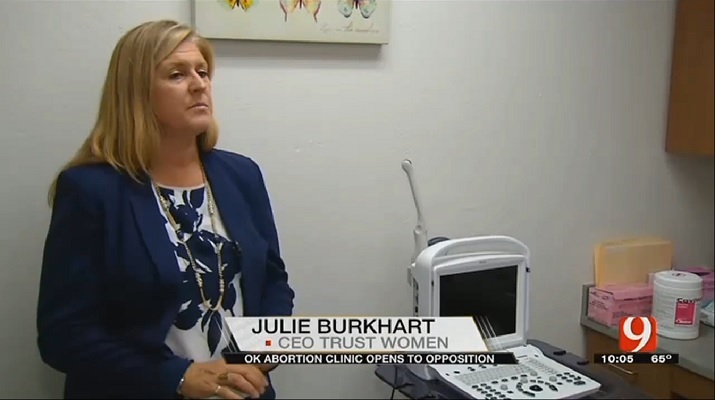
Elsewhere, Julie Burkhart, founder and chief executive of Trust Women, which runs an abortion clinic in Wichita, Kansas, and is opening a facility in Oklahoma City, stated, "Both here in Kansas and in Oklahoma, this case really opens up the door for a relaxation of these laws that are punitive towards physicians who provide abortion care and the clinics where the physicians practice."
Kathaleen Pittman, administrator at Hope Medical Group for Women in Louisiana, said, "Our next step will be to decide what we need to do to have [the state's admitting privileges requirement] permanently enjoined" (Los Angeles Times, 6/27).
Abortion-rights opponents plan next steps
Following the high court's decision, antiabortion-rights lawmakers and advocates are planning new efforts to restrict abortion care access, "Wonkblog" reports.
For instance, Texas Sen. Charles Perry (R) and Texas Rep. Jonathan Stickland (R) both indicated they would push more antiabortion-rights legislation in the next session. John Seago, legislative director of Texas Right to Life, added that his group will continue its efforts to reduce abortion access and defend existing restrictions.
Separately, Texas Rep. Donna Howard (D) noted, "If some of my colleagues chose to continue their assault on the access that women have to this safe, legal, medical procedure ... then we know -- as we saw in 2013 -- that the public will show up, that the public will fight this, and we know after today's Supreme Court decision that the courts are also on our side" ("Wonkblog," Washington Post, 6/27).