
National Partnership for Women & Families

In the News

NYC health system launches social media campaign to promote reproductive health information with adolescents

NYC Health & Hospitals on Monday launched a new outreach campaign to encourage people between the ages 12 to 21 to visit the public health system for confidential sexual and reproductive health care, the New York Times reports.

Campaign details

The public health system aims to connect with young people through the campaign by running promotional material on social media platforms, such as Facebook and Instagram.

The campaign shares various images, including emojis of eggplants and peaches, that include the caption: "Need to talk to someone about 'it'?" Information on how to access emergency contraception confidentially will be promoted via a monkey emoji with its hands over its mouth.

The social media posts lead users to NYC Health & Hospitals' new website, which provides directions to the 20 YouthHealth services centers in New York City. In addition, the website emphasizes that young people can obtain reproductive health care, such as treatment for sexually transmitted infections (STIs) and pregnancy testing, no matter their immigration status, ability to pay, sexual orientation or gender identity.

Comments

Richard Zapata, outreach and education manager for population health at NYC Health & Hospitals, said the campaign in part aims to boost the number of adolescents who seek care at the health system.

According to a Health & Hospitals release, the health system in 2015 provided care for about 152,000 teenage patients. Of those patients, Health & Hospitals provided STI testing for more than 38,000 teenagers, pregnancy tests for about 30,000 teenagers and birth services for about 2,400 teenagers.

Zapata noted that many teenagers in the area seem to be unaware that they can seek certain sexual and mental health care confidentially, and such care does not require parental notification. Further, according to Zapata, focus groups found that many teenagers do not talk with their parents about sex.

"It's hard to talk to someone about pregnancy testing," Zapata said, adding, "Those conversations aren't really happening that much at home."

Separately, Warren Seigel, chair of the department of pediatrics and director of adolescent medicine at Coney Island Hospital, pointed to the diverse backgrounds of many of his patients, noting, "Because of their parents' religious and cultural background, teenagers are not encouraged at home to talk about their sexual health."

Seigel said that with the outreach campaign, "We're taking away all of the excuses for adolescents not to enroll in health care."

However, Elizabeth Schroeder -- a sexuality educator, trainer and consultant -- raised concerns that the social media messages might be unclear to young people who do not speak English as their first language. "The question is whether these are the images that will get the most attention," she said. Referring to an emoji image in the campaign, she added, "I wonder whether younger people even get the language of the birds and the bees."

Nonetheless, Zapata said teenagers in focus groups said the images were relatable. In his words, the focus group made clear to Zapata that "[t]his is the way we're talking" (Schmidt, New York Times, 7/17).

Video Round Up

CBS Austin's Adela Uchida covers a rally protesting a Texas proposal that would require burial or cremation of fetal remains.

Video Round Up

NBC2 News' Heather Turco covers arguments before the Florida Supreme Court regarding an injunction against a 24-hour mandatory delay law (HB 633).

Video Round Up

In this clip, NY 1's Natalie Duddridge covers Planned Parenthood's centennial celebration at New York City Hall.

Video Round Up

USA Today covers a new report from the Centers for Disease Control and Prevention (CDC) that found the "most commonly reported sexually transmitted [infections] [STIs] reached an all-time high in 2015."

Video Round Up

The New York Times spotlightsabortion-rights activism against a proposed abortion ban in Poland.

Video Round Up

KUTV/KEYE's Adele Uchida covers a Texas proposal that will require fetal tissue to be buried or cremated.

Video Round Up

In this clip, Rabbi Lori Koffman discusses the intersection of her faith and her advocacy work for abortion rights, stating, "I'm a woman, I'm a mother, I'm a rabbi, I'm a Jew, I'm an American. And all those pieces of me call me to do this work."

Video Round Up

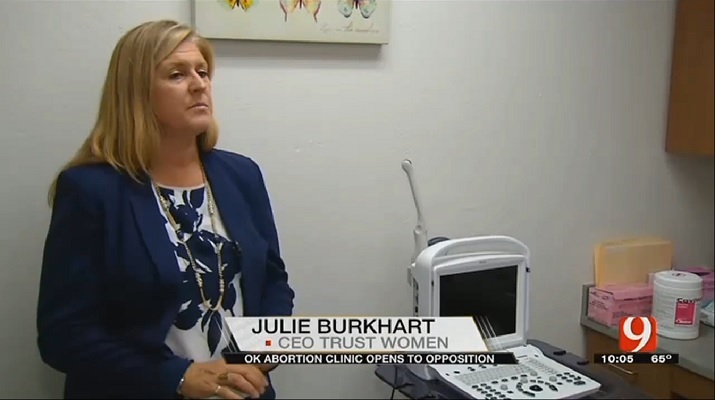
KWTV's Grant Hermes covers the opening of a new reproductive health center in Oklahoma City, which previously had been the largest metropolitan area without an abortion clinic.

Video Round Up

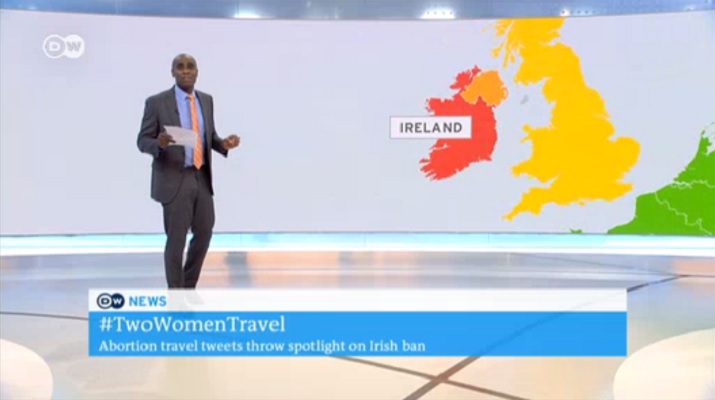
Deutsche Welle's Carl Nasman spotlights @TwoWomenTravel, a Twitter account documenting the experience of two Irish women who traveled to Great Britain to access abortion care for one of the women.

Video Round Up

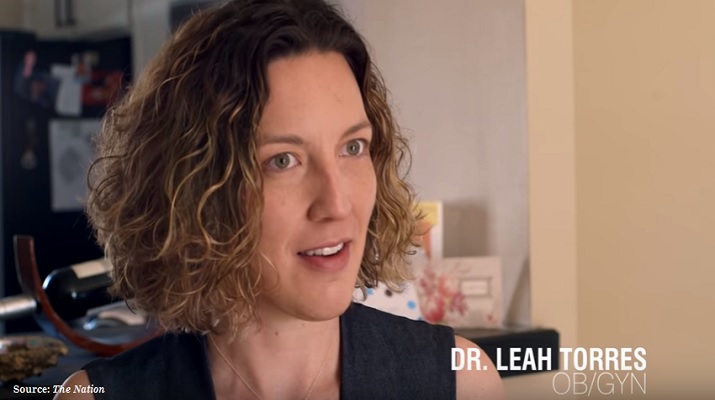
In this clip, The Nation profiles Leah Torres, an OB-GYN who shares her "career changing, life changing" work as an abortion provider in Utah, a state that imposes several restrictions on abortion care.

See All

Datapoints

In this map, the Center for American Progress' "ThinkProgress" highlights the seven states that direct Temporary Assistance for Needy Families (TANF) funds toward crisis pregnancy centers (CPCs), which use misleading tactics to dissuade women from seeking abortion care.

Datapoints

In this map, the Guttmacher Institute spotlights the 18 states that since 2011 have enacted policies that block funding for contraception or other health care services from being allocated to organizations that provide abortion care or are affiliated with abortion providers.

Datapoints

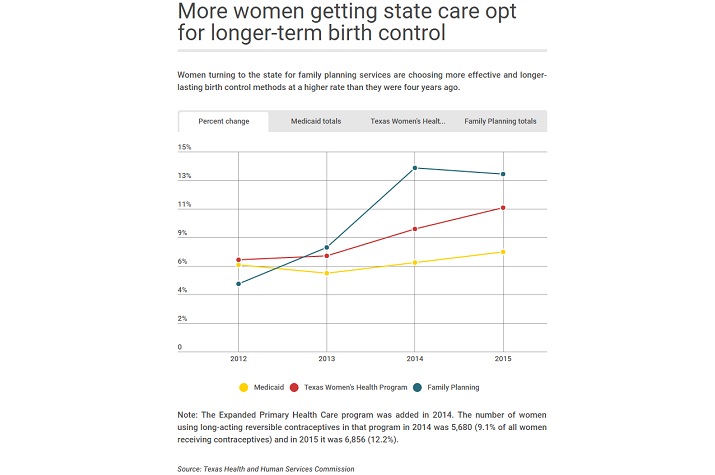
In this infographic, the Texas Health and Human Services Commission (HHSC) outlines data showing that the percentage of Texas women opting for long-acting reversible contraception (LARC) through three state-operated health programs increased between 2012 and 2013.

Datapoints

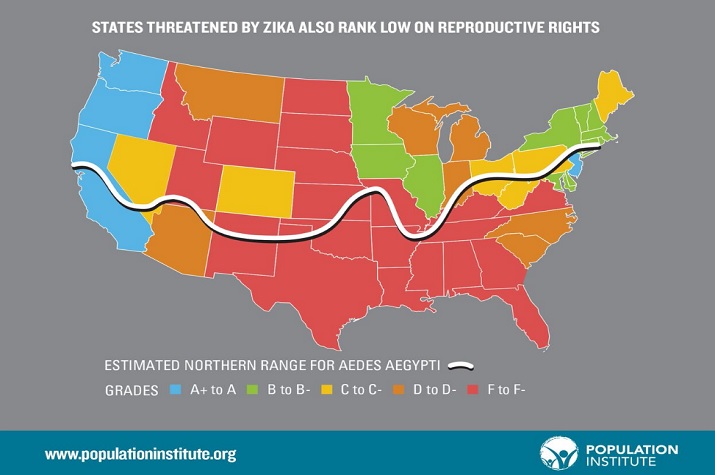
In this map, the Population Institute illustrates how many of the states at risk of the Zika virus scored poorly on measures of reproductive rights and health.

Datapoints

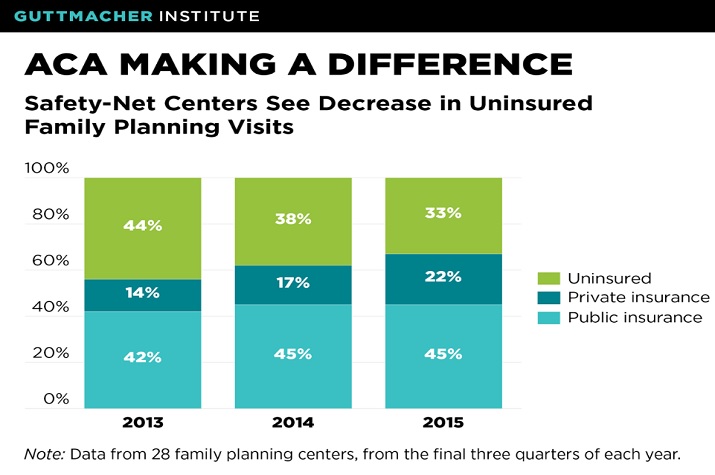
In this infographic, the Guttmacher Institute spotlights the increased proportion of insured visits at 28 Title-X supported family planning centers following the implementation of the Affordable Care Act (ACA) (PL 111-148).

Datapoints

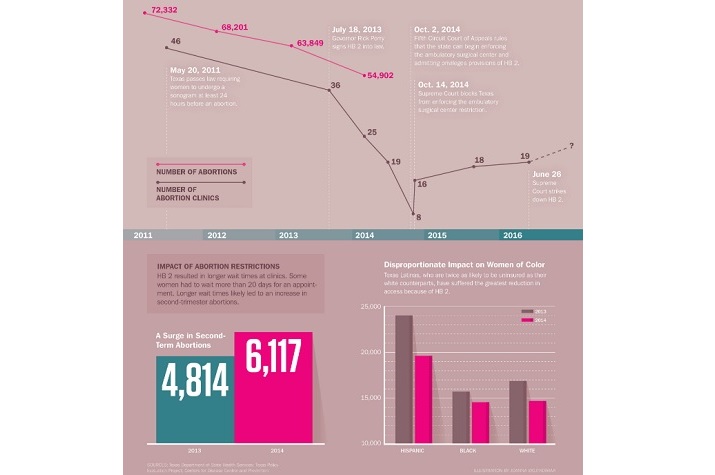
In this infographic, the Texas Observer compiled information from the Texas Department of State Health Services, the Texas Policy Evaluation Project and the Centers for Disease Control and Prevention to provide a snapshot of abortion access in Texas.

Datapoints

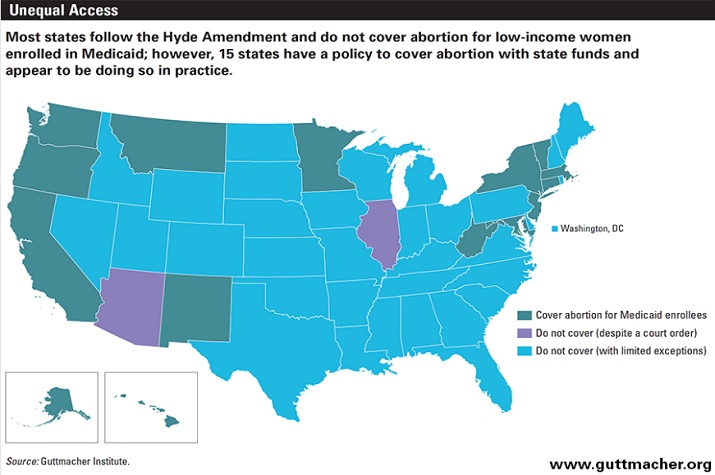
In this map, the Guttmacher Institute highlights the effects of the Hyde Amendment, an appropriations rider that bars federal Medicaid funding from covering abortion care except in the limited cases of rape, incest and life endangerment.

Datapoints

In this infographic, the Guttmacher Institute tracks recent trends in state abortion laws.

Datapoints

In this map, the Kaiser Family Foundation spotlights five states and Washington, D.C., which have each enacted policies designed to facilitate access to contraception.

Datapoints

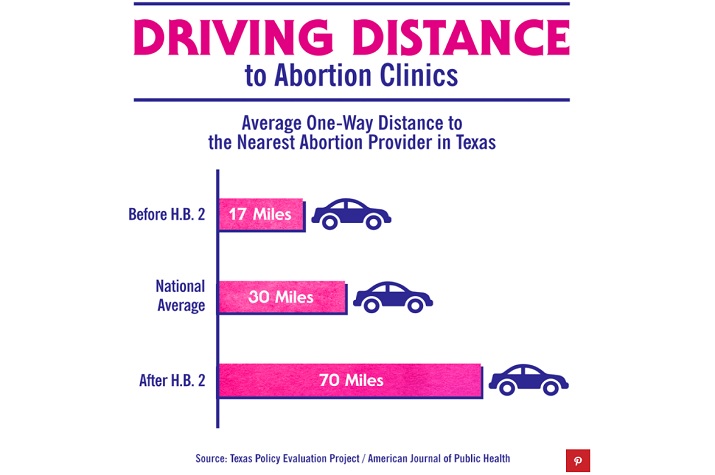
In this gif, Cosmopolitan shares research from the Texas Policy Evaluation Project showing that the average distance a woman in Texas must drive to access the nearest abortion clinic in the state has increased following the implementation of the state's omnibus antiabortion-rights law (HB 2).

See All

At a Glance

"A woman's ability to end her pregnancy too often depends on where she lives, her age and how much money is in her pocket."

— Marcela Howell of In Our Own Voice: National Black Women's Reproductive Justice Agenda, discussing ongoing disparities in women's access to abortion care on the 43rd anniversary of Roe v. Wade.

At a Glance

"If women are not free to make decisions about their own lives and health, they are not free. And if women are not free, none of us are."

— Abortion provider Warren Hern, in a STAT News opinion piece on why he continues to offer abortion care despite receiving harassment and death threats throughout his 42-year career.

At a Glance

"Not since before Roe v. Wade has a law or court decision had the potential to devastate access to reproductive health care on such a sweeping scale."

— Nancy Northup, president and CEO of the Center for Reproductive Rights, on a ruling from the 5th U.S. Circuit Court of Appeals that upheld major portions of a Texas antiabortion-rights law.