

Read the week's best commentary from bloggers at American Civil Liberties Union's "Speak Freely," Religion Dispatches' "RD Blog" and more.
WHOLE WOMAN'S HEALTH V. HELLERSTEDT:
"Yesterday's Supreme Court decision on abortion was a great victory for women, but it should have been a no brainer," Jennifer Dalven, American Civil Liberties Union's "Speak Freely": Dalven, who works for the American Civil Liberties Union's (ACLU) Reproductive Freedom Project, notes that while the Supreme Court's decision to strike down two Texas abortion restrictions "is rightly being heralded as a major victory for abortion rights," she cannot help but wonder how "a law [HB 2] that decimates a woman's access to abortion for no medical reason [could] have gotten this far?" Dalven explains that not only have "leading medical experts, including the American Medical Association and the American College of Obstetricians and Gynecologists, ... long said that far from making women safer, these laws actually put women at risk by forcing clinics to close," but "[c]ourt after court -- in Alabama, Wisconsin, Texas, and Louisiana -- found that there was no medical justification for these laws." Similarly, according to Dalven, the Supreme Court in Whole Woman's Health v. Hellerstedt "recognized that the Texas laws did nothing to protect women's health but instead just put unnecessary obstacles in the path of women who had decided to have an abortion." Dalven writes, "So while yesterday's decision is a major victory, it really should have been a no brainer. The Texas law should never have been passed," much less reached the Supreme Court. Noting that abortion-rights opponents plan to continue trying to restrict access despite the high court's ruling, Dalven concludes, "[W]hile yesterday was a day for celebration, today is a day for rolling up out sleeves and getting back to work ... we won't stop until every woman -- no matter where she lives and how much money she has -- can get the compassionate, quality care she deserves. When we achieve that victory, we can celebrate without pausing to wonder how we got here" (Dalven, "Speak Freely," American Civil Liberties Union, 6/28).
What others are saying about Whole Woman's Health v. Hellerstedt:
~ "SCOTUS abortion case decision a huge win, but battle for access continues," Linda Goler Blount, American Constitution Society blog.
~ "In rejecting abortion restrictions, Supreme Court shuts down dubious claims of 'protecting women's health,'" Amie Newman, Our Bodies Ourselves' "Our Bodies, Our Blog."
~ "Symposium: Is Hellerstedt this generation's Roe?" Erika Bachiochi, SCOTUSblog.
~ "The Texas SCOTUS decision is already toppling other abortion restrictions," Laurel Raymond, Center for American Progress' "ThinkProgress."
SUPREME COURT:
"Did SCOTUS just restore sanity to religious liberty debate?" Patricia Miller, Religion Dispatches' "RD Blog": In a decision that "may recast the parameters of the religious liberty debate," the Supreme Court this week "declined to hear a challenge to a Washington State law that requires pharmacies to dispense emergency contraception even if the owners of the pharmacy have a religious objection to the medication because they believe (incorrectly, as far as science is concerned) that it is an abortifacient," Miller writes. She explains that the majority of justices "agreed with Washington State's contention that the law offers sufficient protection for religious freedom because it allows individual pharmacists to decline to dispense emergency contraceptives as long as the pharmacy has another pharmacist on hand who will." According to Miller, the Washington law's "accommodation hews much more closely to the traditional understanding of religious liberty -- the protection of individual conscience -- than the broader interpretation offered by the court's Hobby Lobby ruling, which made the employees of the owners of the Hobby Lobby craft store chain a conduit and proxy for their owners' consciences." While "[o]nly time will tell" whether this decision "mark[s] a restoration of sanity -- and some reasonable boundaries -- on the religious liberty debate," Miller concludes that, "at least for the time being, it appears that religious liberty is no longer whatever conservatives say it is" (Miller, "RD Blog," Religion Dispatches, 6/29).
ABORTION-RIGHTS MOVEMENT:
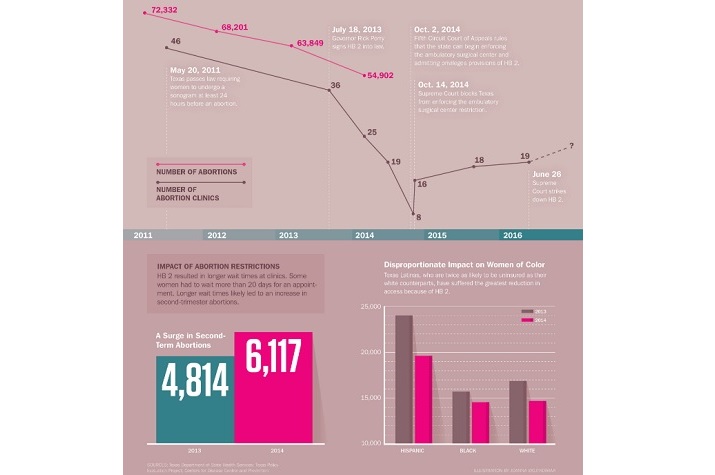
"The scientists behind this week's big SCOTUS victory for abortion rights," Erica Hellerstein, Center for American Progress' "ThinkProgress": Monday's Supreme Court decision to strike down two provisions of Texas' omnibus abortion law (HB 2) was not only "a coup" for abortion-rights supporters fighting targeted regulation of abortion providers (TRAP) laws, "[b]ut the ruling was a rare victory for another group as well: researchers," Hellerstein writes. She explains that "Justice Stephen Breyer's majority opinion heavily cited studies published by the Texas Policy Evaluation Project (TxPEP), a research group based at the University of Texas at Austin" and led by Daniel Grossman, an OB-GYN professor at the University of California-San Francisco. She notes, "The court's reliance on rigorous data collection to inform their decision was unusual for a topic like abortion, which is often driven by emotional rhetoric instead of scientific evidence and fact." According to Hellerstein, TxPEP researchers found that wait times for abortion care increased following clinic shutdowns in the state, that women had to delay abortion care until later in pregnancy and that it would be unlikely that clinics meeting HB 2's ambulatory surgical center building requirements could meet demand for care should the law remain in place. While "many of the successful arguments [in the Supreme Court ruling] against Texas' restrictions relied on TxPEP's state-specific data about the impacts of the law on women there," the decision "set a legal precedent that irrefutably placed data and scientific evidence at the center of its decision," Hellerstein writes. She concludes, "While laws in other states are being debated, [Grossman] is heartened to see how his team's research was used -- and hopes that the decision will help encourage the development of similar research projects in other states fighting abortion restrictions" (Hellerstein, "ThinkProgress," Center for American Progress, 6/29).
What others are saying about the abortion-rights movement:
~ "Women's groups say Monday's abortion ruling is 'just the beginning,'" Nora Caplan-Bricker, Slate's "XX Factor."
ABORTION RESTRICTIONS:
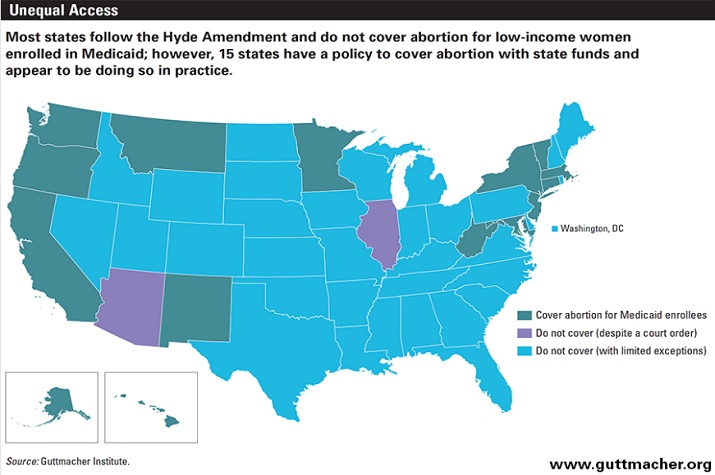
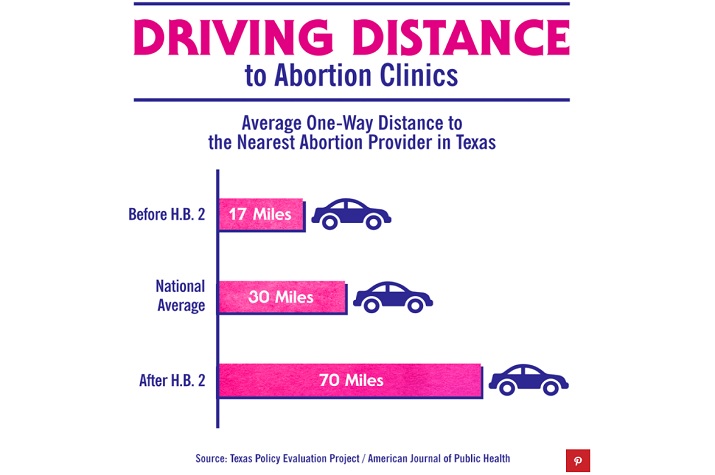
"Abortion is still a luxury, not a right," Ann Friedman, The Cut/Huffington Post blogs: While the "Supreme Court decision in Whole Woman's Health v. Hellerstedt would seem to reinforce that [abortion is] a right" rather than a luxury, "it also reveals a hard truth about the decades-long effort to deliberately deter women from getting abortions," Friedman writes. According to Friedman, federal and state laws force many low-income women to pay for abortion out-of-pocket. In addition, 11 states restrict private insurance coverage for abortion care; 17 states require a woman seeking abortion receive biased conseling; 27 states impose mandatory delays before an abortion; and "the average U.S. county is 59 miles from the nearest abortion clinic." She writes, "Although the Whole Women's Health ruling will leave more clinics open, it doesn't correct the fact that abortion is accessible (albeit stigmatized) for some women, and functionally unavailable to everyone else." Citing Roe v. Wade, which established that "a right is not a right if you can't actually exercise it," Friedman notes, "If abortion were really a right, we wouldn't charge women to access it. We wouldn't allow laws that enforce [mandatory delays] and mandatory counseling to stand. We wouldn't allow providers to be so thoroughly terrorized that only doctors with exceptionally strong political views are willing to help women exercise their right. We wouldn't draw distinctions between abortions." She concludes, "In order for women to fully participate in our society, the Supreme Court has ruled, they need equally open access to abortion services -- without undue burdens," but "[e]ven in the wake of Whole Woman's Health v. Hellerstedt, we don't all have that" (Friedman, The Cut/Huffington Post blogs, 6/28).