

Read the week's best commentary from bloggers at the American Civil Liberties Union's "Speak Freely," Huffington Post and more.
ABORTION RESTRICTIONS:
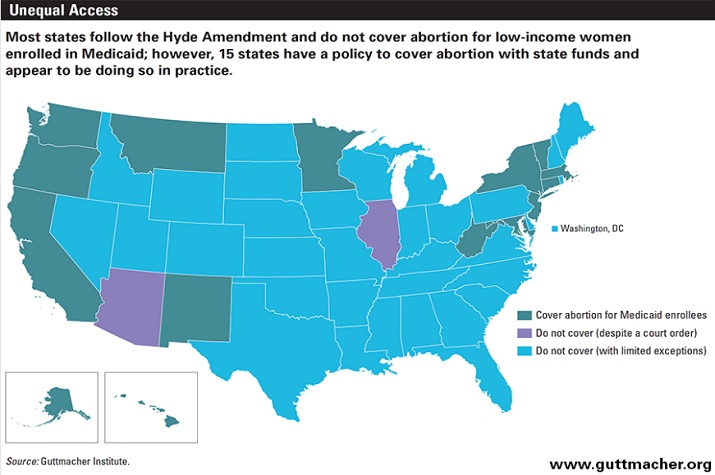
"Arizona: If at first you don't succeed (at interfering with women's health care) try, try, and try again," Jennifer Lee, American Civil Liberties Union's "Speak Freely": Even though a similar 2012 state law (HB 2800) was struck down, Arizona officials are again trying to "deny low-income women the right to obtain reproductive health care from their chosen provider by allowing the state to exclude qualified physicians from the Medicaid program simply because they provide abortions," Lee writes. According to Lee, the American Civil Liberties Union, which successfully challenged the 2012 state law, is now challenging the latest law (HB 2599). Lee explains that under the law, the only way for physicians who provide abortion care "to remain in the Medicaid program is to either stop providing abortion, or to try to comply with the law's vague and complicated requirement, which applies only to abortion providers." She writes that while this law targets abortion providers, "those who will really suffer are Arizona's low-income women," who "will have even fewer [health care] options if the state kicks their providers out of the Medicaid program." Lee concludes by noting that not only have federal courts struck down every state effort to exclude abortion providers from Medicaid, but the federal government has cautioned "states that targeting abortion providers in this way is illegal" (Lee, "Speak Freely," American Civil Liberties Union, 7/14).
ABORTION-RIGHTS MOVEMENT:
"A play about abortion care shows how 'remarkably normal' it is," Katherine Brooks, Huffington Post: Brooks interviews Marie Sproul -- the director of a play helmed by the abortion-rights advocacy group, the 1 in 3 Campaign -- and Jessi Blue Gormezano, the play's writer. According to Brooks, the play, called "Remarkably Normal," is entirely based off of "interviews and experiences submitted [to the 1 in 3 Campaign] by women who want to end the stigma attached to abortion." Brooks writes, "From a Planned Parenthood educator to a teenager living in the South, the storytellers aim to express the emotions and humanity of a common experience that political discussions underplay." When asked what factor is "contributing most to the stigmatization of abortion," Gormezano points to the silence around abortion care, stating, "The fact that so many people receive abortion care in this country and yet there is so little space in our culture to share those experiences." Sproul, citing the dehumanization of those seeking abortion care, adds, "Hopefully 'Remarkably Normal' will help to bring the focus back to the people involved and help people empathize [and understand] that when one in three women have an abortion, it is indeed a remarkably normal occurrence. And that more than likely, someone they know and love has probably had one" (Brooks, Huffington Post, 7/18).
What others are saying about the abortion-rights movement:
~ "NEWSFLASH: Activists in Wichita are mobilizing against anti-abortion extremists," Carmen Rios, Ms. Magazine blog.
~ "Voices of faith speak for abortion rights," Marie Alford-Harkey, Huffington Post blogs.
RELIGIOUS REFUSALS:
"Congress advances discrimination against women and LGBT people before skipping town," Ian Thompson/Georgeanne Usova, American Civil Liberties Union's "Washington Markup": Immediately before its seven-week recess, Congress "doubl[ed] down on proposals that discriminate against women and LGBT people under the guise of religious liberty," Thompson and Usova write. According to Thompson and Usova, the House held a hearing on one bill, "[t]he so-called 'First Amendment Defense Act,'" which would permit anyone, including private businesses and certain federally funded social service programs, "to discriminate based on a religious belief or 'moral conviction' against same-sex marriage, or to sexual relationships outside of a heterosexual marriage." The authors also point to another bill (S 304), which the House passed on Wednesday, that "would dangerously expand the Weldon Amendment," a spending measure that restricts federal health and education funding "from any state, local, or federal government body that doesn't allow a health care entity to refuse to provide, pay for, cover, or refer for an abortion." According to Thompson and Usova, the bill "purports to protect religious liberty but in fact empowers discrimination -- in this case against women seeking reproductive health care." S 304 "would give employers, health insurance companies, and others even more ways to stand between a woman and the health care she needs," such as by allowing a Catholic hospital to "refuse to 'facilitate' or 'make arrangements for' an abortion needed to preserve a woman's health" or enabling a woman's employer to "deny her comprehensive health insurance that covers abortion." Thompson and Usova conclude, "In short, the bill would further undermine women's access to constitutionally-protected health care" (Thompson/Usova, "Washington Markup," American Civil Liberties Union, 7/15).
ZIKA VIRUS:
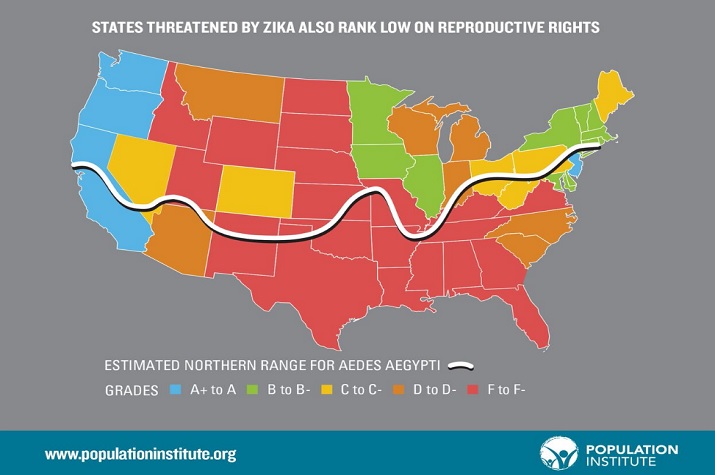
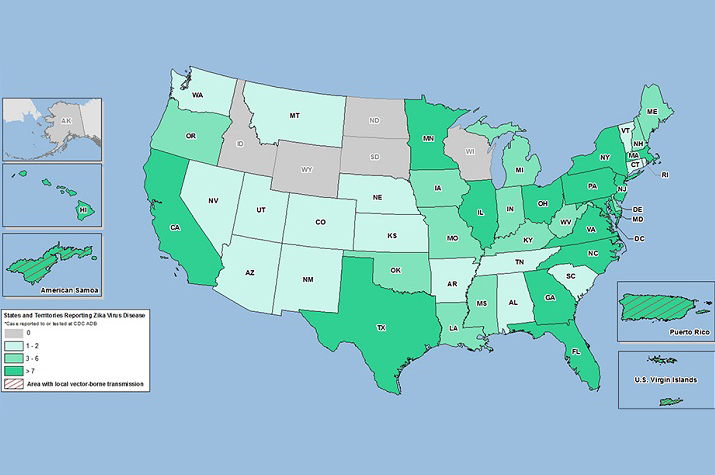
"No additional Zika funding puts women's health at risk," Amie Newman, Our Bodies Ourselves' "Our Bodies, Our Blog": Although polling shows that a majority of U.S. residents want additional funding for Zika response efforts, "Congress has adjourned for the summer, with no additional funding in place to fight the Zika virus," Newman writes. Citing the risks the Zika virus carries for pregnant women, particularly as mosquito season starts in the United States, Newman explains that U.S. health officials have expressed "concern for women who, because of where they live, have minimal access to contraception, family planning, and abortion services." However, despite these risks, conservative lawmakers in recent months "have hamstrung efforts ... to fund anti-Zika efforts by including anti-abortion language in the legislation, stripping money from the Affordable Care Act [PL 111-148], and barring Planned Parenthood from receiving funds," Newman explains. Newman cites an opinion piece, written by Planned Parenthood and the American Congress of Obstetricians and Gynecologists, that explains "the critical importance of family planning and education to anti-Zika efforts in the U.S. and cite[s] the CDC recommendation that ensuring access to voluntary family planning is the primary strategy to reduce Zika-related pregnancy complications." According to Newman, Congress' failure to pass Zika response legislation not only means that CDC and NIH could run out of funding to research and respond to the virus, but "[i]t means that once again women's health and lives are disrupted by the inability of Congress to put health before politics" (Newman, "Our Bodies, Our Blog," Our Bodies Ourselves, 7/18).