

Congress on Friday began its seven-week recess without sending President Obama legislation to fund a response to the Zika virus, Roll Call reports (Shutt, Roll Call, 7/14).
Existing funding for Zika response efforts is expected to run out in late July or early August, according to HHS Secretary Sylvia Mathews Burwell.
Background on Zika
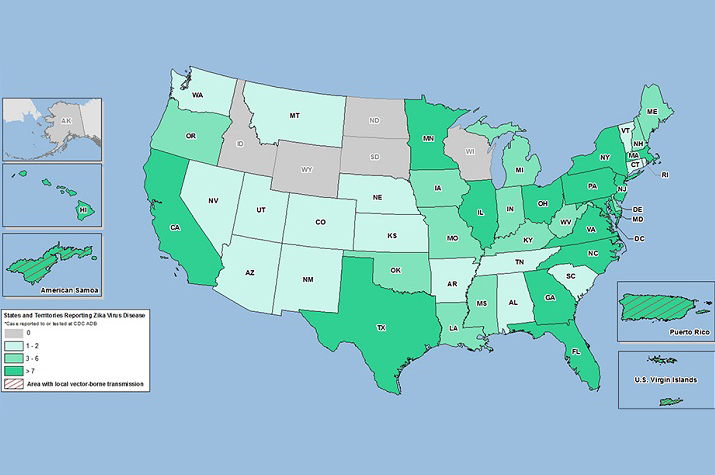
Zika virus is transmitted by mosquitos as well as through sexual activity. The virus is not easily diagnosed, and it does not have a cure or vaccine. It is linked to the birth defect microcephaly, a condition in which an infant is born with an abnormally small head and brain.
The World Health Organization (WHO) has declared the outbreak and its link to microcephaly a public health emergency of international concern. Separately, the United Nations High Commissioner for Human Rights issued a statement directing nations affected by the Zika virus to remove bans on access to sexual and reproductive health care services.
Zika funding proposals
The White House has called for $1.9 billion to combat the virus. Congress has considered several Zika funding proposals (Women's Health Policy Report, 7/13). None have advanced to President Obama (Taylor, AP/Sacramento Bee, 7/14).
Most recently, the House sent to the Senate a bill (HR 2577) that includes $1.1 billion in Zika response funding. HR 2577 would redirect $750 million from other federal programs, including $107 million from Ebola-related efforts and $543 million from a program to help U.S. territories set up insurance marketplaces under the Affordable Care Act (ACA) (PL 111-148). Overall, the proposal allocates about $400 million in new spending for Zika response efforts, short of the $1.9 billion requested by the White House. In addition, the proposal would prohibit Planned Parenthood from receiving funds under a $95 million grant program.
Liberal lawmakers have cited concerns that the proposal is an inadequate response to the Zika outbreak. However, conservative lawmakers have sought several times to advance HR 2577 as is. On Monday, Senate Majority Leader Mitch McConnell rejected a compromise offer from Senate Minority Leader Harry Reid (D-Nev.) (Women's Health Policy Report, 7/13).
On Wednesday, the White House urged Congress to pass a Zika funding measure ahead of the recess.
Lawmakers fail to reach compromise
The Senate on Thursday voted 52-44 to limit debate on HR 2577. The bill required 60 votes to advance, Roll Call reports.
During the debate on Thursday, Reid highlighted the harmful effects of the family planning restriction on women in Puerto Rico, which has been particularly affected by the Zika virus. Reid said, "How could anyone in good conscience vote for that (bill)? ... We can't and we aren't going to."
Separately, liberal lawmakers on the House Appropriations Committee sent a letter to House Speaker Paul Ryan (R-Wis.) urging conservative lawmakers to vote on a measure that would meet Obama's $1.9 billion funding request (Roll Call, 7/14). In addition, House Appropriations ranking member Nita Lowey (D-N.Y.) urged lawmakers to delay the recess until the Zika funding issue was resolved.
House Committee advances spending bill with repro restrictions
In related news, the House Appropriations Committee on Thursday voted 31-19 to approve a draft fiscal 2017 health care spending bill that includes limited funding for Zika response efforts, (Young/Wilkins, CQ News, 7/14 [subscription required]). It also includes proposals that would restrict reproductive health, The Hill reports (Ferris, The Hill, 7/14).
The proposal would grant only $390 million of the $1.9 billion in new spending requested for Zika response efforts. In its current form, the spending bill would cut nearly $300 million in federal family planning funding allocated through the Title X program and more than $100 million from sexual health education programs aimed at preventing teenage pregnancy.
The bill also would bolster refusal provisions for employers who personally oppose abortion, allowing them to exclude abortion care coverage in company health insurance plans (Women's Health Policy Report, 7/7).
Lawmakers reject Zika, family planning amendments, add amendment targeting fertility treatment
Earlier in the week, the House panel voted 21-29 to reject an amendment to the bill that would have filled Obama's $1.9 billion Zika response funding request.
In addition, the panel voted 20-28 to reject an amendment that would have restored federal Title X family planning funding. However, according to CQ News, the Senate version of the Labor-HSS-Education bill (S 3040), which has bipartisan support, maintains Title X funding at $286.5 million.
The House committee also voted to approve an amendment, proposed by Rep. Andy Harris (R-Md.), that would require health care systems operating via government-owned facilities to preserve embryos created through in vitro fertilization treatment. According to Harris, the amendment is aimed at fertility treatment funded through the Department of Defense or the Department of Veterans Affairs (VA) (CQ News, 7/14 [subscription required]).
The Pentagon covers in vitro fertilization (IVF) for active duty troops. While the VA does not cover IVF for service members who have had to retire because of injuries, pending legislation (HR 2577), if approved, would lift the ban (Women's Health Policy Report, 5/24).
Liberal lawmakers on the panel, as well as Rep. Charlie Dent (R-Pa.), said the amendment could affect coverage of IVF. Dent raised concerns about the scope of the amendment, stating, "As drafted, the amendment would have potentially far-reaching implications beyond the parameters of the bill before us today" (CQ News, 7/14).