

With just days left before Congress adjourns for a weeks-long recess, Senate leaders this week rejected competing Zika funding proposals, The Hill's "Floor Action" reports (Carney [1], "Floor Action," The Hill, 7/12).
Congress' seven-week recess is scheduled to begin at the end of this week (Women's Health Policy Report, 7/7). Existing funding for Zika response efforts is expected to run out in late July or early August, according to HHS Secretary Sylvia Mathews Burwell (Kelly, USA Today, 7/12).
Background on Zika
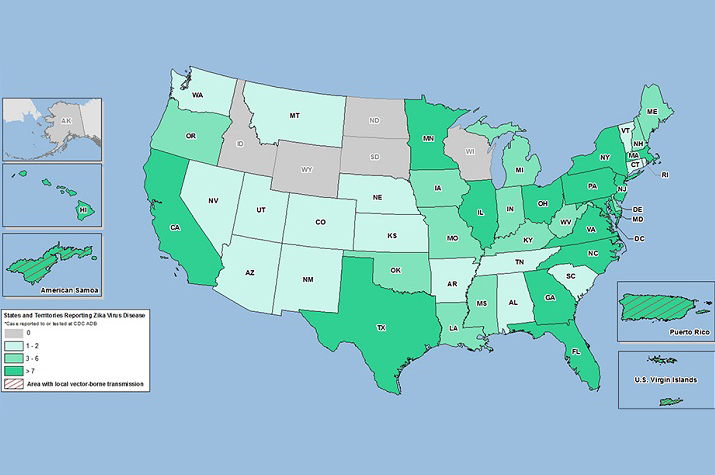
The Zika virus is a mosquito-borne disease that has spread across North and South America over the past year. Researchers recently learned that Zika can also be transmitted through sexual activity. The virus is not easily diagnosed, and it does not have a cure or vaccine. It is linked to the birth defect microcephaly, a condition in which an infant is born with an abnormally small head and brain. The condition is fatal for some infants, while others experience permanent disabilities.
The World Health Organization (WHO) has declared the outbreak and its link to microcephaly a public health emergency of international concern. Separately, the United Nations High Commissioner for Human Rights issued a statement directing nations affected by the Zika virus to remove bans on access to sexual and reproductive health care services.
U.S. response
The White House has called for $1.9 billion to combat the virus.
The House and Senate each approved a funding proposal for Zika response earlier this year. The Senate's measure (SA 3900) would provide $1.1 billion in funding, while the House's measure (HR 5243) would allocate $622 million. Both Zika response proposals include antiabortion-rights language. Last month, the Senate voted to go to conference with the House to negotiate and merge the proposals.
The House later voted 239-171 to advance a separate bill, HR 2577, which includes $1.1 billion in Zika response funding that differs from the Senate's original proposal. HR 2577 would redirect $750 million from other federal programs, including $107 million from Ebola-related efforts and $543 million from a program to help U.S. territories set up insurance marketplaces under the Affordable Care Act (ACA) (PL 111-148). Overall, the proposal allocates about $400 million in new spending for Zika response efforts, short of the $1.9 billion requested by the White House. In addition, the proposal would prohibit Planned Parenthood from receiving funds under a $95 million grant program.
The Senate in late June held a procedural vote on HR 2577, voting 52-48, which falls short of the 60 votes needed for the measure to defeat liberal lawmakers' filibuster. Among other concerns, liberal lawmakers in the Senate said they voted against the measure because its prohibitions on funding providers such as Planned Parenthood would undermine efforts to protect reproductive-age women, who are especially vulnerable to the effects of the virus.
Separately, President Obama has said he would veto the House bill in its current form (Women's Health Policy Report, 7/7).
Congress in stalemate
Senate leaders blocked the competing Zika funding proposals twice this week, The Hill's "Floor Action" reports (Carney [2], "Floor Action," The Hill, 7/12).
On Monday, Senate Majority Leader Mitch McConnell (R-Ky.) objected to an effort by Sen. Bill Nelson (D-Fla.) to bring up SA 3900, the Senate's original $1.1 billion funding proposal (Carney [1], "Floor Action," The Hill, 7/12).
Also on Monday, McConnell rejected a compromise offer from Senate Minority Leader Harry Reid (D-Nev.). In the compromise, Reid proposed separating the Zika issue from HR 2577, which contains broader funding allocations. He also proposed eliminating a provision to block funding from Planned Parenthood, as well as a provision to loosen regulations on pesticide spraying. In return, Reid said liberal lawmakers would agree to spending cuts to defray the proposal's cost (Taylor/Jalonick, AP/Sacramento Bee, 7/12).
Separately, McConnell again was unsuccessful in an effort to bring up HR 2577 for a vote. Nonetheless, McConnell has promised to attempt to bring up the bill at least once more this week (Carney [1], "Floor Action," The Hill, 7/12). According to "Floor Action," liberal lawmakers continue to cite concerns that the proposal is an inadequate response to the Zika outbreak.
On Tuesday, Reid said conservative lawmakers rejected an effort by the Obama administration to arrange a meeting between McConnell, House Speaker Paul Ryan (R-Wis.), Burwell and Shaun Donovan, the director of the Office of Management and Budget (Carney [2], "Floor Action," The Hill, 7/12).
Comments
Burwell and Donovan on Tuesday sent a letter to lawmakers stating that failure to approve Zika funding before the recess would "significantly impede the administration's ability to prepare for and respond" to the virus this summer and thereafter. Further, the letter noted the funding holdout could delay development of a Zika vaccine (AP/Sacramento Bee, 7/12).
Separately, Sen. Patty Murray (D-Wash.) stated, "I'm urging my [conservative] colleagues to do what they should have done months ago: push aside the extreme members of their party, drop the partisan politics on women's health, and work with [liberal lawmakers] to send a serious Zika response bill to the president's desk" (USA Today, 7/12). With just days left before Congress adjourns for a weeks-long recess, Senate leaders this week rejected competing Zika funding proposals, The Hill's "Floor Action" reports (Carney [1], "Floor Action," The Hill, 7/12).