

"In the face of spurious explanations for public policies that would foreseeably inflict real damage on identifiable groups of people, judges and justices are abandoning the traditional diffidence of the judicial role and expressing a new willingness to call out legislatures for what they are really doing, not just what they say they are doing," Linda Greenhouse writes in a New York Times opinion piece, highlighting a recent Supreme Court decision to strike down abortion restrictions in Texas.
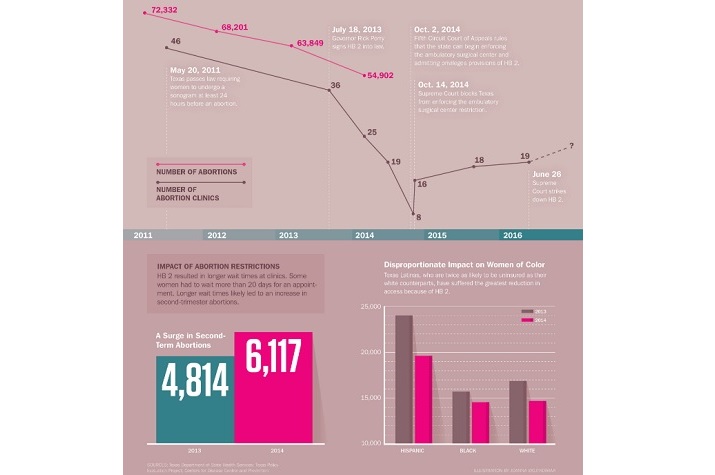
According to Greenhouse, the justices in Whole Woman's Health v. Hellerstedt assessed "whether a new Texas law [HB 2] setting elaborate physical requirements for abortion clinics and requiring the clinics' doctors to have admitting privileges at nearby hospitals imposed an 'undue burden' on access to abortion."
Greenhouse writes, "In his majority opinion finding the regulations unconstitutional, Justice Stephen G. Breyer observed the ways Texas singled out abortion for restrictions not imposed on more dangerous medical procedures," such as childbirth, colonoscopy and liposuction. Greenhouse explains, "In other words, abortion regulations that in isolation may seem inoffensive or even desirable assume a different cast when placed alongside the state's more relaxed treatment of outpatient medical procedures."
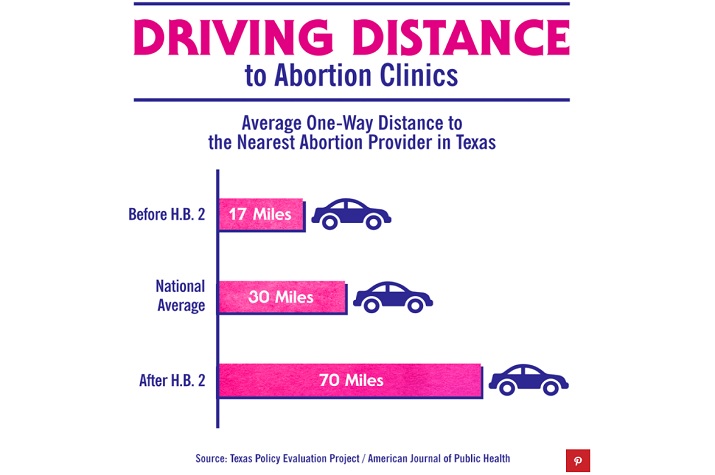
Greenhouse continues, "The opinion asked: Was there a problem for which the Texas law actually promised a solution? The answer Justice Breyer gave was no." She notes that abortion care "as regulated in Texas had been extremely safe before the new law was passed." Further, Greenhouse writes that while Breyer said "Texas had a legitimate interest in protecting women's health," he found that "'there was no significant health-related problem that the new law helped to cure.'" Moreover, Greenhouse writes that according to Breyer, "by predictably closing clinics that couldn't meet the requirements, it was a 'common-sense inference' that the effects of the law 'would be harmful to, not supportive of, women's health' by making women travel long distances 'to get abortions in crammed-to-capacity superfacilities,' the only clinics able to comply with the regulations."
According to Greenhouse, "The full impact of Justice Breyer's opinion in the abortion case will be measured by how lower courts, and eventually the Supreme Court itself, treat a new generation of abortion restrictions now in the judicial pipeline." She notes that while lawmakers "had taken bold, even flagrant steps to suppress" abortion rights, among others, "[j]udges responded." Such decisions, Greenhouse writes, "mark a departure and make a difference" (Greenhouse, New York Times, 8/18).