

Read the week's best commentary from bloggers at Bustle, the Center for American Progress' "ThinkProgress" and more.
ABORTION-RIGHTS MOVEMENT:
"These pro-choice dads are showing their support in an open letter on Father's Day," Alex Gladu, Bustle: "The presidential election that occurs in November could have serious implications for women's health issues, but it's not just women who are concerned," writes Gladu. According to Gladu, NARAL Pro-Choice America on Father's Day "published an open letter signed by several male lawmakers, candidates, and activists ... to support pro-choice policies." Gladu notes that the letter, which calls for "'a world where men and women are truly equal and are treated as such,'" faults conservative Donald Trump for certain antiabortion-rights statements. Gladu notes that 30 individuals signed the letter, "including seven members of Congress, 15 state legislators, and three NARAL board members." According to Gladu, key signatories include Sen. Richard Blumenthal (D-Conn.), Missouri Secretary of State Jason Kander (D), Rep. Tim Ryan (D-Ohio), and New York Attorney General Eric Schneiderman (D) (Gladu, Bustle, 6/20).
What others are saying about the abortion-rights movement:
~ "The pro-choice hero in Alabama you need to know about," Dawn Porter, Glamour.
~ "Focus on a provider: Dr. Bhavik Kumar," Reproductive Health Access Project blog.
~ "I'm an abortion doula. This is why I want to help women," Patrice Williams, Glamour.
ABORTION RESTRICTIONS:
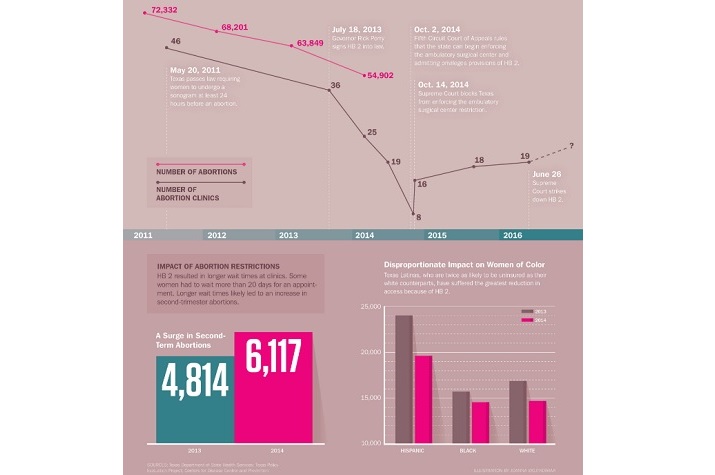
"The justices are about to hand down the most important abortion case in a quarter century," Ian Millhiser, Center for American Progress' "ThinkProgress": Before the Supreme Court begins its summer vacation next week, the justices must decide "the most significant abortion case to reach the Supreme Court since the right to choose's near death experience in 1992," Millhiser writes. Millhiser points to the high court's 2007 ruling in Gonzales v. Carhart, which granted lawmakers "'wide discretion to pass legislation in areas where there is medical and scientific uncertainty.'" According to Millhiser, "It didn't take long before anti-abortion advocates and their allies in state legislatures began to test just how far the courts were willing to push Carhart -- and whether they would sustain anti-abortion laws based on the illusion of medical uncertainty." Whole Woman's Health v. Hellerstedt, the abortion case currently before the justices, "is the culmination of this strategy," Millhiser writes, noting that the Texas law (HB 2) around which the case revolves "imposes potentially crippling burdens on abortion clinics, often with no apparent health benefits whatsoever." He explains that if the contested provisions of the law are upheld, the number of clinics in the state would decline to less than 10, and even those remaining clinics could face closure "because it is almost certain that states like Texas would try to push the envelope even further if they scored a big victory in the Supreme Court." He writes, "Once the courts permit states to enact sham health laws whose real purpose is to restrict abortion, the only limit on such restrictions may be lawmakers' ability to pass clever laws. A decision upholding HB2 could allow abortion opponents to turn packs of wolves loose in abortion clinics, so long as those wolves are dressed in sheep's clothing" (Millhiser, "ThinkProgress," Center for American Progress, 6/20).
ACCESS TO CARE:
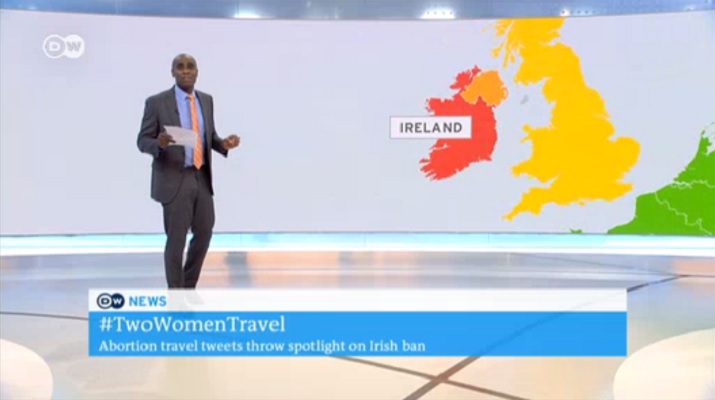
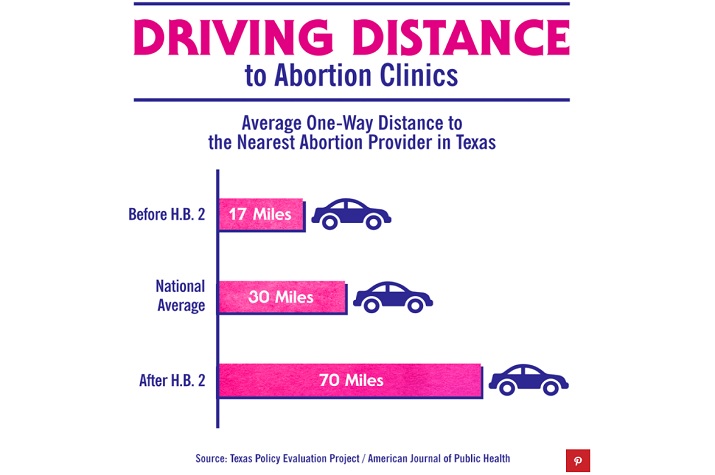
"Send in the abortion drones: We could use this Irish pro-choice tech protest here in the U.S., too," Mary Elizabeth Williams, Salon: "Pro-choice advocates have scheduled a drone drop for next week to send abortion pills to a border area between the Republic of Ireland and Northern Ireland to protest restrictive reproductive health laws in both places," Williams writes. She explains that advocates, using a drone, will bring birth control pills into Northern Ireland, where "a group of women who are not pregnant have pledged to take the pills -- mifepristone and misoprostol -- to demonstrate their safety and to make a plea for reproductive rights." Williams notes that Woman on Waves, a reproductive-rights advocacy group that helped organize the delivery, said the event aims to "'highlight the violation of human rights caused by the existing laws that criminalize abortion in both the north and south of Ireland except in very limited circumstances.'" She notes that while "an astonishing 4,000 women travel from Ireland to England" annually to seek abortion care, "it gets pretty depressing when you realize that those women may still have an easier experience than women" in the United States, where abortion is a "constitutionally protected right." According to Williams, research shows that one-third of U.S. women must travel more than 25 miles to access abortion care, while some women "in Texas, where nearly half of its previous 41 clinics have closed," must travel more than 300 miles for care. Williams concludes that "while the push to improve reproductive rights for women in other countries intensifies, we could use a fleet of drones right here in the U.S. to help a growing population of women in need right now" (Williams, Salon, 6/17).
What others are saying about access to care:
~ "Seeking justice for Tamesha Means in court today," Brigitte Amiri, American Civil Liberties Union's "Speak Freely."
LGBT:
"Gay men wanted to donate blood in Orlando. They're still not allowed to," Nathan Kohrman, Mother Jones: Following the mass shooting at a gay nightclub in Orlando last week, "hundreds of sympathizers had lined up to donate blood to the 53 young men and women who had survived the shooting," including "many gay men who would have liked to help but couldn't," Kohrman writes. He explains that while FDA last year "lifted its lifetime ban on blood donations by men who have sex with men" (MSM), the agency said MSM only could donate blood "if they've been celibate for a year beforehand." According to Kohrman, medical experts have denounced the year-long deferral, which they say discriminates against gay men and fails to take into account advances in HIV testing that could enable safe blood donation based on individual assessment or a 30-day deferral. Moreover, Kohrman notes that the "American Red Cross, a private entity regulated by the FDA [that] is responsible for about 40 percent of the nation's blood supply" has yet to fully update its deferral policies per FDA's latest guidance. "The ongoing deferral puzzles many LGBTQ advocates, given how vital blood is to the health care system," Kohrman writes, citing research showing that "[e]nding [the 12-month deferral] ... could 'help save the lives of more than a million people.'" Kohrman concludes, "The current policy suggests that the federal government is more concerned with preventing injury than insult. With better evidence, it won't have to choose one or the other" (Kohrman, Mother Jones, 6/19).