
National Partnership for Women & Families

In the News

Blogs comment on the sex discrimination of abortion stigma, economic ramifications of a SCOTUS ruling upholding Whole Woman's Health and more

Read the week's best commentary from bloggers at the American Constitution Society blog, The American Prospect and more.

ABORTION-RIGHTS MOVEMENT:

"Whole Women's Health: Abortion stigma is sex discrimination," Danielle Lang, American Constitution Society blog: The Supreme Court should not only rule that provisions in Texas' omnibus antiabortion-rights law (HB 2) are unconstitutional because they "present substantial practical obstacles to access to abortion," but also because HB 2 and similar restrictions in other states "enforce an outdated vision of women's autonomy and role in society," Lang writes. According to Lang, such antiabortion-rights laws have "real consequences on women's health, women's identity and our society's ability to truly reshape itself to deliver on the promise of women's equality." Noting that the medical justification for the contested Texas provisions "is a complete farce," Lang writes, "Ultimately, the message sent by these laws -- which purport to protect women's health but do nothing to further medical safety -- is that women need to be saved from their own decisions to seek abortions." Citing Supreme Court precedent that prohibits states from "legislat[ing] to promote any particular view of women's proper role in society" or "protect[ing] women from choices outside of that role," Lang writes that Texas "cannot enforce laws, in the name of women's health, that do not further medical safety but rather seek to 'protect' women from their own self-determination and impose shame and stigma on women." She concludes, "Recognition of this basic point would be entirely consistent with the Court's sex discrimination precedent and would mark a welcome change in an abortion jurisprudence that seems ever less tethered to the women's rights it claims to protect" (Lang, American Constitution Society blog, 6/23).

ABORTION RESTRICTIONS:

"Will the court restrict abortion to the wealthy?" Caroline Fredrickson, The American Prospect: "As the Supreme Court prepares to decide on the blockbuster abortion case Whole Woman's Health v. Hellerstedt, it's worth remembering that one of the ruling's main implications will be economic," Fredrickson writes, explaining that "women's control of their own fertility is a key driver of our nation's economic success." According to Fredrickson, abortion-rights opponents "have found a clever way ... to undermine legal access to reproductive health care" by passing "restrictions that raise the cost of abortion and contraception," thereby "target[ing] low-income women [and] eroding the gains of past decades." For example, Fredrickson points out how low-income women in Texas are disproportionately affected by clinic closures under HB 2 because they cannot afford the travel and lodging costs required to access abortion care elsewhere. Fredrickson concludes that "if the Supreme Court upholds Texas-style restrictions in Hellerstedt, the effect will be to make abortion completely inaccessible to far too many women" for whom the cost of access care will be prohibitive (Fredrickson, The American Prospect, 6/21).

ACCESS TO CARE:

"In June, dig deeper into abortion access for low-income women," Amie Newman, Our Bodies Ourselves' "Our Bodies, Our Blog": "This month, two important discussions about abortion access and the impact of specific anti-choice regulations called TRAP [laws] (targeted regulation of abortion providers) are happening in two very different spaces: one on PBS and the other in the Supreme Court," Newman writes. She explains that PBS is airing a documentary called "Trapped," which "looks at how abortion clinics are (or aren't) surviving as they battle the onslaught of harmful state TRAP laws." Meanwhile, according to Newman, "It's one of these laws -- HB2 in Texas -- that the Supreme Court is now tasked with either upholding or overturning in Whole Woman's Health v. Hellerstedt." She writes, "On the surface, the Supreme Court case and the film examine how these anti-choice regulations affect clinic closures ... Dig a little deeper, though, and you unearth the ways in which these laws sharply impact women at the lowest rungs of the economic ladder." Newman writes, "The more low-income women are stripped of their access to this critical reproductive health care, the more difficult it is for them to move up the income ladder and escape poverty." Newman concludes by calling for "abortion access laws that respect and value women as agents of their own lives, ... that care for vulnerable women's bodies" and "that respect all women's choices as they make them, even if they are different than what we would choose for ourselves" (Newman, "Our Bodies, Our Blog," Our Bodies Ourselves, 6/22).

What others are saying about access to care:

~ "A bishop in the exam room: When faith dictates health care instead of science," Erica Hellerstein/Josh Israel, Center for American Progress' "ThinkProgress."

Video Round Up

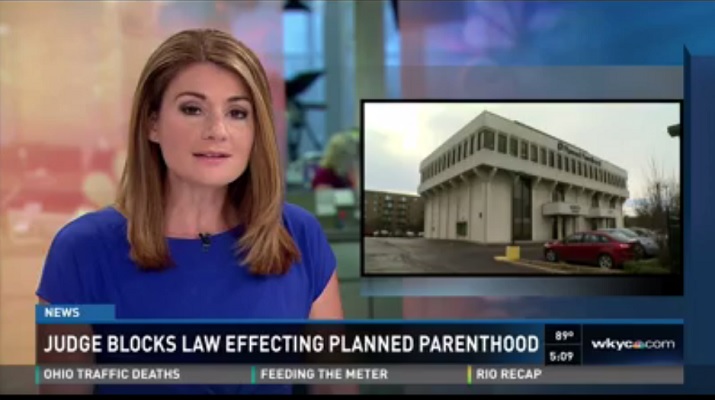
In this clip, WKYC's Maureen Kyle covers a recent decision by a federal judge to grant a permanent injunction against an Ohio law (HB 294) that would cut $1.3 million from abortion providers.

Video Round Up

In an interview with AOL Build's Emma Gray, Tracy Droz Tragos discusses her new documentary, "Abortion: Stories Women Tell," which shares women's perspectives on abortion care and abortion rights.

Video Round Up

In this clip, WJHG's Matt Galka discusses Florida's decision not to appeal a federal court order currently blocking parts of a state omnibus antiabortion-rights law (HB 1411) from taking effect.

Video Round Up

Marissa Silver, a reporter with Coastal Television's "Your Alaska Link," shares the Alaska Supreme Court's decision to strike down a state law that required a minor's parent to be notified of her decision to seek abortion care.

Video Round Up

Fox 13's Matt McDonald reports on a ruling by a panel of the 10th U.S. Circuit Court of Appeals that blocks Utah Gov. Gary Herbert (R) from cutting funding to Planned Parenthood.

Video Round Up

Richard Besser, ABC News' chief health and medical editor, discusses a case in which a woman in New York City transmitted the Zika virus to her male partner, the first such occurrence reported in the United States.

Video Round Up

WHNT 19 News' Kristen Conner explains what the Supreme Court's ruling striking down two provisions of a Texas omnibus antiabortion-rights law (HB 2) could mean for two antiabortion-rights measures in Alabama.

Video Round Up

Ryan Braschler of WEHT's "Eyewitness News" covers Indiana University's (IU) lawsuit against fetal tissue restrictions included in an Indiana antiabortion-rights law (HEA 1337).

Video Round Up

KIRO 7's Essex Porter discusses the Supreme Court's decision not to review a 9th U.S. Circuit Court of Appeals ruling that upheld a Washington state regulation requiring pharmacies to dispense emergency contraception (EC).

Video Round Up

In this clip, MSNBC's Rachel Maddow speaks with Nancy Northup, the president and CEO of the Center for Reproductive Rights, about the ramifications of the Supreme Court's ruling in Whole Woman's Health v. Hellerstedt to strike down two contested provisions in Texas' omnibus antiabortion-rights law (HB 2).

See All

Datapoints

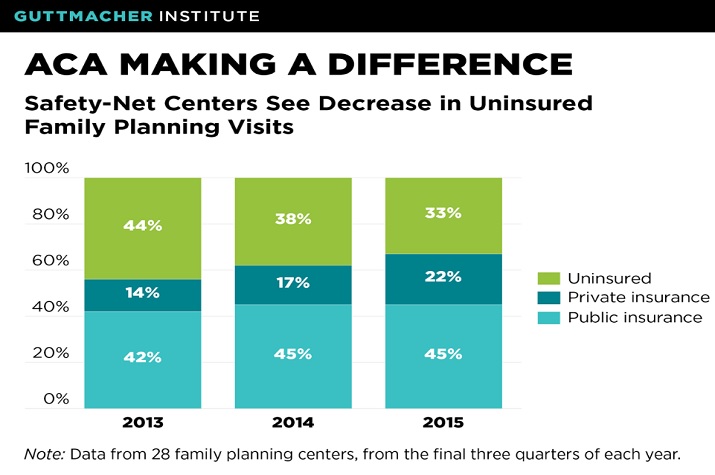
In this infographic, the Guttmacher Institute spotlights the increased proportion of insured visits at 28 Title-X supported family planning centers following the implementation of the Affordable Care Act (ACA) (PL 111-148).

Datapoints

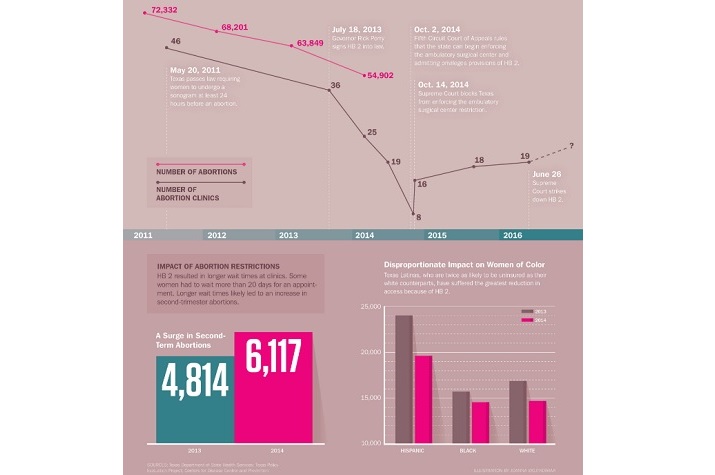
In this infographic, the Texas Observer compiled information from the Texas Department of State Health Services, the Texas Policy Evaluation Project and the Centers for Disease Control and Prevention to provide a snapshot of abortion access in Texas.

Datapoints

In this infographic, the Guttmacher Institute tracks recent trends in state abortion laws.

Datapoints

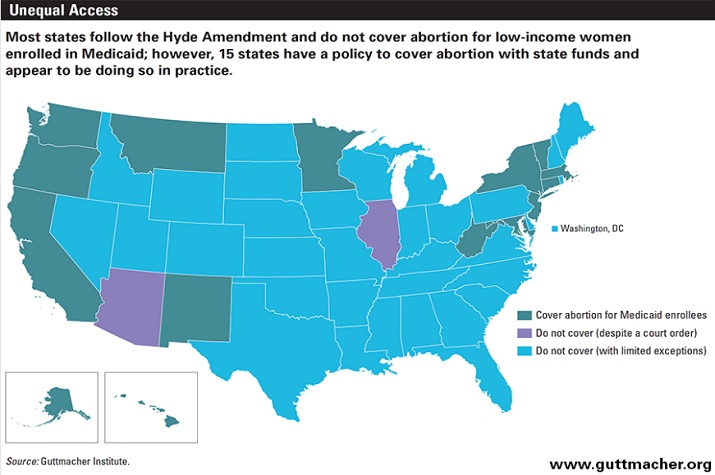
In this map, the Guttmacher Institute highlights the effects of the Hyde Amendment, an appropriations rider that bars federal Medicaid funding from covering abortion care except in the limited cases of rape, incest and life endangerment.

Datapoints

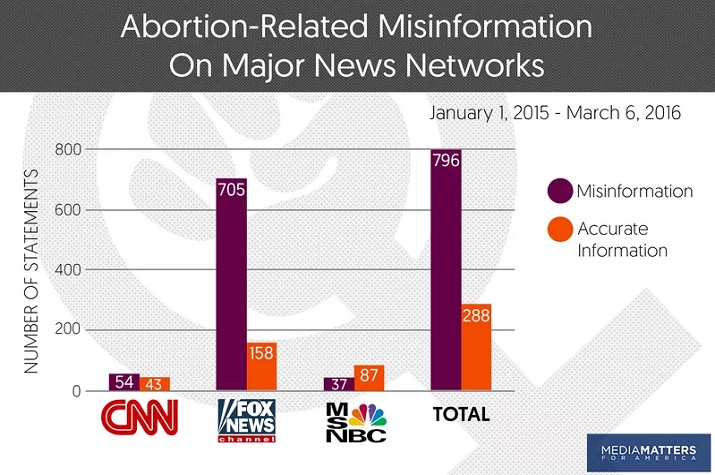
In this chart, Media Matters highlights the findings of a study showing how evening and primetime news programs airing on cable news conveyed more inaccurate than accurate statements about abortion.

Datapoints

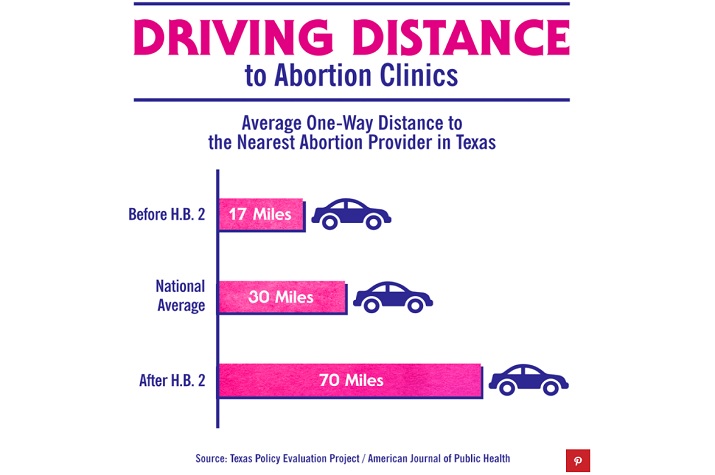
In this gif, Cosmopolitan shares research from the Texas Policy Evaluation Project showing that the average distance a woman in Texas must drive to access the nearest abortion clinic in the state has increased following the implementation of the state's omnibus antiabortion-rights law (HB 2).

Datapoints

In this map, the Kaiser Family Foundation spotlights five states and Washington, D.C., which have each enacted policies designed to facilitate access to contraception.

Datapoints

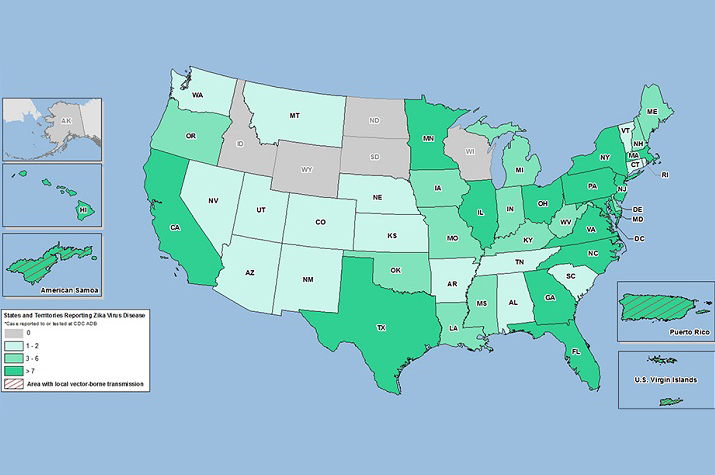
In this map, CDC documents the laboratory-confirmed cases of the Zika virus reported in the United States and U.S. territories.

Datapoints

In this infographic, the Guttmacher Institute highlights research showing how an increasing proportion of women who obtain abortion care in the United States are lower-income.

Datapoints

In this map, the New York Times highlights the regions in the United States where mosquitos carrying the Zika virus -- which has been linked to a fetal brain defect -- are most likely to spread during the upcoming spring and summer seasons.

See All

At a Glance

"A woman's ability to end her pregnancy too often depends on where she lives, her age and how much money is in her pocket."

— Marcela Howell of In Our Own Voice: National Black Women's Reproductive Justice Agenda, discussing ongoing disparities in women's access to abortion care on the 43rd anniversary of Roe v. Wade.

At a Glance

"If women are not free to make decisions about their own lives and health, they are not free. And if women are not free, none of us are."

— Abortion provider Warren Hern, in a STAT News opinion piece on why he continues to offer abortion care despite receiving harassment and death threats throughout his 42-year career.

At a Glance

"Not since before Roe v. Wade has a law or court decision had the potential to devastate access to reproductive health care on such a sweeping scale."

— Nancy Northup, president and CEO of the Center for Reproductive Rights, on a ruling from the 5th U.S. Circuit Court of Appeals that upheld major portions of a Texas antiabortion-rights law.