
National Partnership for Women & Families

In the News

Datapoint: Women seeking abortion care increasingly likely to be low income

In this infographic, the Guttmacher Institute highlights research showing how an increasing proportion of women who obtain abortion care in the United States are lower income. Guttmacher categorized women with incomes below the federal poverty level (FPL) as poor, and women with incomes at 100 to 199 percent of FPL as low income.

Overall, Guttmacher found that the proportion of women with incomes below FPL who obtained abortion care increased from 42 percent in 2008 to 49 percent in 2014. Meanwhile, according to the report, 26 percent of women who obtained abortion care in 2014 qualified as low income.

The report also noted that while the proportion of women seeking abortion care who did not have health insurance decreased from 34 percent in 2008 to 28 percent in 2014, such women were not necessarily able to use their insurance to cover their abortion care. The Hyde Amendment bars the use of federal Medicaid funding for most abortion care, and states vary in abortion coverage allowed through state-run Medicaid programs or through private insurance offered via state insurance marketplaces. Overall, according to the report, 53 percent of women who obtained abortion care in 2014 paid for the procedure out-of-pocket (Jerman et al., Guttmacher Institute report, May 2016).

Video Round Up

Fox 13's Matt McDonald reports on a ruling by a panel of the 10th U.S. Circuit Court of Appeals that blocks Utah Gov. Gary Herbert (R) from cutting funding to Planned Parenthood.

Video Round Up

Richard Besser, ABC News' chief health and medical editor, discusses a case in which a woman in New York City transmitted the Zika virus to her male partner, the first such occurrence reported in the United States.

Video Round Up

Ryan Braschler of WEHT's "Eyewitness News" covers Indiana University's (IU) lawsuit against fetal tissue restrictions included in an Indiana antiabortion-rights law (HEA 1337).

Video Round Up

WHNT 19 News' Kristen Conner explains what the Supreme Court's ruling striking down two provisions of a Texas omnibus antiabortion-rights law (HB 2) could mean for two antiabortion-rights measures in Alabama.

Video Round Up

KIRO 7's Essex Porter discusses the Supreme Court's decision not to review a 9th U.S. Circuit Court of Appeals ruling that upheld a Washington state regulation requiring pharmacies to dispense emergency contraception (EC).

Video Round Up

In this clip, MSNBC's Rachel Maddow speaks with Nancy Northup, the president and CEO of the Center for Reproductive Rights, about the ramifications of the Supreme Court's ruling in Whole Woman's Health v. Hellerstedt to strike down two contested provisions in Texas' omnibus antiabortion-rights law (HB 2).

Video Round Up

In this short documentary, filmmaker Dawn Porter profiles Yashica Robinson, one of the few physicians in Alabama who provides abortion care.

Video Round Up

RTV6's Katie Heinz reports on arguments held Tuesday in federal court over an Indiana antiabortion-rights law (HEA 1337) that Planned Parenthood of Indiana and Kentucky has challenged.

Video Round Up

The Wichita Eagle spotlights an abortion clinic set to open in Oklahoma City this summer.

Video Round Up

In this clip, the New York Times explores the experiences of pregnant women in Brazil during the ongoing Zika outbreak, which "has been blamed for thousands of neurological birth defects across the country."

See All

Datapoints

In this infographic, the Guttmacher Institute tracks recent trends in state abortion laws.

Datapoints

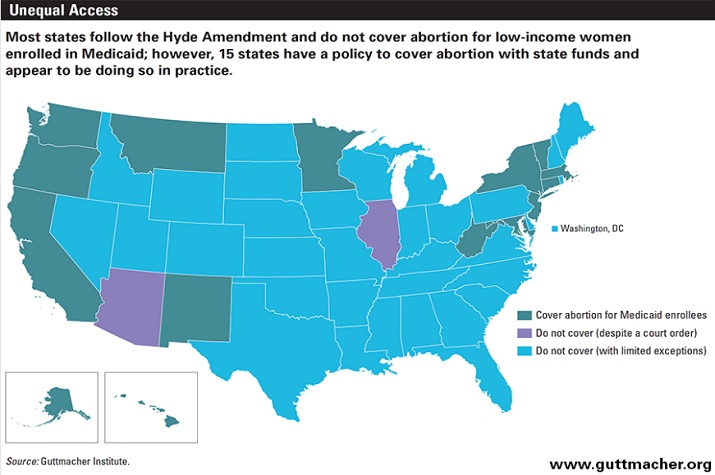
In this map, the Guttmacher Institute highlights the effects of the Hyde Amendment, an appropriations rider that bars federal Medicaid funding from covering abortion care except in the limited cases of rape, incest and life endangerment.

Datapoints

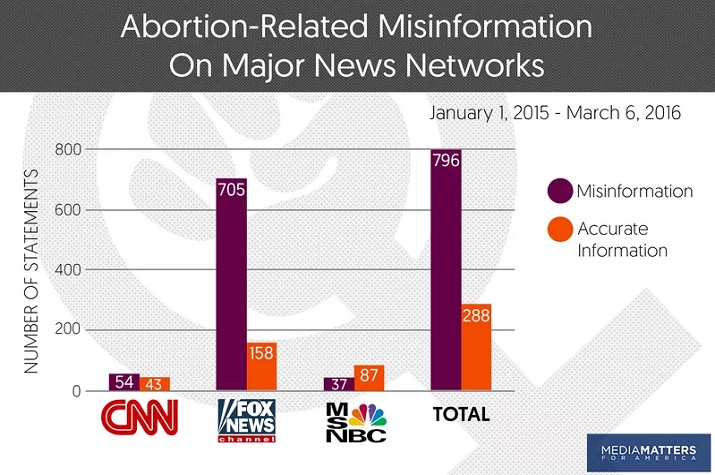
In this chart, Media Matters highlights the findings of a study showing how evening and primetime news programs airing on cable news conveyed more inaccurate than accurate statements about abortion.

Datapoints

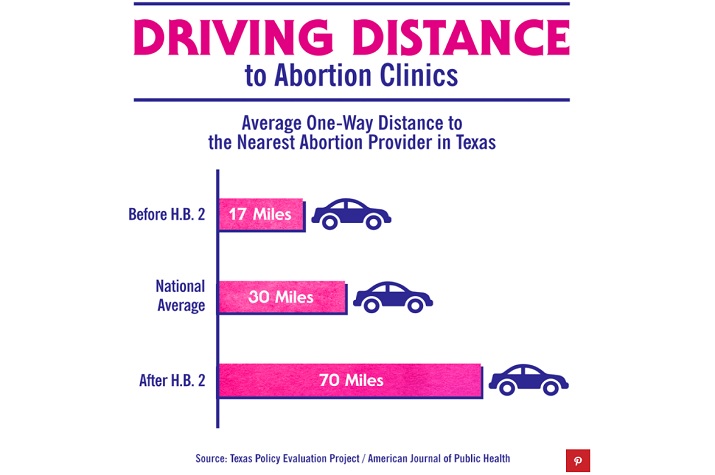
In this gif, Cosmopolitan shares research from the Texas Policy Evaluation Project showing that the average distance a woman in Texas must drive to access the nearest abortion clinic in the state has increased following the implementation of the state's omnibus antiabortion-rights law (HB 2).

Datapoints

In this map, the Kaiser Family Foundation spotlights five states and Washington, D.C., which have each enacted policies designed to facilitate access to contraception.

Datapoints

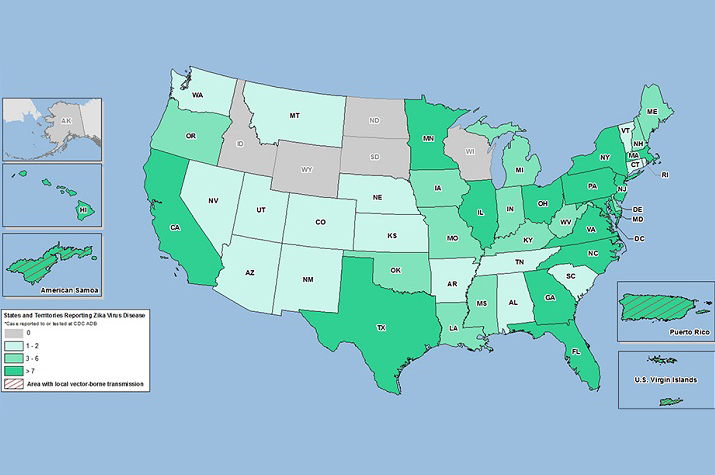
In this map, CDC documents the laboratory-confirmed cases of the Zika virus reported in the United States and U.S. territories.

Datapoints

In this infographic, the Guttmacher Institute highlights research showing how an increasing proportion of women who obtain abortion care in the United States are lower-income.

Datapoints

In this map, the New York Times highlights the regions in the United States where mosquitos carrying the Zika virus -- which has been linked to a fetal brain defect -- are most likely to spread during the upcoming spring and summer seasons.

Datapoints

This map, from the Center for Reproductive Rights (CRR), spotlights abortion laws around the world.

Datapoints

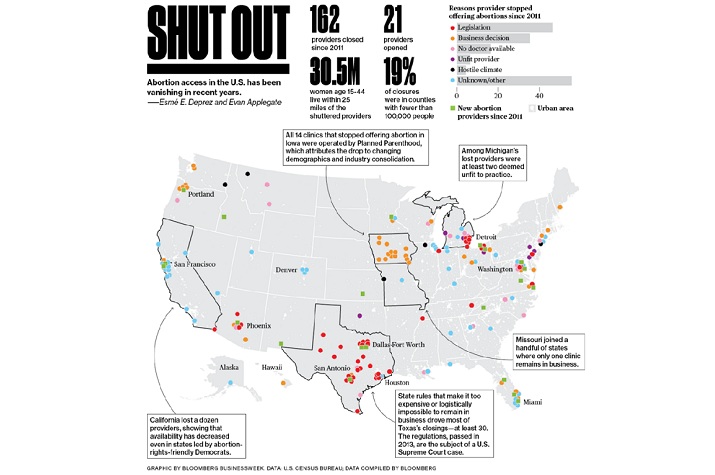
This map, from Bloomberg Business, highlights the rapid decline in abortion access in the United States since 2011.

See All

At a Glance

"A woman's ability to end her pregnancy too often depends on where she lives, her age and how much money is in her pocket."

— Marcela Howell of In Our Own Voice: National Black Women's Reproductive Justice Agenda, discussing ongoing disparities in women's access to abortion care on the 43rd anniversary of Roe v. Wade.

At a Glance

"If women are not free to make decisions about their own lives and health, they are not free. And if women are not free, none of us are."

— Abortion provider Warren Hern, in a STAT News opinion piece on why he continues to offer abortion care despite receiving harassment and death threats throughout his 42-year career.

At a Glance

"Not since before Roe v. Wade has a law or court decision had the potential to devastate access to reproductive health care on such a sweeping scale."

— Nancy Northup, president and CEO of the Center for Reproductive Rights, on a ruling from the 5th U.S. Circuit Court of Appeals that upheld major portions of a Texas antiabortion-rights law.