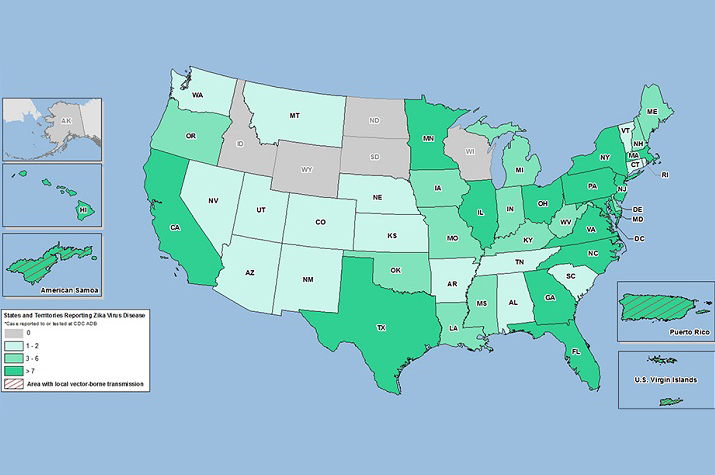


Thousands of pregnant women in Puerto Rico could be at risk for contracting the Zika virus in coming months, CDC Director Thomas Frieden said on Friday, the Washington Post's "To Your Health" reports.
Frieden's assessment stems from data obtained during screening of blood donors in Puerto Rico. According to "To Your Health," the data provides the most representative sample of infection rates available among the Puerto Rico population overall (Sun, "To Your Heath," Washington Post, 6/17).
Background on Zika virus
The Zika virus is a mosquito-borne disease that has spread across North and South America over the past year. Researchers recently learned that Zika can also be transmitted through sexual activity. The virus is not easily diagnosed, and it does not have a cure or vaccine. It is linked to the birth defect microcephaly, a condition in which an infant is born with an abnormally small head and brain. The condition is fatal for some infants, while others experience permanent disabilities.
Officials in Brazil and Honduras have issued guidance recommending that women avoid pregnancy. El Salvador's recommendation is that women not get pregnant until 2018. However, many countries in Latin America restrict access to contraception and often ban abortion. In addition, women have been advised to protect themselves against mosquitos, but insect repellant can be unaffordable for low-income women.
The World Health Organization (WHO) has declared the outbreak and its link to microcephaly a public health emergency of international concern. Separately, the United Nations High Commissioner for Human Rights issued a statement directing nations affected by the Zika virus to remove bans on access to sexual and reproductive health care services.
Last Thursday, CDC said it was monitoring 234 pregnant women in U.S. states and 189 women in U.S. territories who have the Zika virus. Currently, congressional lawmakers are working to merge the House (HR 5243) and Senate (SA 3900) funding proposals for Zika response efforts, both of which include antiabortion-rights language and fall short of the $1.9 billion requested by President Obama (Women's Health Policy Report, 6/17).
CDC's update on Puerto Rico
The Zika-positive rate among blood donors in Puerto Rico was about 1 percent for the week ending June 11. According to CDC, the rate is the highest it has been since testing started in April.
Frieden, who noted that the infection rate was higher than expected, said the 1 percent positive rate indicates there will be a 2 percent rate of infection each month. Overall, those figures could lead to an annual infection rate of about 25 percent. Matthew Kuehnert, CDC's director of blood and organ safety, said no blood donations collected in the continental United States have been found to be infected by the virus.
According to Puerto Rico's health department, there currently are 1,726 confirmed Zika cases, 191 of which are among pregnant women. About 32,000 infants are delivered in Puerto Rico each year. In Brazil, doctors have found a 13 percent prevalence of microcephaly among infants born to women who contracted Zika during the first trimester of pregnancy.
Based on the data, Frieden said Puerto Rico could see "dozens to hundreds of infants born with microcephaly in the coming year." Citing other fetal anomalies stemming from Zika, he added, "[W]e simply don't know if there will be long-term consequences on brain development."
Frieden urged officials and communities to prevent mosquito exposure. He stated, "I want to try and make sure all of us involved in the response don't get to a situation three, six or 12 months later where we look back and say we wish we had done more back in June."
He noted that peak season for mosquito-related outbreaks in Puerto Rico has not yet arrived. That time period spans summer into fall ("To Your Health," Washington Post, 6/17).
Health officials encounter challenges connecting women with contraceptives in Puerto Rico
In related news, according to public health officials, very few women in Puerto Rico this month are expected to receive contraception donated to help prevent unintended pregnancy amid the Zika outbreak, Reuters reports.
According to CDC, up to 138,000 women in Puerto Rico are at risk for unintended pregnancy. In recent weeks, several major drugmakers have donated about 60,000 intrauterine devices (IUDs) and 80,000 packs of oral hormonal contraception.
The CDC Foundation, CDC's philanthropic arm, said it needs about $20 million more in funding for training and follow-up services to help women access contraception. Currently, many physicians in Puerto Rico lack training in IUD insertion, though some drugmakers have started offering training to providers about how to use their devices. According to Reuters, health care providers also are facing strain under Puerto Rico's financial crisis and because of low Medicaid reimbursements.
Judith Monroe, president and CEO of the CDC Foundation, said the foundation so far has provided training for roughly 24 health care providers and raised about $1.7 million, which will cover the cost of providing contraception at no out-of-pocket cost for 700 women beginning in June. The organization currently is working to arrange a licensed distributor for the contraception in the area.
According to Monroe, the CDC Foundation in February started seeking private donations for the contraceptive distribution effort in Puerto Rico. However, according to Reuters, fundraising has proven difficult because prospective donors might not understand the need for quick action to address the situation (Mincer, Reuters, 6/20).
Regulators OK human trial for Zika vaccine
In other related news, U.S. regulators have granted Inovio Pharmaceuticals and GeneOne Life Sciences approval to launch an early stage human trial for their Zika vaccine, Reuters reports (Penumudi, Reuters, 6/20).
The vaccine's working name is GLS-5700. FDA's approval marks the first clinical trial for a Zika vaccine.
According to WHO, as of earlier this year, 18 organizations and academic labs said they were working on Zika vaccines. For example, the National Institute of Allergy and Infectious Diseases also is working on a vaccine and anticipates FDA approval for clinical trials in a few weeks (Branswell, STAT News, 6/20). A separate drugmaker, Sanofi SA, expects to begin testing its own vaccine on human subjects in 2017.
J. Joseph Kim, CEO of Inovio, said the company "plan[s] to dose our first subjects in the next weeks and expect[s] to report phase I interim results later this year." The GLS-5700 study will evaluate safety, immune response and tolerability of the vaccine in 40 human trial participants (Reuters, 6/20). Inovio plans to test one-dose, two-dose and three-dose regimens.
According to STAT News, testing in animal models indicated that the vaccine yielded what Kim described as a robust antibody response (STAT News, 6/20).