
National Partnership for Women & Families

In the News

NYT op-ed highlights potential to reduce teen pregnancy through LARC use

To further reduce the incidence of teenage pregnancy, U.S. health policymakers should adopt strategies that promote and support the use of long-acting reversible contraceptives (LARC), Tina Rosenberg writes in an opinion piece for the New York Times.

Teenage pregnancy in the U.S.

In 2014, the U.S. teenage birth rate fell to "a historic low," according to Rosenberg. She notes that the 2014 rate, at 24.2 per 1,000 women ages 15 to 19, marks a 40 percent decline since "its modern peak in 1991," when the rate was 61.8 per 1,000. Rosenberg calls the decline "excellent news," noting that teenagers who become pregnant "are less likely to finish their education, and their babies are at high risk for health problems, incarceration, academic troubles and, yes, teenage pregnancy."

While "[n]o one really knows why these birthrates have dropped," Rosenberg suggests that "[t]he most important reason appears to be increased contraceptive use." She notes that media depictions of the challenges of teenage pregnancy may also have played a role.

Nonetheless, despite the decline, "the United States has a far higher rate of teenage pregnancies than most developed countries," Rosenberg writes. She adds that according to the Guttmacher Institute, three-quarters of teenage pregnancies are unintended.

Colo. LARC initiative

In terms of what can be done to help teenagers avoid unintended pregnancy, Rosenberg highlights a Colorado initiative that provides LARC to low-income women at no cost.

In the last seven years, Colorado has seen the birth rate among 15-to-19-year-old women "cut ... by nearly half," while "[r]epeat teenage births have dropped by 58 percent," Rosenberg writes. She adds that as a result, "the state has saved tens or perhaps hundreds of millions of dollars."

The LARC initiative is "a main reason for Colorado's success," Rosenberg states. She notes that since the program began, the rate of teenagers seeking family planning services at clinics for low-income or uninsured individuals and receiving LARC has increased from 2.5 percent to 28.9 percent.

Promoting LARC

While the effectiveness of the 7-year-old program "ha[s] been widely reported," Rosenberg writes that "other states are getting off to a slow start in replicating the program." According to Rosenberg, 13 states have joined an Association of State and Territorial Health Officials working group to "brin[g] officials from states seeking to provide LARCs to women who have just given birth."

Rosenberg explains, "The challenges illustrate how difficult it is to spread new medical practices." She quotes Lisa Waddell, the community health and prevention chief program officer at the health officials' association, who cites a need for education about LARCS. To address misconceptions about LARCs and promote their use, Rosenberg writes, paraphrasing Waddell, that "the best remedy is word of mouth from women who are happy with their birth control."

However, Rosenberg cautions, "Health workers must use care when talking about LARCs, as with other forms of birth control." She notes, "America has a sorry history of coercing young minority women into sterilization or birth control."

Accessing a physician to discuss LARC poses another obstacle to care, Rosenberg writes. According to Amy Crockett -- a maternal-fetal medicine specialist at the Greenville Health System in South Carolina and clinical lead for the Birth Outcomes Initiative, a state program -- "'The biggest barrier is access to care.'" Crockett explained that in some cases, obtaining LARC can entail two separate appointments if a physician does not have LARC in stock on the day of the initial visit.

Noting these barriers, Rosenberg writes, "This is one reason many states focus on women who have just given birth." However, "while many state governments wanted hospitals to insert LARCs, state Medicaid systems initially discouraged the procedure with their disbursement system," Rosenberg continues, explaining that Medicaid bundled payments for birth did not include extra payment for LARCs. Nonetheless, she notes that starting with South Carolina in 2012, many states have since adopted payment policies that reimburse for LARCs in a separate payment, while "Blue Cross and Blue Shield, the dominant insurer, quickly followed."

According to Rosenberg, the state Medicaid programs' "policy change was necessary but far from sufficient." For example, she notes that while Montana's "Medicaid added a separate payment for LARC on" Jan. 1, 2015, "10 months later, only four women had received LARCs immediately after giving birth, because providers hadn't been told that they could get paid."

Rosenberg concludes by quoting Crockett, who, acknowledging the "'logistical issues'" of promoting LARC use, says, "'I learned it really takes leadership'" (Rosenberg, New York Times, 7/19).

Video Round Up

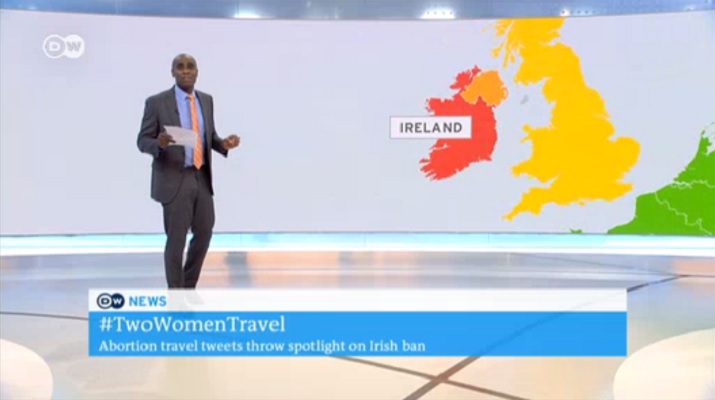
Deutsche Welle's Carl Nasman spotlights @TwoWomenTravel, a Twitter account documenting the experience of two Irish women who traveled to Great Britain to access abortion care for one of the women.

Video Round Up

In this clip, The Nation profiles Leah Torres, an OB-GYN who shares her "career changing, life changing" work as an abortion provider in Utah, a state that imposes several restrictions on abortion care.

Video Round Up

In an interview with AOL Build's Emma Gray, Tracy Droz Tragos discusses her new documentary, "Abortion: Stories Women Tell," which shares women's perspectives on abortion care and abortion rights.

Video Round Up

In this clip, WKYC's Maureen Kyle covers a recent decision by a federal judge to grant a permanent injunction against an Ohio law (HB 294) that would cut $1.3 million from abortion providers.

Video Round Up

In this clip, WJHG's Matt Galka discusses Florida's decision not to appeal a federal court order currently blocking parts of a state omnibus antiabortion-rights law (HB 1411) from taking effect.

Video Round Up

Marissa Silver, a reporter with Coastal Television's "Your Alaska Link," shares the Alaska Supreme Court's decision to strike down a state law that required a minor's parent to be notified of her decision to seek abortion care.

Video Round Up

Richard Besser, ABC News' chief health and medical editor, discusses a case in which a woman in New York City transmitted the Zika virus to her male partner, the first such occurrence reported in the United States.

Video Round Up

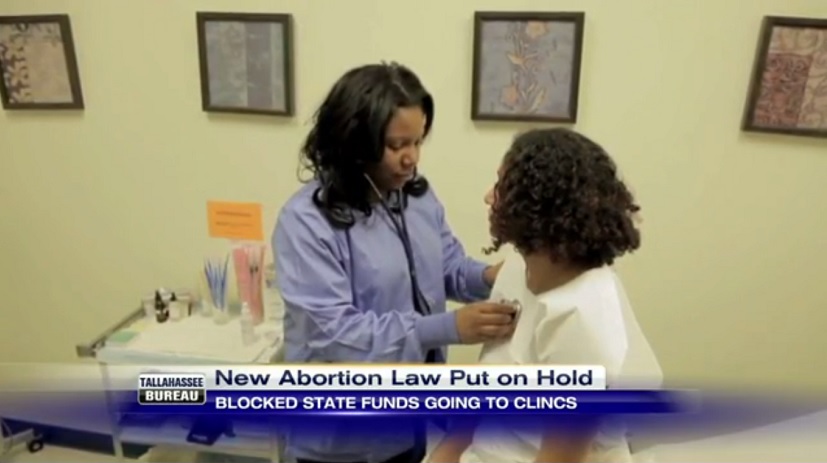
Fox 13's Matt McDonald reports on a ruling by a panel of the 10th U.S. Circuit Court of Appeals that blocks Utah Gov. Gary Herbert (R) from cutting funding to Planned Parenthood.

Video Round Up

WHNT 19 News' Kristen Conner explains what the Supreme Court's ruling striking down two provisions of a Texas omnibus antiabortion-rights law (HB 2) could mean for two antiabortion-rights measures in Alabama.

Video Round Up

Ryan Braschler of WEHT's "Eyewitness News" covers Indiana University's (IU) lawsuit against fetal tissue restrictions included in an Indiana antiabortion-rights law (HEA 1337).

See All

Datapoints

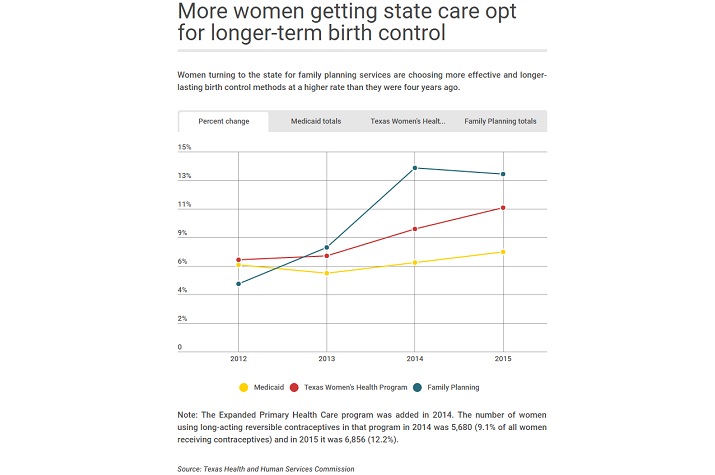
In this infographic, the Texas Health and Human Services Commission (HHSC) outlines data showing that the percentage of Texas women opting for long-acting reversible contraception (LARC) through three state-operated health programs increased between 2012 and 2013.

Datapoints

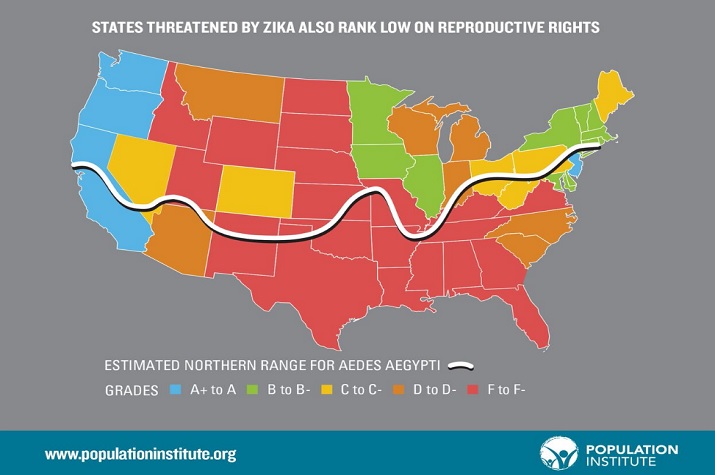
In this map, the Population Institute illustrates how many of the states at risk of the Zika virus scored poorly on measures of reproductive rights and health.

Datapoints

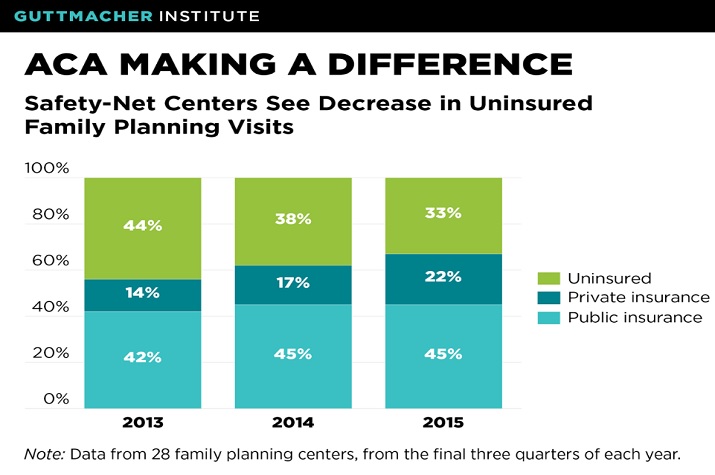
In this infographic, the Guttmacher Institute spotlights the increased proportion of insured visits at 28 Title-X supported family planning centers following the implementation of the Affordable Care Act (ACA) (PL 111-148).

Datapoints

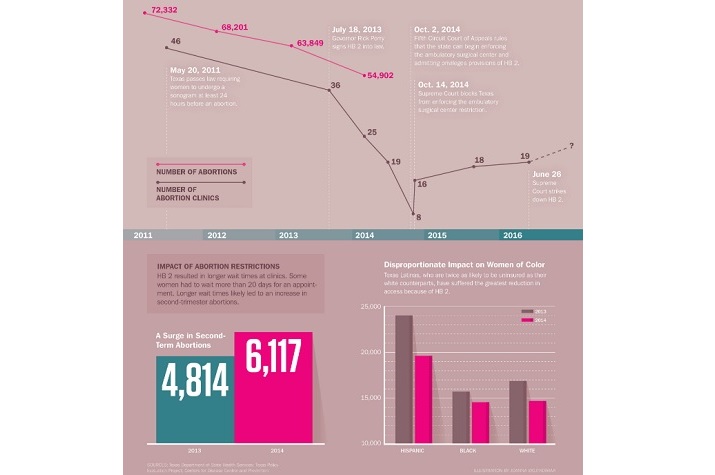
In this infographic, the Texas Observer compiled information from the Texas Department of State Health Services, the Texas Policy Evaluation Project and the Centers for Disease Control and Prevention to provide a snapshot of abortion access in Texas.

Datapoints

In this infographic, the Guttmacher Institute tracks recent trends in state abortion laws.

Datapoints

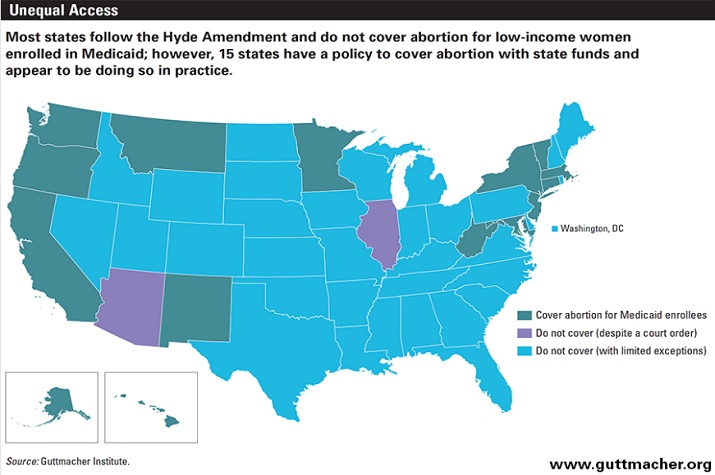
In this map, the Guttmacher Institute highlights the effects of the Hyde Amendment, an appropriations rider that bars federal Medicaid funding from covering abortion care except in the limited cases of rape, incest and life endangerment.

Datapoints

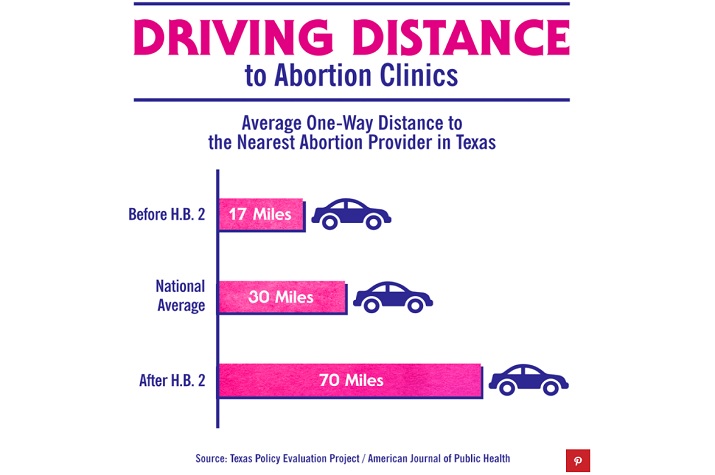
In this gif, Cosmopolitan shares research from the Texas Policy Evaluation Project showing that the average distance a woman in Texas must drive to access the nearest abortion clinic in the state has increased following the implementation of the state's omnibus antiabortion-rights law (HB 2).

Datapoints

In this map, the Kaiser Family Foundation spotlights five states and Washington, D.C., which have each enacted policies designed to facilitate access to contraception.

Datapoints

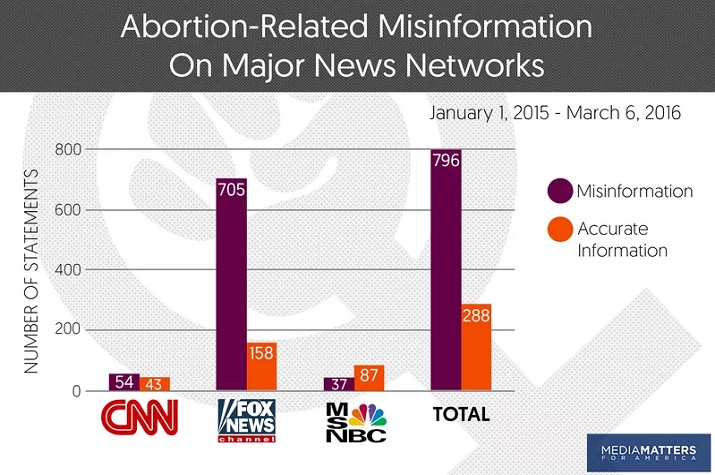
In this chart, Media Matters highlights the findings of a study showing how evening and primetime news programs airing on cable news conveyed more inaccurate than accurate statements about abortion.

Datapoints

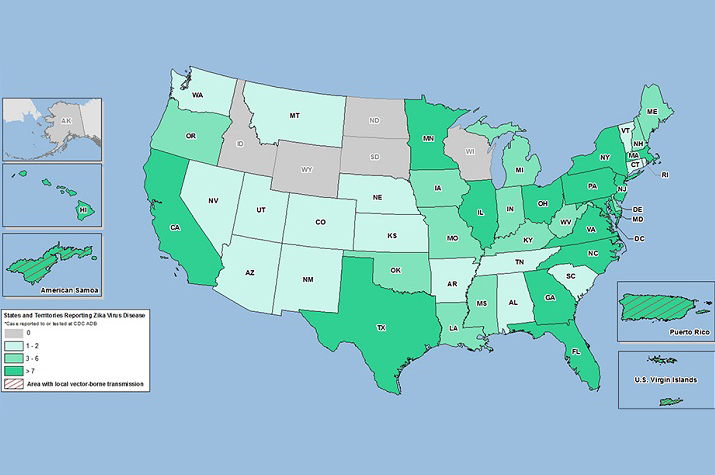
In this map, CDC documents the laboratory-confirmed cases of the Zika virus reported in the United States and U.S. territories.

See All

At a Glance

"A woman's ability to end her pregnancy too often depends on where she lives, her age and how much money is in her pocket."

— Marcela Howell of In Our Own Voice: National Black Women's Reproductive Justice Agenda, discussing ongoing disparities in women's access to abortion care on the 43rd anniversary of Roe v. Wade.

At a Glance

"If women are not free to make decisions about their own lives and health, they are not free. And if women are not free, none of us are."

— Abortion provider Warren Hern, in a STAT News opinion piece on why he continues to offer abortion care despite receiving harassment and death threats throughout his 42-year career.

At a Glance

"Not since before Roe v. Wade has a law or court decision had the potential to devastate access to reproductive health care on such a sweeping scale."

— Nancy Northup, president and CEO of the Center for Reproductive Rights, on a ruling from the 5th U.S. Circuit Court of Appeals that upheld major portions of a Texas antiabortion-rights law.