
National Partnership for Women & Families

In the News

Federal judge rules Mo. may not revoke Planned Parenthood clinic's license

A federal judge on Wednesday ruled that Missouri may not revoke the license of a Planned Parenthood clinic prior to its expiration, saying the state's move to revoke the license likely was motivated by "political pressure," the AP/Sacramento Bee reports (Ballentine, AP/Sacramento Bee, 5/11).

Background

Under Missouri law, abortion clinics are required to meet ambulatory surgical center requirements. To meet those requirements, physicians who provide surgical abortions must have admitting privileges with a nearby hospital.

In 2014, University of Missouri Health Care granted "refer and follow" privileges to Colleen McNicholas, a physician who began providing medication abortions at the Columbia-based Planned Parenthood of Kansas and Mid-Missouri's (PPKM) clinic on Aug. 3, 2015.

In August 2015, conservative state senators and the health department director in Missouri debated at a hearing whether the Columbia clinic met state licensing requirements when it received its license in July 2015. During the hearing, state Sen. Kurt Schaefer (R) -- chair of the Missouri Senate Appropriations Committee, as well as an interim committee investigating Planned Parenthood -- said the clinic failed to meet the ambulatory surgical center standards because the clinic's abortion provider does not have admitting privileges. However, Gail Vasterling, director of DHSS, said the standard does not apply because the clinic only provides medication abortions, not surgical abortions. Physicians at the clinic or the clinic itself would need to obtain admitting privilege requirements only if the clinic started to offer surgical abortion.

Following a unanimous vote by a committee of executive staff, MU Health Care announced that it would cease refer and follow privileges, which permit physicians to provide medication abortions, beginning Dec. 1, 2015.

The Columbia clinic on Nov. 23, 2015, stopped offering abortion care in anticipation of McNicholas losing her privileges. MU interim Chancellor Hank Foley said he would support MU Health Care's decision to end refer and follow privileges. McNicholas currently is seeking other privileges at MU Health Care.

In December 2015, U.S. District Judge Nanette Laughrey issued a ruling that blocks DHSS from revoking the clinic's license until the lawsuit over the clinic's licensure is resolved. In her ruling, she stated that PPKM was subject to unfair treatment because it provides abortion care, and that revoking the clinic's license would cause irreparable harm. The Missouri Attorney General's office appealed the ruling.

Hearing details

At a hearing last week, attorneys representing Planned Parenthood said the court should issue a permanent injunction against state officials because the state's actions were politically motivated and violated state licensure laws and Planned Parenthood's right to due process.

Melissa Cohen, an attorney for Planned Parenthood, added that the state did not give the clinic time to find a physician. She noted that the state had allowed another clinic, the Surgical Center of Creve Couer, several opportunities to address issues when the state sought to revoke that clinic's license. Further, according to Cohen, Planned Parenthood is not requesting for the license to be extended past its expiration date, which is June 30.

James Layton, an attorney with the state attorney general's office, at the hearing said the state had notified the clinic of the license revocation in October and the clinic had not yet proposed a plan for correction (Women's Health Policy Report, 5/3).

Ruling details

In Wednesday's ruling, Laughrey wrote that the department's actions "likely were the result of political pressure being exerted by Missouri legislators and the Department's perception that if it did not act in accordance with the legislature's desires, its budget would be cut."

Laughrey stated that the "disparate treatment" of the clinic "cannot be justified by political pressure or public opposition." Further, she noted differences between the state's handling of the Planned Parenthood case and the state's actions in the only other case where it sought to revoke an ambulatory surgical center's license. She noted that the department gave the other facility time to submit a correction plan and return to compliance before the state acted.

Per Laughrey's ruling, the clinic may keep its license until it expires in June.

PPKM CEO Laura McQuade said the ruling confirms that Missouri "unfairly targeted Planned Parenthood and its staff for providing safe, legal abortion" (AP/Sacramento Bee, 5/11).
Video Round Up

In this clip, WJHG's Matt Galka discusses Florida's decision not to appeal a federal court order currently blocking parts of a state omnibus antiabortion-rights law (HB 1411) from taking effect.

Video Round Up

Marissa Silver, a reporter with Coastal Television's "Your Alaska Link," shares the Alaska Supreme Court's decision to strike down a state law that required a minor's parent to be notified of her decision to seek abortion care.

Video Round Up

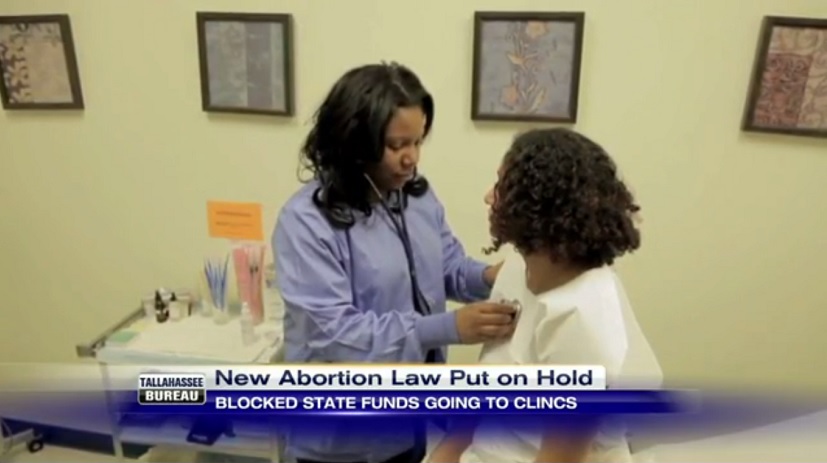
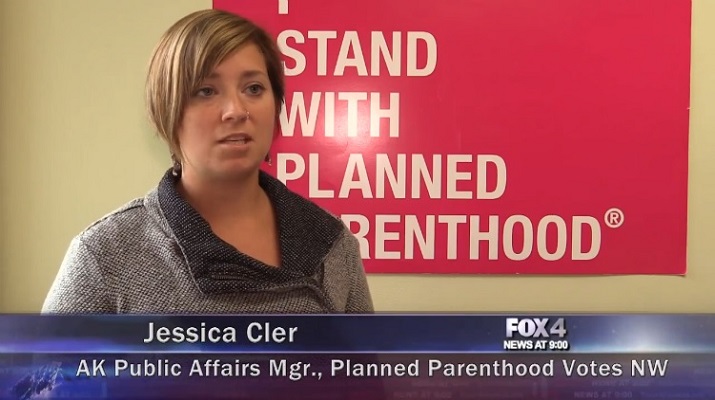
Fox 13's Matt McDonald reports on a ruling by a panel of the 10th U.S. Circuit Court of Appeals that blocks Utah Gov. Gary Herbert (R) from cutting funding to Planned Parenthood.

Video Round Up

Richard Besser, ABC News' chief health and medical editor, discusses a case in which a woman in New York City transmitted the Zika virus to her male partner, the first such occurrence reported in the United States.

Video Round Up

Ryan Braschler of WEHT's "Eyewitness News" covers Indiana University's (IU) lawsuit against fetal tissue restrictions included in an Indiana antiabortion-rights law (HEA 1337).

Video Round Up

WHNT 19 News' Kristen Conner explains what the Supreme Court's ruling striking down two provisions of a Texas omnibus antiabortion-rights law (HB 2) could mean for two antiabortion-rights measures in Alabama.

Video Round Up

KIRO 7's Essex Porter discusses the Supreme Court's decision not to review a 9th U.S. Circuit Court of Appeals ruling that upheld a Washington state regulation requiring pharmacies to dispense emergency contraception (EC).

Video Round Up

In this clip, MSNBC's Rachel Maddow speaks with Nancy Northup, the president and CEO of the Center for Reproductive Rights, about the ramifications of the Supreme Court's ruling in Whole Woman's Health v. Hellerstedt to strike down two contested provisions in Texas' omnibus antiabortion-rights law (HB 2).

Video Round Up

RTV6's Katie Heinz reports on arguments held Tuesday in federal court over an Indiana antiabortion-rights law (HEA 1337) that Planned Parenthood of Indiana and Kentucky has challenged.

Video Round Up

In this short documentary, filmmaker Dawn Porter profiles Yashica Robinson, one of the few physicians in Alabama who provides abortion care.

See All

Datapoints

In this infographic, the Guttmacher Institute tracks recent trends in state abortion laws.

Datapoints

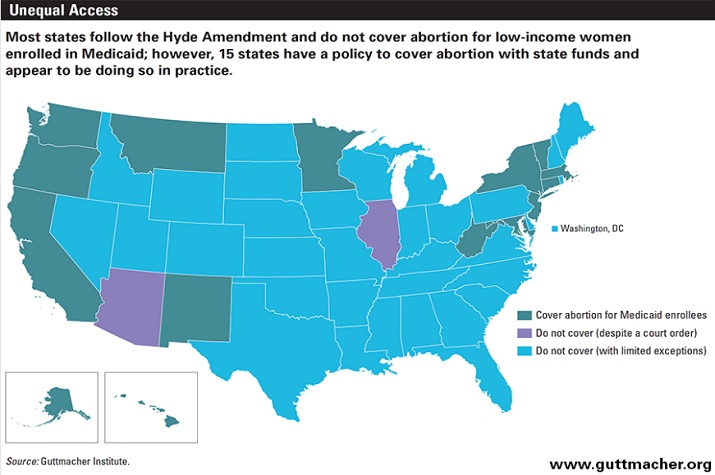
In this map, the Guttmacher Institute highlights the effects of the Hyde Amendment, an appropriations rider that bars federal Medicaid funding from covering abortion care except in the limited cases of rape, incest and life endangerment.

Datapoints

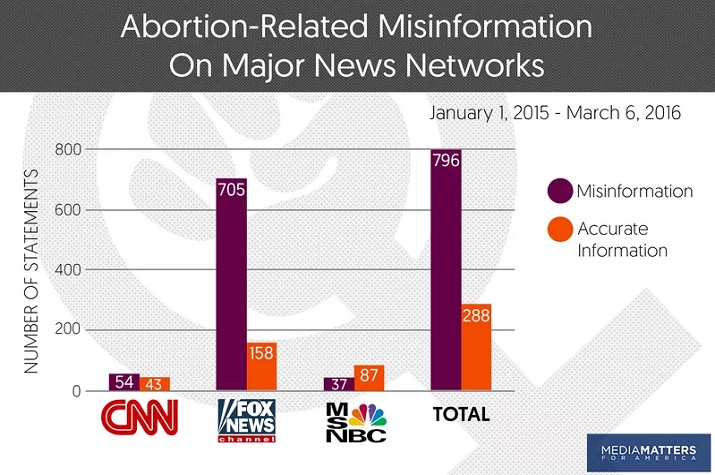
In this chart, Media Matters highlights the findings of a study showing how evening and primetime news programs airing on cable news conveyed more inaccurate than accurate statements about abortion.

Datapoints

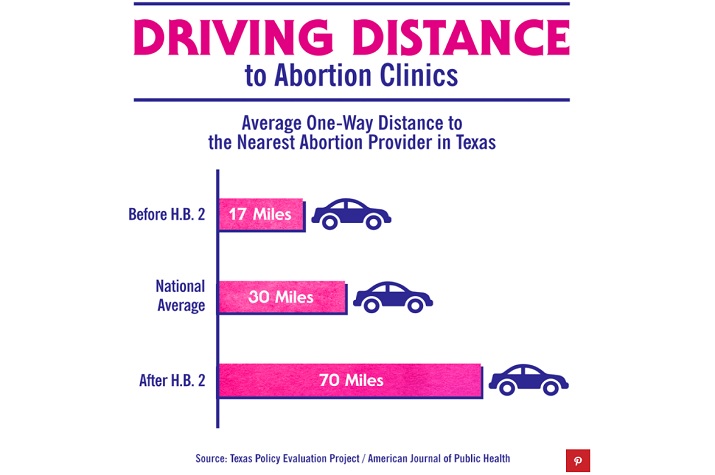
In this gif, Cosmopolitan shares research from the Texas Policy Evaluation Project showing that the average distance a woman in Texas must drive to access the nearest abortion clinic in the state has increased following the implementation of the state's omnibus antiabortion-rights law (HB 2).

Datapoints

In this map, the Kaiser Family Foundation spotlights five states and Washington, D.C., which have each enacted policies designed to facilitate access to contraception.

Datapoints

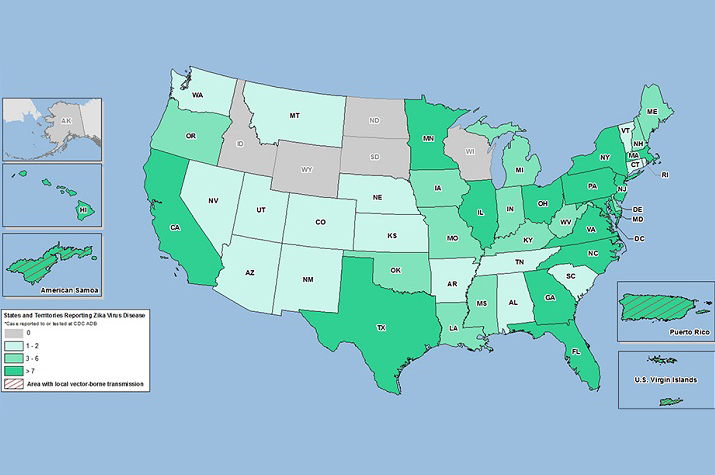
In this map, CDC documents the laboratory-confirmed cases of the Zika virus reported in the United States and U.S. territories.

Datapoints

In this infographic, the Guttmacher Institute highlights research showing how an increasing proportion of women who obtain abortion care in the United States are lower-income.

Datapoints

In this map, the New York Times highlights the regions in the United States where mosquitos carrying the Zika virus -- which has been linked to a fetal brain defect -- are most likely to spread during the upcoming spring and summer seasons.

Datapoints

This map, from the Center for Reproductive Rights (CRR), spotlights abortion laws around the world.

Datapoints

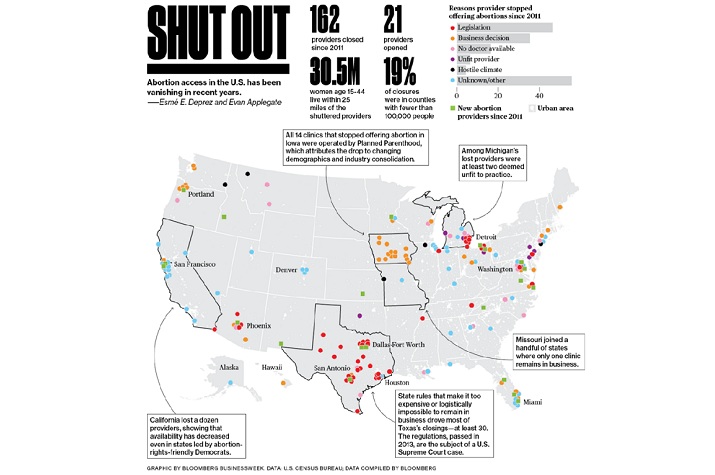
This map, from Bloomberg Business, highlights the rapid decline in abortion access in the United States since 2011.

See All

At a Glance

"A woman's ability to end her pregnancy too often depends on where she lives, her age and how much money is in her pocket."

— Marcela Howell of In Our Own Voice: National Black Women's Reproductive Justice Agenda, discussing ongoing disparities in women's access to abortion care on the 43rd anniversary of Roe v. Wade.

At a Glance

"If women are not free to make decisions about their own lives and health, they are not free. And if women are not free, none of us are."

— Abortion provider Warren Hern, in a STAT News opinion piece on why he continues to offer abortion care despite receiving harassment and death threats throughout his 42-year career.

At a Glance

"Not since before Roe v. Wade has a law or court decision had the potential to devastate access to reproductive health care on such a sweeping scale."

— Nancy Northup, president and CEO of the Center for Reproductive Rights, on a ruling from the 5th U.S. Circuit Court of Appeals that upheld major portions of a Texas antiabortion-rights law.