

Read the best commentaries from bloggers at Huffington Post blogs, Glamour and more.
CRIMINALIZING PREGNANCY:
"Purvi Patel, abortion, and the feticide playbook," Lynn Paltrow, Huffington Post blogs: Paltrow, executive director of National Advocates for Pregnant Women, writes about the case of Purvi Patel, an Indiana woman imprisoned under the state's feticide law for attempting to self-induce an abortion. According to Paltrow, Patel's conviction fits into a larger antiabortion-rights "feticide playbook," in which abortion-rights opponents draft laws "declaring that -- for the purposes of homicide and assault offenses -- a 'person' includes [a fetus] at every stage of gestation from conception until live birth." Abortion-rights opponents pass the laws by claiming "that the law[s] will ensure justice for the loss of fetal life and protect pregnant women against violence," Paltrow writes, explaining that the tactic has resulted in the federal government and 38 states enacting "feticide, unborn victims of violence laws, or expanded murder laws that define the 'unborn' as a person from the moment of fertilization." Paltrow continues, "Once the law is in place, it is only a matter of time before a prosecutor uses the law as a basis for arresting or otherwise punishing a pregnant woman or new mother, not protecting her." She explains that prosecutors "argue that it is hypocritical and unfair to treat fetuses as persons when attacked by third parties but not when they are harmed (or at risk of being harmed) by the pregnant woman herself." According to Paltrow, Indiana officials used this "playbook" against Patel, as have officials in multiple other states where women have been arrested under similar laws, including California, Mississippi, Oklahoma and Utah. Pointing to South Carolina and Alabama, Paltrow also notes that "[p]rosecutors in other states have successfully used the state's feticide law and its protection of the unborn to provide the legal precedent for using other criminal laws to punish pregnant women." She writes, "Pregnant women have been arrested even in states where the feticide law clearly explains that it may not be used to punish the woman herself." She adds that while some state courts "have eventually rejected this feticide bait-and-switch, this is small comfort to women who have spent months or years in jail as their cases worked their way through the criminal court system." Noting that feticide laws "effectively define women who have abortions, experience miscarriages, and stillbirths, or who disagree with a doctor's advice about cesarean delivery as criminals," Paltrow concludes, "Respect for pregnant women requires rejection of new feticide laws and repeal of any that directly or indirectly provide the basis for punishing pregnant women" (Paltrow, Huffington Post blogs, 5/27).
ACCESS TO CARE:
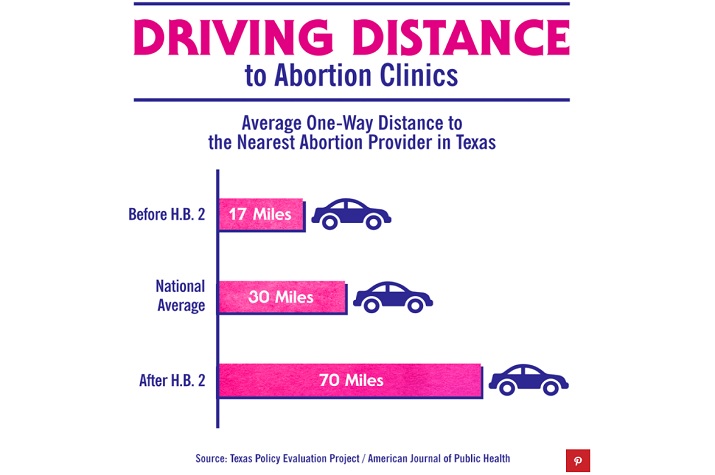
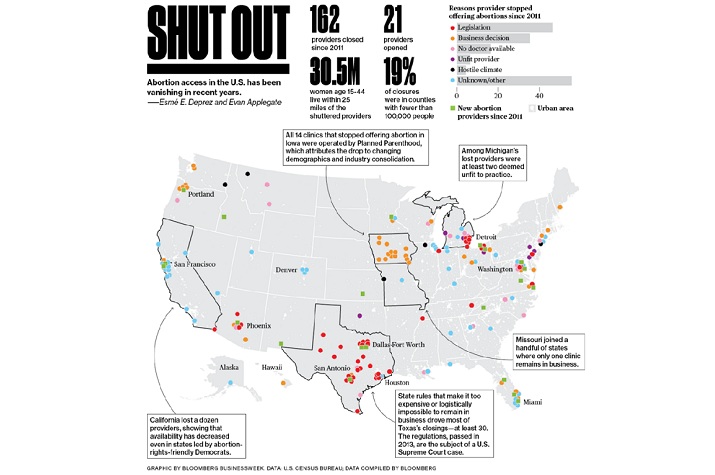
"The rise of the DIY abortion," Phoebe Zerwick, Glamour: As part of a series examining abortion restrictions, Zerwick discusses how and why "more and more women ... are opting for what's being called do-it-yourself abortions." She writes, "In the past five years, highly restrictive Targeted Regulation of Abortion Providers (TRAP) state laws have shut down at least 162 clinics or stopped them from terminating pregnancies, and made both surgical and medica[tion] abortions incredibly expensive and time-consuming in many areas. As a result, some women are taking matters into their own hands, a phenomenon that, experts say, will only become more common if the Supreme Court upholds Whole Woman's Health v. Hellerstedt when the ruling is handed down this summer," a case involving TRAP provisions in Texas' omnibus antiabortion-rights law. Zerwick cites a study that "suggested that up to 240,000 women in [Texas] alone had ... tried to end their own pregnancies." She continues, "And it's not just Texas," noting that out of 15 providers surveyed in over 10 states, "most ... said they knew of women trying to self-induce abortions" and "five had seen patients who had attempted it." Zerwick discussed the issue with experts, who said the methods women use to attempt self-inducing abortion vary, ranging from the use of herbs and supplements "to more extreme measures, like self-injury." According to Zerwick, many women try to obtain an abortion drug called misoprostol either online or in Mexico. However, she notes that while the drug is "100 percent legal ... when prescribed by a doctor," a medically supervised medication abortion also involves the use of mifepristone, a second, more highly regulated drug that increases the effectiveness of the process from about 80 percent to about 97 percent. On the one hand, Zerwick says that some "argue that taking misoprostol at home is actually a practical solution for women with little access to care, a position shared by the World Health Organization." However, she also notes that "[p]ills bought online or through a nonmedical source can be fake or contaminated." In addition, Zerwick notes that many of the providers she spoke with "stressed that most women who end their own pregnancies aren't doing it because it's a more empowered choice; they simply don't have other options." Zerwick questions, "What will that choice look like in 2017? 2027?" She concludes, "Even if the Texas law is struck down, the effort to pass more restrictions won't stop, especially if the next president fills the Supreme Court vacancy with a justice who opposes the right to choose" (Zerwick, Glamour, 5/31).
What others are saying about access to care:
~ "Terrifying (and true) facts about violence against abortion providers," Meredith Clark, Glamour.
TEEN BIRTH RATE:
"The U.S. teen birth rate dropped again in 2015, hitting new all-time low," Christina Cauterucci, Slate's "XX Factor": Improved contraceptive access could be "[o]ne possible -- and eminently logical -- contributing factor" to "the swift waning of the teen birth rate" in the United States, Cauterucci writes. She cites a new CDC study that found the "rate of teenage births in the U.S. fell 8 percent in 2015," which marks the eighth consecutive year it has declined. Specifically, Cauterucci notes that the rate "has dropped 46 percent since 2007 and now stands at 22.3 live births per 1,000 teens aged 15 to 19." She writes, "The Affordable Care Act's [PL 111-148] passage in 2010 made contraceptives free for insured patients, and since the peak of the teen birth rate in the 1990s, many states have enacted policies that allow underage patients to access contraceptives without parental notification," while other states have eased access to long-acting reversible contraception. Although "experts haven't landed on a single explanation" to account for the decline, Cauterucci notes, "[i]mproved access to contraception is a much more likely explanation for the precipitous drop in the teen birth rate than any change in teen sexual activity, which has fallen since the '90s but has remained largely stable since 2007." According to Cauterucci, another potential contributing factor could be "[t]he Obama administration's rollback of funding for abstinence-only sex education ... since those programs have been shown to reduce teens' knowledge of and willingness to use contraception." Citing steep declines in the birth rate among black and Hispanic teens, Cauterucci writes that because of "the proliferation of programs focused on teaching pregnancy prevention to black and Hispanic teens and the concentration of teens of color in metropolitan areas, where comprehensive sex education remains widely available, teens of color have maintained access to information about birth control." However, she notes that "fewer white and rural teens are learning about contraception now than they did six to 10 years ago," concluding, "If U.S. legislators want to maintain our teen-birth decline, they should consider aligning their sex-ed funding provisions with the facts" (Cauterucci, "XX Factor," Slate, 6/2).