

Read the week's best commentary from bloggers at Huffington Post blogs, Care2 and more.
ZUBIK V. BURWELL:
"Access to contraception is a moral issue," Debra Haffner, Huffington Post blogs: When the Supreme Court on Wednesday considers Zubik v. Burwell, the "justices will consider whether religiously affiliated nonprofits, such as Catholic hospitals or religious universities, will be able to use their religion to prevent their female employees or students from being able to access contraception through their health insurance plans," Haffner, president and CEO of the Religious Institute, writes. She explains that the lawsuit is brought by several not-for-profits that hold themselves out as religious, oppose contraception and object to an accommodation to the federal contraceptive coverage rules. According to Haffner, the accommodation allows eligible not-for-profits to "simply sig[n] a form ... to opt out of the contraceptive benefit," which alerts the federal government "that insurance companies should provide contraceptive care directly to [employees of the objecting not-for-profit] without involving the objecting employers." These not-for-profits "clai[m] that their religion is burdened by the act of signing the opt-out form," she writes, but "[t]he reality is that they are claiming this as an undue burden because they disapprove of their employees using birth control." Haffner states, "Religious freedom means each individual has the right to exercise their own beliefs; it cannot mean that an employer has the right to deny its employees the right to exercise their own personal beliefs. All individuals must have the right to accept or reject the principles of their own faith without their employers' objections or legal restrictions." Noting that almost 90 percent of U.S. residents believe using contraception is morally acceptable, Haffner adds that the Religious Institute was among the many religious organizations who "joined the friend-of-the-court brief filed in the Zubik case to highlight the vast numbers of people of faith who support women's access to basic health care, including contraception." Further Haffner states that she believes, "[i]n a just world, all people would have access to contraception." She continues, "Denying women health insurance coverage for family planning services effectively translates to coercive childbearing, and disproportionately hurts low-income women and their children." Haffner writes, "Religious leaders support universal access to family planning because it saves lives, improves health, enhances sexuality, and assures intentional parenthood. I oppose any attempt to restrict or deny access to family planning services and am offended by those who falsely use religious freedom as a way to force their morality on others" (Haffner, Huffington Post blogs, 3/18).
What others are saying about Zubik v. Burwell:
~ "Sometimes nuns need contraceptives, too," Stephanie Mencimer, Mother Jones.
~ "10 things you need to know about the Supreme Court showdown over contraception and religious freedom," Sarah Smith/Nina Martin, Mother Jones.
ABORTION RESTRICTIONS:
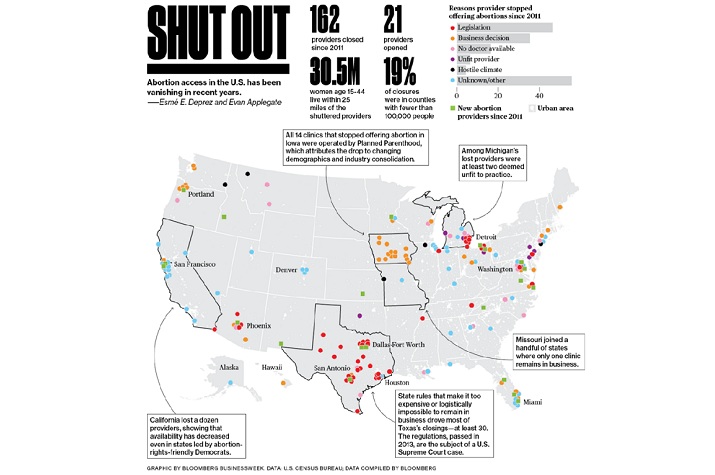
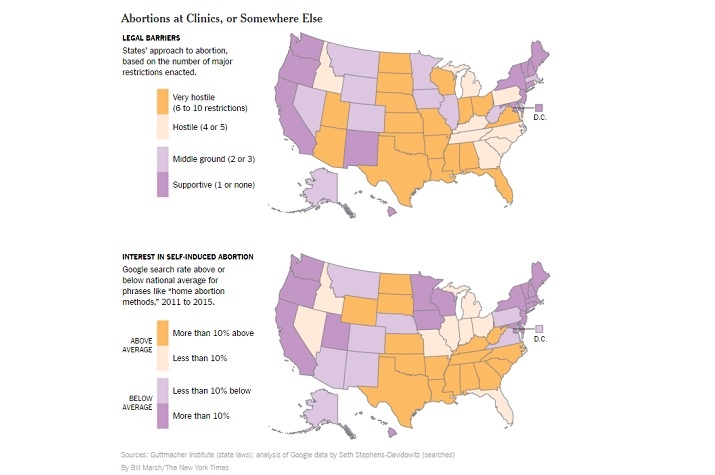
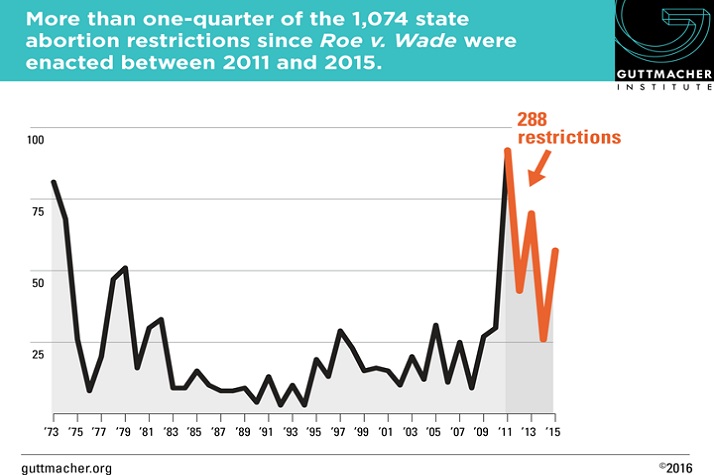
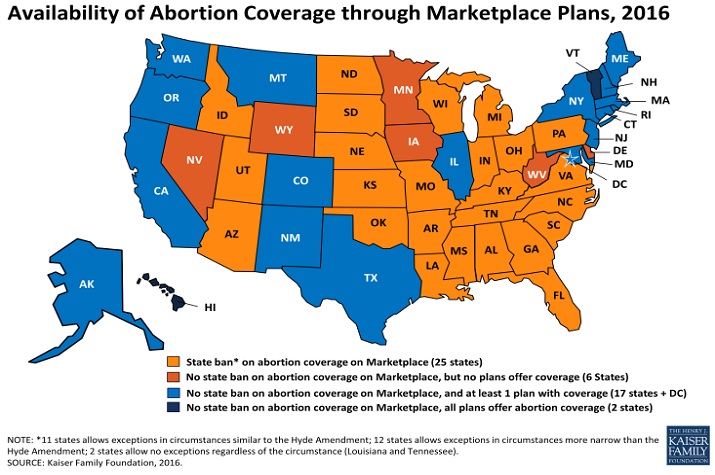
"Two new offensive ways to attack abortion rights," Robin Marty, Care2: Noting that since 2010 more than 200 abortion restrictions have passed in state legislatures, Marty highlights two new types of antiabortion-rights measures that have been proposed in Iowa and Oklahoma. Marty writes that while "Oklahoma has passed many anti-abortion restrictions over the last five years," the latest measure (SB 1552) that "has been progressing through the Oklahoma legislature ... would strip the medical license of any doctor who performed an abortion." According to Marty, "If SB 1552 were to ever be enforced, there would be no doctor who could perform abortions in the state for any reason, either in a clinic, an office, even an emergency in a hospital." She writes, "And there's a certain amazing irony in writing a bill that makes the act of performing a legal medical procedure be a catalyst for losing one's ability to practice medicine at all." Still, the Oklahoma measure is "not the most offensive way offered to stop abortion so far this month," she notes, writing, "In Iowa, one state legislator tried to reclassify abortion as a 'hate crime'" in a proposed amendment to a bill (SF 2284) that would "add gender identity and gender expression to the list of protected classes covered by the state's hate crimes law." Marty notes that even though the Iowa amendment was rejected, and the Oklahoma measure, if ever enacted, would certainly be struck down in the courts, these attempts to restrict abortion care indicate "a new frontier when it comes to attacking the right to terminate a pregnancy" (Marty, Care2, 3/18).
What others are saying about abortion restrictions:
~ "New study shows how Texas law has increased abortion travel distances and costs," Maya Dusenbery, Feministing.
~ "Challenging the stereotype of the 'evil, irresponsible' abortion-seeker," Kathryn Francis, Ms. Magazine blog.
~ "Get your birth control from your dentist, advise Florida legislators who voted to defund Planned Parenthood," Christina Cauterucci, Slate's "XX Factor."
REPRODUCTIVE HEALTH:
"This news about 'tampon tax' is promising -- but it's not enough," Morgan Brinlee, Bustle: In votes "indicative of a growing national movement to remove the taboo around menstruation and eliminate taxes on items nearly half the U.S. population considers a basic necessity," the New York state Assembly and the Chicago City Council last week "both voted unanimously to drop sales tax on tampons and other sanitary products," Brinlee writes. According to Brinlee, "New York is set to become the sixth state to opt out of taxing women for having their period, while advocates hope Chicago's decision to drop the so-called 'tampon tax' will inspire state legislatures to follow suit when a bill exempting feminine hygiene products from state sales tax comes up for vote in the Illinois state Senate later this year." She explains that, if approved, New York's proposal would affect about "10 million women of child-bearing age" by 2017. Under the Chicago measure, the council members voted "to drop the 1.25 percent sales tax levied by the city on tampons and pads and reclassify the feminine hygiene products as 'medical necessities' rather than a luxury 'grooming and hygiene' item, Brinlee writes. She writes that despite the votes in New York and Chicago, "the fight to stop women from being penalized for menstruating isn't being won everywhere," citing a failed effort in Utah and pending legislation in Ohio and Virginia. She notes, "Eliminating sales tax on tampons across the board is a complex proposal because taxes differ state to state." Still, "no matter what legislatures might say, having your period isn't a luxury and bleeding without protection isn't a choice," Brinlee concludes (Brinlee, Bustle, 3/17).
What others are saying about reproductive health:
~ "Endometriosis, social pathologies, and public health," Jhumka Gupta, Huffington Post blogs.