

Read the week's best commentary from bloggers at RH Reality Check, Salon and more.
ABORTION RESTRICTIONS:
"'Sex-selective' abortion bans are offensive and dangerous," Ying Zhang, RH Reality Check: Zhang, a family physician and abortion provider based in Washington state, discusses a recently expired state bill (SB 6612) that "aimed to criminalize doctors who knowingly perform an abortion sought on the basis of the sex of the fetus." She notes that while the measure will not advance further in this legislative session, "it remains concerning that this bill was even a consideration in the first place." Noting that seven other states have passed such legislation, Zhang explains that while supporters claim the laws "are necessary to prevent gender discrimination," the legislation actually "serves as a back-door way of restricting abortion access for women." Such legislation essentially forces physicians "to police patient decision-making," she writes, noting that under the bans, "a simple misunderstanding could result in denial of care for women with language barriers and undermine patients' trust in their physicians and in the health care system." Zhang also notes that such bans are based on false stereotypes about Asian American and Pacific Islander communities, even though U.S. census data show that "more girls are born to Asian-American families than to white families." Moreover, data from states where such bans have been implemented "indicat[e] that the bans did not affect sex ratios at birth." According to Zhang, such bans not only exacerbate barriers that immigrant and refugee communities already face, but they also "set a dangerous precedent for defining which reasons are acceptable for women seeking an abortion, thus opening the door to increasingly specific restrictions that will gradually chip away at care for more and more women." She concludes, "The bottom line is this: A patient's race or ethnicity should have no bearing on her ability to access health care or on a physician's ability to provide quality and compassionate medical services. And 'sex-selective' abortion bans create an unnecessary obstacle to accessing -- and providing -- that care" (Zhang, RH Reality Check, 3/8).
What others are saying about abortion restrictions:
~ "What are herbal abortions? Doctors are speaking out against this incredibly dangerous practice," Lara Rutherford-Morrison, Bustle.
~ "Moderators ignore the anti-choice elephant in the room during Democratic debate," Alex Zielinski, Center for American Progress' "ThinkProgress."
~ "Women are coming to D.C. from Texas and Colorado for abortions," Rachel Kurzius, DCist.
ANTIABORTION-RIGHTS MOVEMENT:
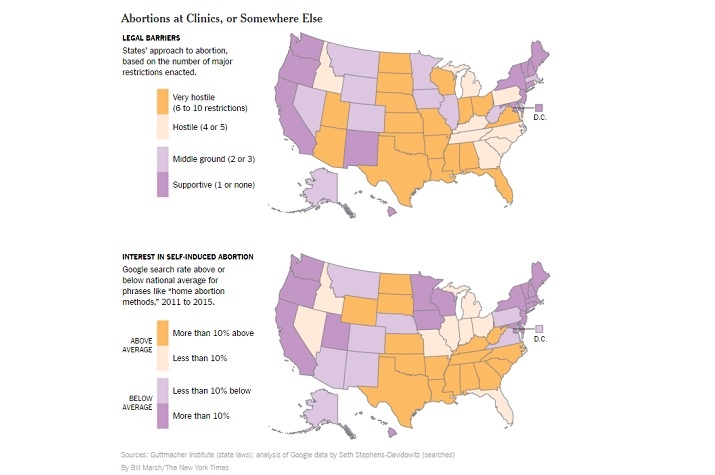
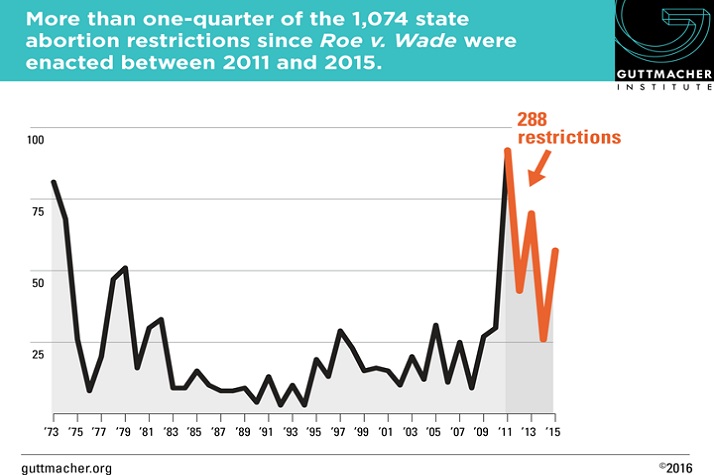
"A warning to the Supreme Court: The true lesson of Kermit Gosnell is that abortion restrictions get women killed," Daniel Denvir, Salon: Antiabortion-rights activists cite the case of Kermit Gosnell as justification for targeted regulation of abortion providers (TRAP laws) that "use the pretext of protecting women's health to shut down abortion clinics," but in reality, low-income women "were driven to Gosnell precisely because anti-abortion advocates have denied them access to affordable procedures," Denvir writes. Denvir explains that Gosnell was a physician who performed illegal abortions while "[s]tate regulators ... looked the other way ... despite repeated complaints." According to Denvir, "In a United States where abortions were available free and on demand, and where comprehensive sexual education and contraception were prevalent, Gosnell's business model would have been a bust." Denvir spoke with advocates and experts following the 2011 grand jury report in the Gosnell case, who explained "how [low-income] women, unable to afford an abortion often delay getting them, scrambling to put together necessary funds as their pregnancy progresses and abortions become more expensive and, ultimately, illegal." At the time, Susan Schewel, executive director of the Women's Medical Fund, said, "'I think that as abortion access becomes narrower and narrower and more and more limited, there will be more and more of these types of providers.'" Pointing to a recent New York Times analysis showing an increase in searches for self-induced abortion, particularly after "2011, when post-Gosnell abortion restrictions first arose," Denvir writes, "It appears that Schewel was right." Calling out contested provisions in Texas' omnibus antiabortion-rights law (HB 2) that would shut down clinics under the guise of health protections, Denvir concludes, "Gosnell's true lesson is that the anti-abortion movement's supposed concern for women's health is a farce. Safe and affordable abortions, incorporated into mainstream medicine, are the best way to save women's lives" (Denvir, Salon, 3/8).
FETAL PROTECTION POLICIES:
"The companies that treated women as wombs," Gillian Thomas, The Atlantic: Thomas draws parallels between CDC's widely criticized guidelines urging women to avoid alcohol unless using birth control, "irrespective of their parenting intentions," and "a landmark Supreme Court case centered on the same idea of wom[e]n as wombs-in-waiting." Thomas writes that the United Auto Workers (UAW) in the 1980s filed a legal challenge against Johnson Controls over "the company's 'fetal-protection policy,'" which prohibited female employees from working "in any area of the company's 16 plants that exposed her to lead" unless she "could prove she was infertile." Thomas notes, "Because the best-paying jobs at Johnson Controls involved lead exposure, the policy amounted to a wholesale demotion for most of the 275 women working for the company, regardless of whether they planned to have children." She writes that UAW in its lawsuit "conceded that lead was dangerous, but faulted the company's solution, which only addressed the harm that might occur to a developing fetus while ignoring lead's damage to men's reproductive organs." According to Thomas, the UAW lawsuit was part of "a growing chorus of women's rights activists challenging similar policies" at other companies, and all of the lawsuits "relied on Title VII of the 1964 Civil Rights Act [PL 88-352], which prohibited discrimination in employment because of race, color, national origin, religion, and sex," including, under a later amendment, "discrimination on the basis of pregnancy." Advocates fighting against these fetal-protection policies also believed that companies, hoping to avoid political controversy over abortion rights, "feared that a female employee would unintentionally conceive, continue to work in a lead-exposed job until she learned of her pregnancy, and then choose to terminate the pregnancy rather than give birth to a potentially impaired baby," Thomas writes. She notes that when the lawsuit finally reached the Supreme Court, it was "unanimously deemed ... a Title VII violation." According to Thomas, the ruling "rested on an ... important principle, one that still bears noting: It takes two to make a pregnancy, and it takes two to make it a healthy one" (Thomas, The Atlantic, 3/8).
SEXUAL HEALTH:
"HPV vaccines are working, so it's time to stop arguing about them," Martha Kempner, RH Reality Check: Although a new study finds that "human papilloma virus (HPV) rates have plummeted in the first six years vaccines against the virus have been available" -- declining by 64 percent among teenage girls and by 34 percent among women in their 20s -- "HPV vaccination rates lag behind those of other recommended inoculations, in part because of the stigma that stifles conversations around sexually transmitted infections [STIs]," Kempner writes. According to Kempner, as of 2014, about 40 percent of teenage girls ages 17 and younger had received the three recommended doses of the HPV vaccine and about 42 percent of young men had been given at least one dose. In contrast, "about eight in ten teens ages 17 and under had received [meningitis] vaccines and roughly 87 percent had received the Tdap vaccine, which covers tetanus, diphtheria, and pertussis," Kempner writes. She lists several possible reasons for the discrepancy in vaccination rates, such as "the fact that only two states and Washington, D.C. require the [HPV] vaccine for school-aged children," parents' lack of "resources or time to take their children to get a series of three vaccinations" and "a discomfort with the sexually transmitted nature of HPV." However, Kempner notes that several "studies have found that HPV vaccines do not, in fact, turn young people into sex machines," citing one that found "girls who have been vaccinated are less likely to engage in risky sexual behavior than those who have not." She writes, "We have a vaccine that prevents cancer, it's working, and that's a major public health victory. It's time to stop arguing about whether vaccinating kids against an ST[I] is a good idea and start protecting everyone" (Kempner, RH Reality Check, 3/9).
ABORTION-RIGHTS MOVEMENT:
"Q&A; with an abortion provider in Pennsylvania: What should people know about your job?" Tara Murtha, Women's Law Project blog: Murtha commemorates Abortion Provider Appreciation Day on March 10 by speaking with Amanda Kifferly, director of patient advocacy for the abortion provider group Women's Centers, about her job. During the interview, Kifferly defines the term "abortion provider," noting that the term "doesn't distinguish between a physician, a telephone advocate or a medical assistant." She says, "It's a great way for us to build a sense of pride and partnership about the work we do, and acknowledge in our own way that it takes a group of talented passionate people to provide the excellent care that we all strive to give." Describing her own position, Kifferly states that it is her responsibility to be "the voice of the patient," helping them to access abortion care by "educat[ing] them on state laws," arranging payment and preparing for potential antiabortion-rights harassment outside the clinic. She adds, "There's a need for someone to be in charge of the advocacy work in navigating what's necessary to schedule an abortion, to help identify the barriers that our patients experience, to identify populations in need within our communities, and what the unique needs of those patients are." Beyond patient-centered work, Kifferly notes that she also works with hospitals to arrange abortion care for patients when the hospital cannot do so, with law enforcement to try to curb antiabortion-rights harassment at the clinics and with a national network of abortion care funds that help patients pay for their care. Kifferly states, "People should know that abortion isn't a separate issue, that it's a part of a woman's spectrum of care, ... that you never know when you may need an abortion or want to have an abortion" and "that you may not have the resources to have an abortion." Noting that her mother had two illegal abortions prior to Roe v. Wade, Kifferly says abortion care "should be easy to access in the same way other healthcare is. That's what motivates me to identify barriers for other people, and makes me so passionate about removing them for our patients" (Murtha, Women's Law Project blog, 3/10).