

Read the week's best commentary from bloggers at Bustle, Slate's "XX Factor" and more.
CLINIC VIOLENCE:
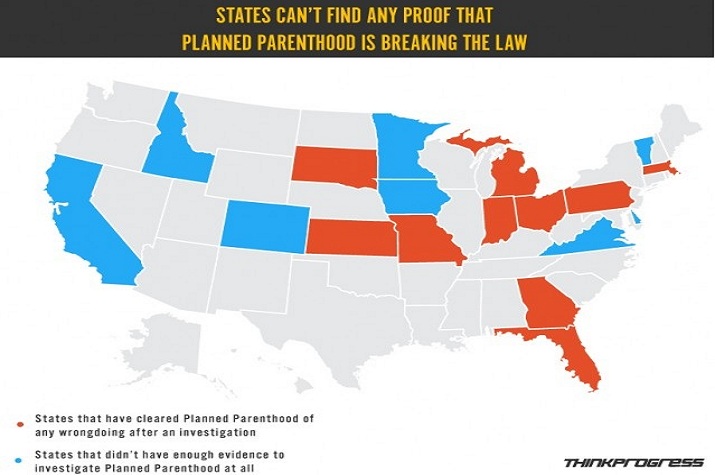
"Anti-abortion violence hit an all-time high in 2015, according to NAF report, and the correlation is hard to miss," Megan Grant, Bustle: Grant writes about a new report from the National Abortion Federation that found "anti-abortion violence hit a record high in 2015, with the number of cases of online hate speech, threats, and violence absolutely skyrocketing." Grant notes that according to the report, instances of online hate speech targeting abortion providers increased from 91 in 2014 to a "staggeringly awful" 25,839 in 2015, while "the number of threats of bodily harm went from one ... to 94" over the same time period. Moreover, while 11 murders have occurred since "NAF started keeping track of violence in 1977, three of them came from the Colorado Springs Planned Parenthood shooting in November of 2015," Grant writes, noting, "That's more than a quarter of the total." Grant continues that according to NAF, "[b]ehind all of these shocking statistics is one common correlation": the release in 2015 of "heavily manipulated" videos targeting Planned Parenthood. Grants notes that not only have several state and federal investigations cleared Planned Parenthood of any wrongdoing, but "unreleased footage showed Center for Medical Progress founder David Daleiden, who created the videos, coaching participants through repeated takes." Daleiden has since been indicted and had his home searched by the California Department of Justice, Grant writes. Noting that the man accused of last year's deadly shooting at a Colorado-based clinic cited the videos, Grant writes that according to the NAF report, "the sharp increase in violence coincided with the release of videos in July of 2015." She continues, "In a year when clinic blockades almost doubled, arson and bomb threats quadrupled, and acts of vandalism multiplied by five, what has been accomplished?" Grant writes that for every time she "hear[s] news of some state giving women more power over their own bodies ... [she] read[s] another article about a different state making access to safe and legal abortion 10 times more difficult." Noting that "NAF's findings are not speculation," bur rather show a direct correlation between the videos and the increase in antiabortion-rights violence, Grant concludes, "[T]he correlation speaks volumes, and it cannot be ignored: Despite the fact that violence is never the answer, it keeps growing -- and it's unacceptable" (Grant, Bustle, 4/7).
What others are saying about clinic violence:
~ "How an anti-vax scientist helped inspired the Planned Parenthood videos," Becca Andrews, Mother Jones.
SEXUALITY EDUCATION:
"Senate bill would require sex ed to be LGBTQ-inclusive, medically accurate," Christina Cauterucci, Slate's "XX Factor": Cauterucci writes about a bill [S 2765], sponsored by Sen. Cory Booker (D-N.J.), that "could drastically improve the sad state of sex education in this country." According to Cauterucci, the Real Education for Healthy Youth Act (REHYA) "would provide funding for sex-ed teacher training and grants for education programs that address the needs of LGBTQ young people." She explains that the measure, originally introduced in 2013 and reintroduced last March, is "the first piece of federal legislation to assert a young person's right to comprehensive education about sexual health that includes information about dating violence, communication and decision-making, sexual assault, sexual harassment, and preventing pregnancy and [sexually transmitted infections]." Noting that "[m]ost U.S. states don't mandate any kind of sex[uality] education, and only 13 states require that the information taught be medically accurate," Cauterucci writes, "Those lax requirements have paved the way for untrained or religiously motivated sex-ed teachers to use bizarre, inaccurate metaphors that imply that sex makes people dirty and unlovable." Further, "[s]ome states even instruct their public-school sex-ed teachers to tell students that gay sex is immoral, against the law, and a surefire way to end up with AIDS," she adds. Cauterucci notes that Booker's measure would not only "provide grants for teacher training and comprehensive sex education programs in K-12 schools and institutions of higher education," but it also "would prohibit the use of federal grants for programs that promote gender stereotypes, suppress information about HIV/AIDS, teach any medically inaccurate information, or do not include accurate, sensitive information for LGBTQ youth and survivors of sexual abuse." Moreover, according to Cauterucci, "REHYA would ... allow schools to use these federal funds for contraception distribution." Pointing to the widespread support for comprehensive sexuality education across demographic groups, and noting that it is "a proven way to prevent new cases of sexually transmitted infections and teen pregnancy in a country that has one of the highest rates of both," Cauterucci concludes, "This bill seems like a no-brainer" (Cauterucci, "XX Factor," Slate, 4/8).
ABORTION-RIGHTS MOVEMENT:
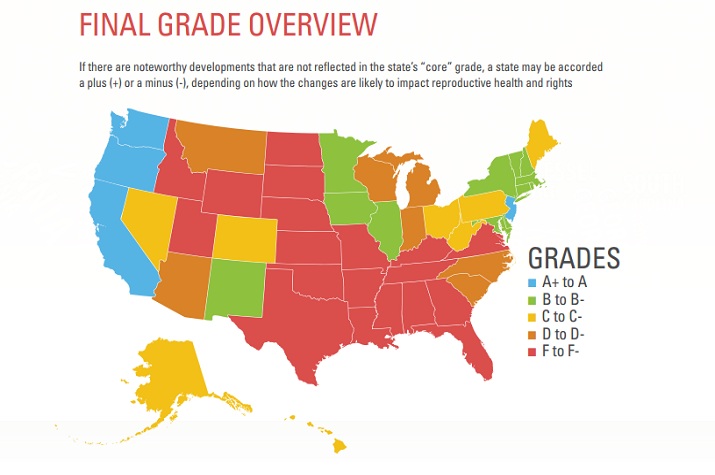
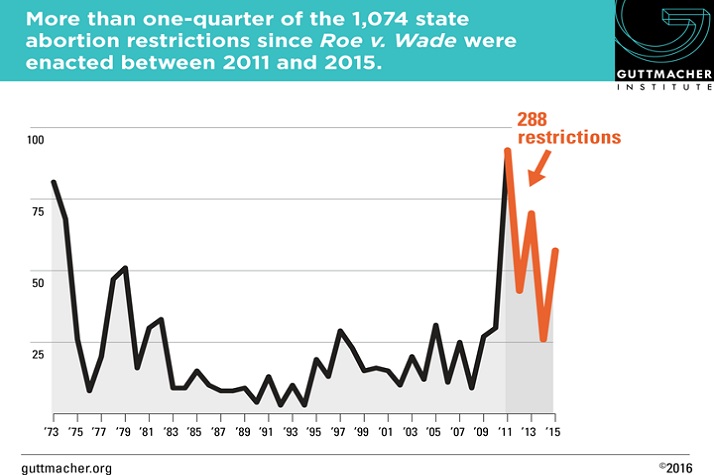
"This one-liner from Cecile Richards captures our feeling on the Republican war on women," Lauren Holter, Bustle: Holter writes about Planned Parenthood Federation of American President Cecile Richard's interview last week with Fusion news anchor Alicia Menendez. According to Holter, Richards during the discussion "summed up her feelings on [conservative lawmakers'] war on women in one simple sentence: 'I'm just honestly so sick of men telling us what to do with our bodies.'" The statement speaks to the "issue of conservative politicians limiting women's access to health care and reproductive services" and "feel[ing] more qualified than women and their doctors to make [women's] health care decisions," Holter writes. She notes that a "total of 396 anti-abortion bills were introduced across the country in 2015, 57 of which were enacted across 17 states, meaning the pervasiveness of [conservative lawmakers targeting women's health care] reaches far beyond the presidential race and even Congress." Holter continues, "[T]he war [conservative lawmakers] have waged on women's rights is really about telling women what to do -- taking away an entire gender's autonomy. While [conservative lawmakers] tout religious and moral reasons for limiting abortion access, it all boils down to this simple principle." This "recent surge of anti-abortion legislation seems to contradict [conservative lawmakers'] basic ideologies of small government and personal privacy," Holter adds, noting, "Nothing's more invasive than deciding what goes on in a woman's uterus." According to Holter, Richards during the interview also demonstrated her frustration with "men think[ing] that they have the right to dictate women's choices" by stating, "'The people of America don't like it when politicians put their own personal politics ahead of people's health.'" Holter concludes, "Above all else, reproductive rights are simply about giving women power over their own lives. No matter how you feel about abortion, feminists can agree that women deserve to decide their own life choices without unsolicited input or prodding from men" (Holter, Bustle, 4/11).
CRIMINALIZING PREGNANCY:
"Pregnancy, drug use, and why prison is not the solution," Marianne Mollmann, Huffington Post blogs: A New Hampshire bill (S 515) that would "redefine opioid use or addiction in 'custodial parents,' including pregnant women, as child abuse is making its way through the legislature, despite vocal objection from the state's medical community," Mollmann, a senior researcher with Physicians for Human Rights, writes. According to Mollmann, the bill comes as state lawmakers "increasingly seek to hold women criminally responsible for not having healthy pregnancy outcomes." She notes that since the start of 2016, "at least eight state legislatures have introduced bills to redefine legal personhood as starting at 'fertilization' or 'conception.'" She explains that while such "personhood" bills are medically unsound and logistically impossible to implement, supporters of "punitive pregnancy-related provisions have ... successfully advocated for the growing surveillance of pregnant women from marginalized or stigmatized communities through social services, and in particular through medical providers." Mollman cites documentation by National Advocates for Pregnant Women that shows a "growing arsenal of state laws that treat drug use and addiction in pregnant women as a form of child abuse." She writes, "Because health care providers in all states must report child abuse to the authorities, this reframing forces doctors and nurses to breach patient confidentiality for pregnant women who admit to struggling with drug use or addiction. The predictable result is a breakdown in the therapeutic relationship at best, and at worst, a reluctance to seek care at all for the women who arguably need it the most." Mollman notes, "Many of these bills are pushed through without consulting the medical community, which is the case for the bill currently pending in New Hampshire," adding that medical professionals are expected to "testify to [the New Hampshire bill's] predictably disastrous effects on the provision of addiction treatment and child welfare." She explains that while "both child abuse and drug addiction are serious matters, which require appropriate state support," efforts to "redefine drug use or addiction as child abuse in pregnant women ... disregard the medical and psychological needs of both abused children and pregnant women." Mollman contends, "Advocates of such legislation are attempting to transform the fiction of fetal personhood into law by appropriating the problem of child abuse and punishing pregnant women in need of treatment for substance dependency or addiction." She concludes, "Whether the conversation is about ... abortion, treatment for substance use disorder, or any other medical intervention, decisions about care are best made by the patient in private consultation with her doctor" (Mollman, Huffington Post blogs, 4/11).