
National Partnership for Women & Families

In the News

SCOTUS halts enforcement of La. admitting privileges requirement

The Supreme Court on Friday issued an order temporarily halting enforcement of an admitting privileges requirement in a Louisiana law (Act 620), the New York Times reports (Liptak, New York Times, 3/4).

According to the Los Angeles Times, the order allows two Louisiana clinics, located in Bossier and Baton Rouge, to resume providing abortion care after they temporarily suspended such care under the law (Savage, Los Angeles Times, 3/4).

Louisiana case background

The law requires abortion providers in the state to have admitting privileges at hospitals within 30 miles of the facility where they practice. Abortion clinics in Shreveport, Bossier City and Metairie filed suit against the law in August 2014.

In March 2015, former Louisiana Gov. Bobby Jindal's (R) administration asked U.S. District Judge John deGravelles to dismiss parts of the suit, arguing that the court should throw out the clinics' claims that the law constitutes a "medically unreasonable" requirement and that lawmakers intended for the law to reduce abortion access.

Ilene Jaroslaw -- an attorney for the Center for Reproductive Rights (CRR), which is representing the plaintiffs -- argued that case law is not settled on such issues and that the claims should be considered during the trial. She added that dismissing those claims would reduce the ability of the facilities to provide the court with medical evidence that could show that the admitting privileges measure restricts abortion access "with no obvious benefits to women's health."

In May 2015, deGravelles dismissed some claims, ruling that while the law could have a rational basis, it could put too great a burden on women trying to access abortion in the state. In early 2016, deGravelles ruled that the admitting privileges requirement is unconstitutional and finalized a preliminary injunction barring the enforcement of the requirement. DeGravelles has not yet issued a ruling on the law itself.

The state appealed the ruling to the 5th U.S. Circuit Court of Appeals, which blocked deGravelles' temporary injunction on the law and allowed it to take effect while it is being challenged. The abortion clinics filed an emergency appeal in response, asking the Supreme Court to block the 5th Circuit's ruling and noting that only one clinic in the state would be able to remain open if the law was permitted to take effect (Women's Health Policy Report, 2/29).

Details of SCOTUS injunction

The Supreme Court did not state a reason for the injunction. However, the high court noted that the hold was "consistent with its action to grant a stay" in a challenge to a Texas law (HB 2) that imposes similar regulations on abortion providers.

The Supreme Court heard oral arguments in the Texas case, Whole Woman's Health v. Hellerstedt, last week (Los Angeles Times, 3/4). Whole Woman's Health centers on two provisions of HB 2. One requires abortion clinics in the state to meet the same building standards as ambulatory surgical centers, and the other requires abortion providers to have admitting privileges at local hospitals (Women's Health Policy Report, 3/3).

According to the New York Times, Friday's order suggests that the high court will keep the Louisiana admitting privileges rule on hold until it rules on the Texas lawsuit (New York Times, 3/4). The high court is expected to release its decision in Whole Woman's Health in late June (Los Angeles Times, 3/4).

CRR, La. abortion clinic praise hold

Regarding the order to halt the Louisiana law, CRR CEO Nancy Northup said, "For the third time in a little over a year, the Supreme Court has stepped in to preserve women's ability to get the constitutionally protected health care they need."

She added, "Just two days after arguing our case before the Supreme Court to strike down a similar sweeping law in Texas, we look to the Justices to put an end to these sham measures threatening women's rights, health and lives across the [United States]" (Barnes, Washington Post, 3/4).

Separately, Kathaleen Pittman -- administrator for Hope Medical Group for Women, the abortion clinic located in Shreveport, Louisiana -- said she was "delighted" with the order. Pittman said she was not sure the Shreveport clinic would have been able to stay open after trying to accommodate all the patients diverted from the two clinics that shut down under the law's temporary enforcement. "We were having to delay care because there was no way for us to handle all this," she said (Los Angeles Times, 3/4).

Video Round Up

Broadly shares a behind-the-scenes clip from "Across the Line," a virtual reality documentary that uses video and audio recordings from antiabortion-rights protests at U.S. clinics to show viewers what many women experience when trying to access abortion care.

Video Round Up

In this clip, RTV6's Katie Heinz discusses a new social medial campaign launched in reaction to a harmful Indiana law (HB 1337) that bans abortion care based on the sex of the fetus or a fetal disability diagnosis, among other restrictions.

Video Round Up

In this clip, Fox 17 News' Michele DeSelms covers legislation (HB 4787, HB 4830) passed last week in the Michigan House that would penalize individuals who coerce a woman into receiving an abortion.

Video Round Up

In part of a longer clip covering multiple topics, Reuters TV reports on an omnibus antiabortion-rights measure (HB 1411) recently signed into law by Florida Gov. Rick Scott (R) that bars local health departments from distributing funds for non-abortion-related care to organizations affiliated with abortion providers, among several other provisions.

Video Round Up

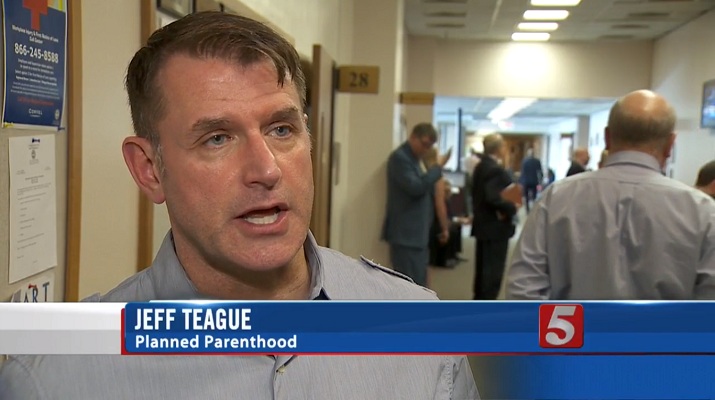
WTVF's Chris Conte reports on the outcome of a Tennessee House subcommittee hearing, which advanced one antiabortion-rights bill while deferring or withdrawing several others.

Video Round Up

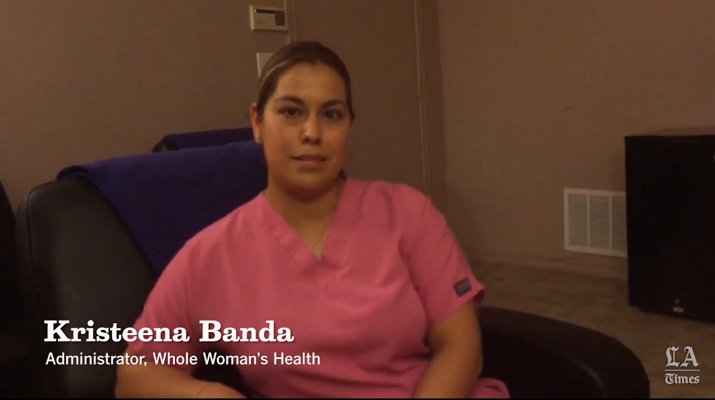
In this clip, Los Angeles Times reporter Molly Hennessy-Fiske hears from Kristeena Banda -- a clinic administrator at Whole Woman's Health, an abortion clinic in McAllen, Texas -- about what is at stake in a legal challenge to parts of Texas' omnibus antiabortion-rights law (HB 2).

Video Round Up

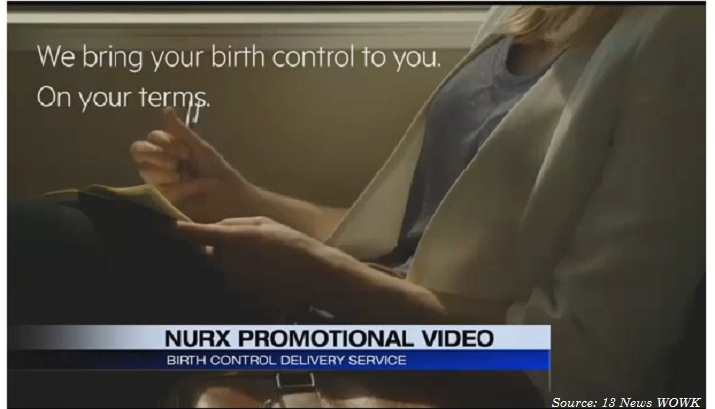
13 News WOWK reporter Alyssa Meisner interviews several women in West Virginia about Nurx, a smartphone application that helps women access birth control.

Video Round Up

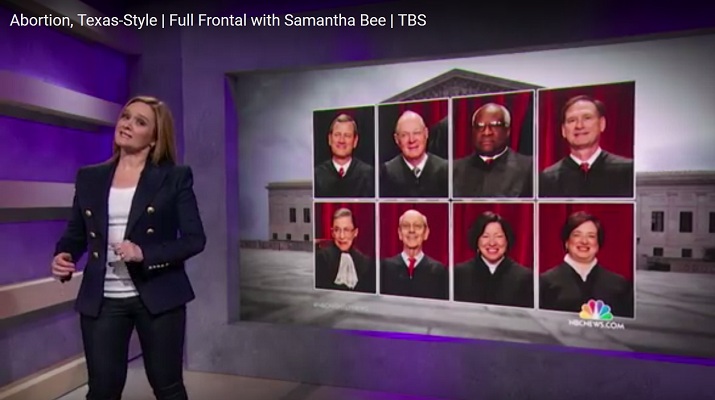
In a segment on HB 2, comedian Samantha Bee interviews Ilyse Hogue, president of NARAL Pro-Choice America, and Texas Rep. Dan Flynn (R), one of the bill's authors, for TBS' "Full Frontal with Samantha Bee," Vox reports.

Video Round Up

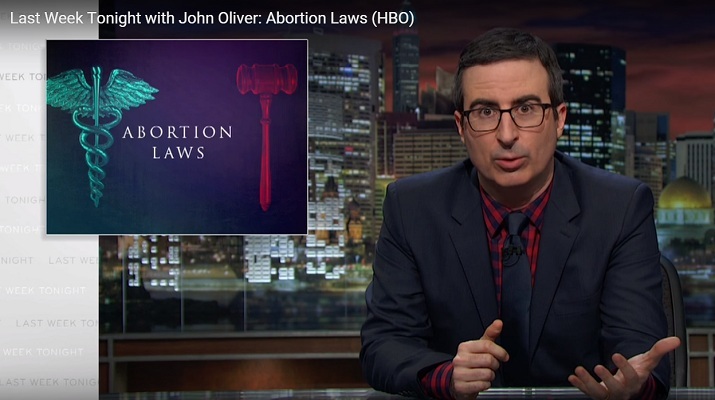
John Oliver on HBO's "Last Week Tonight with John Oliver" discusses the proliferation of attacks on abortion rights in the United States and comments on how such restrictions affect a woman's access to abortion care.

Video Round Up

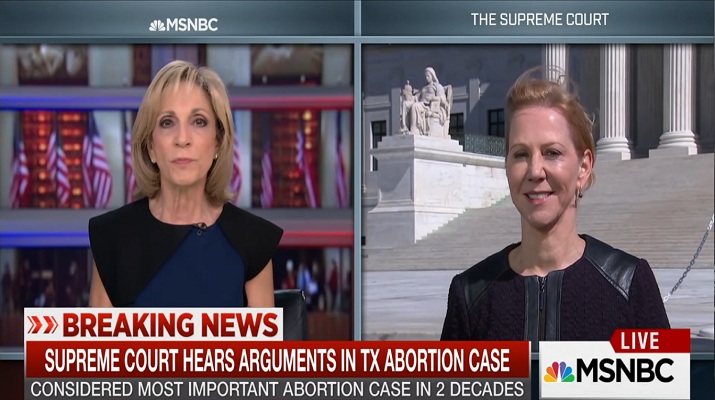
MSNBC's Andrea Mitchell hears from Nancy Northup, president of the Center for Reproductive Rights, about oral arguments before the Supreme Court in a case challenging provisions of Texas' omnibus antiabortion-rights law (HB 2).

See All

Datapoints

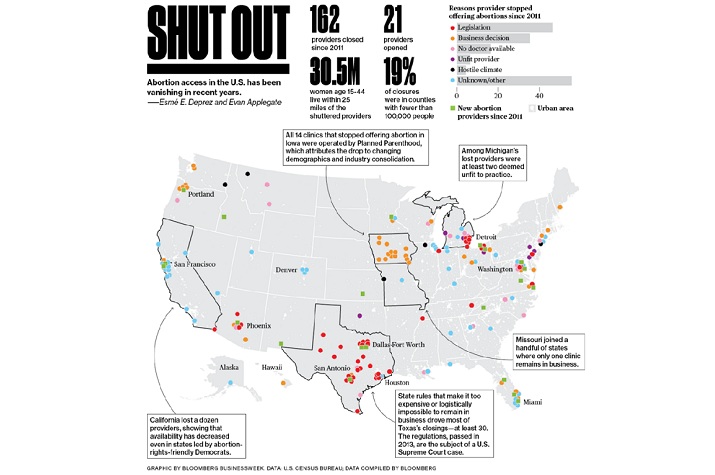
This map, from Bloomberg Business, highlights the rapid decline in abortion access in the United States since 2011.

Datapoints

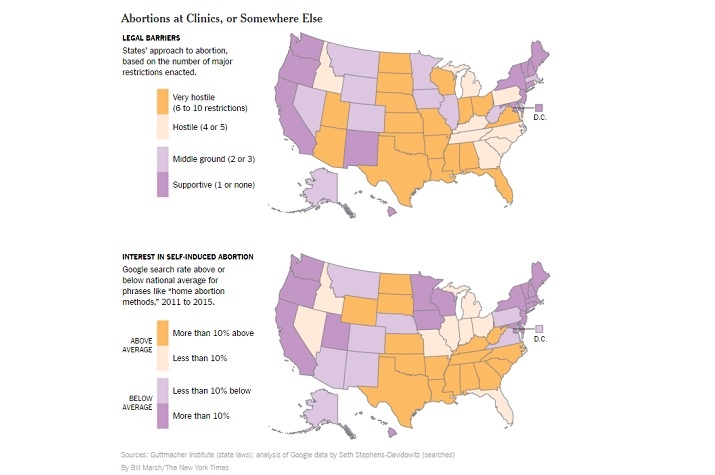
These maps, compiled using data from the New York Times and the Guttmacher Institute, underscore findings from a recent Times investigation, including that there were more than 700,000 searches for how to self-induce an abortion in 2015.

Datapoints

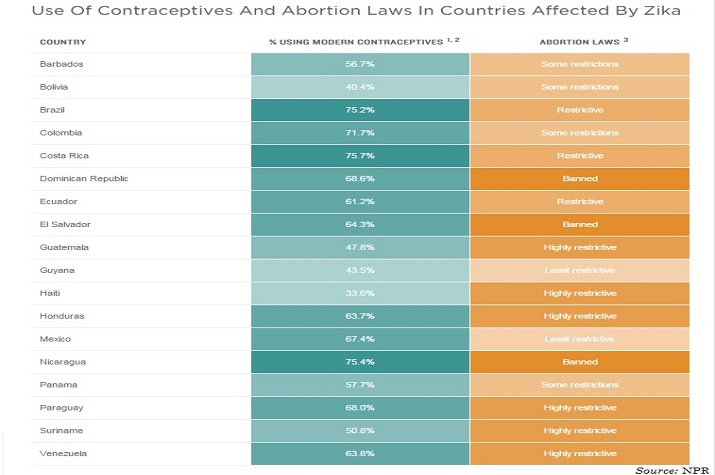
This chart, compiled by NPR, shows how the majority of countries affected by the Zika virus, which might be linked to a severe birth defect, curb access to contraception and abortion care.

Datapoints

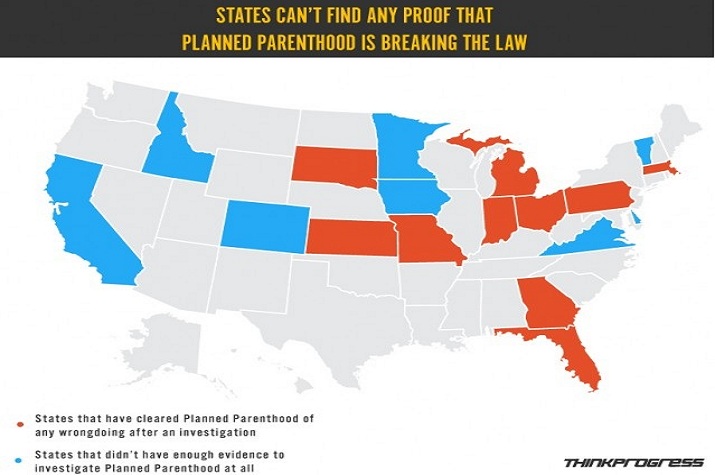
In this map, Center for American Progress' "ThinkProgress" spotlights the 12 states that have cleared Planned Parenthood of any wrongdoing after launching investigations into the organization.

Datapoints

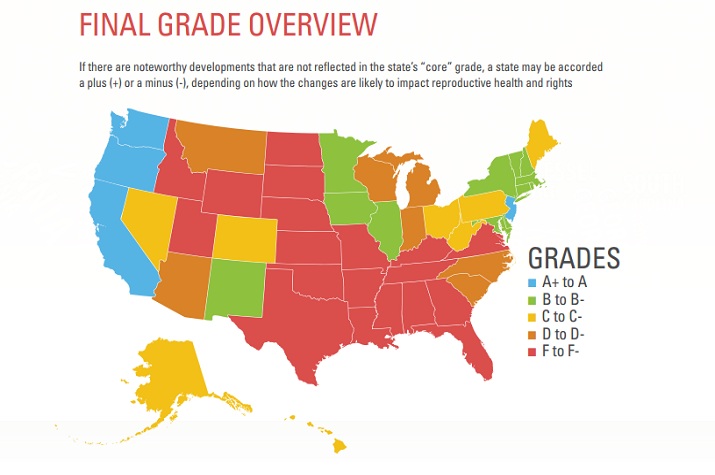
In its latest report card, the Population Institute provides a snapshot of the condition of reproductive rights and health in each state in 2015.

Datapoints

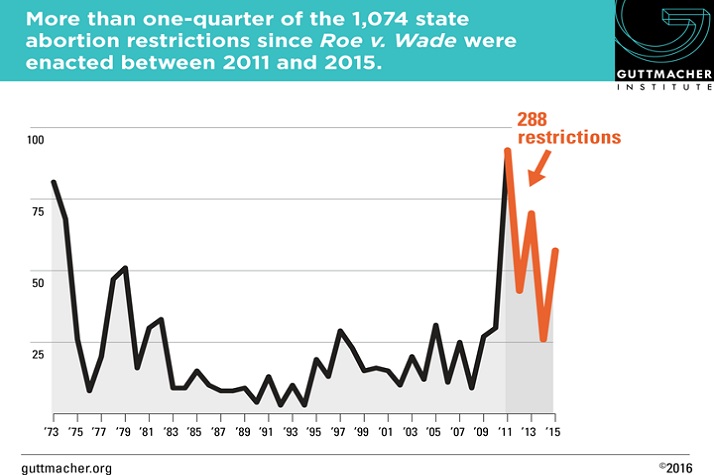
The Guttmacher Institute in this graph shows the rapid increase in the number of state abortion restrictions over the past few years.

Datapoints

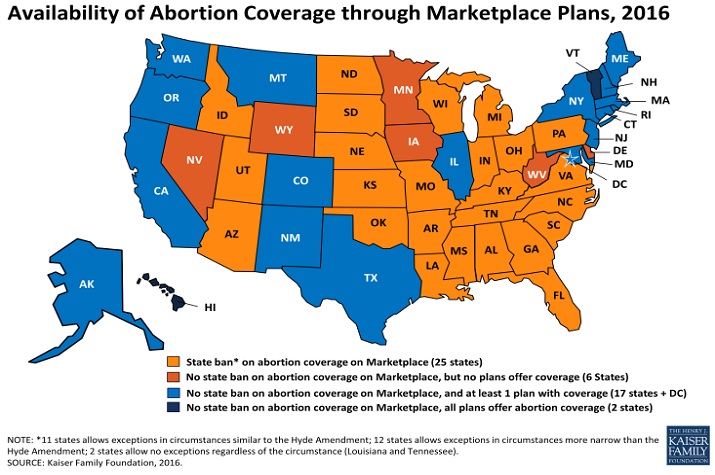
In this map, the Kaiser Family Foundation shows how widely abortion coverage varies from state to state in insurance plans sold through the Affordable Care Act's (PL 111-148) insurance marketplaces.

Datapoints

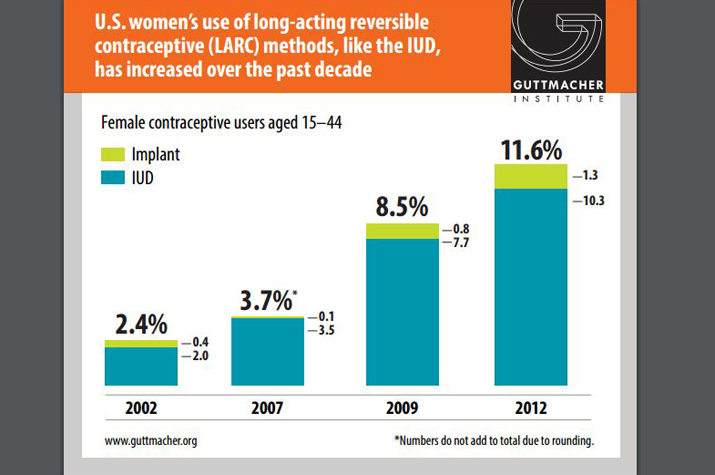
This infographic, released with a new Guttmacher Institute study, shows the increase in use of long-acting reversible contraception among U.S. women between 2002 and 2012.

Datapoints

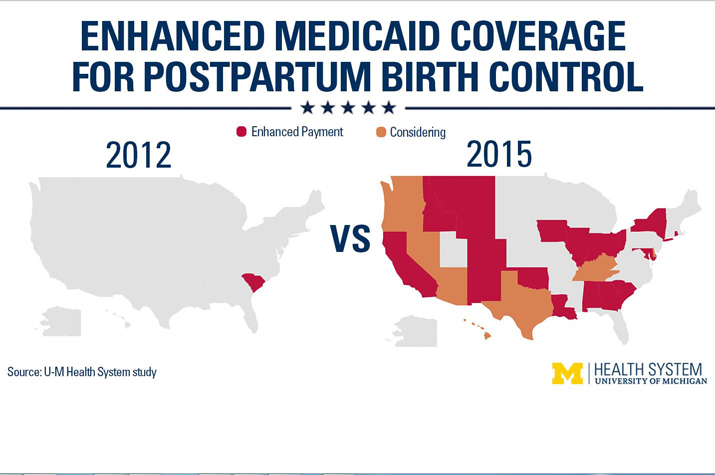
This map, released with a study from the University of Michigan Health System, shows how an increasing number of state Medicaid programs over the last three years are providing reimbursement for immediate postpartum LARC provision.

Datapoints

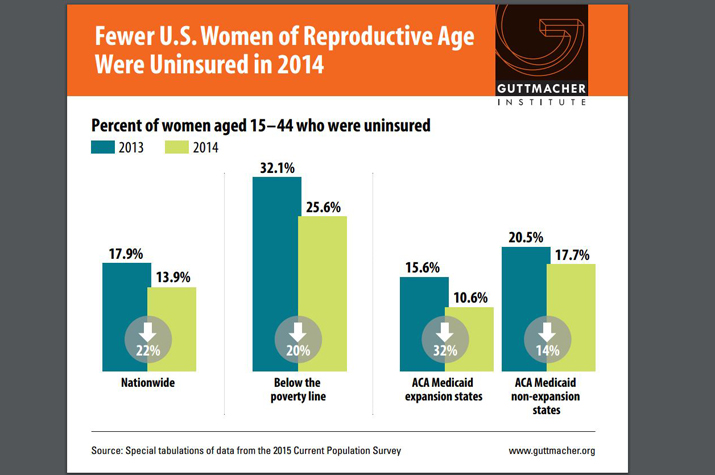
In this infographic, the Guttmacher Institute shows how the proportion of uninsured reproductive-age women in the U.S. declined from 17.9% in 2013 to 13.9% in 2014, the first year in which the Affordable Care Act was implemented fully.

See All

At a Glance

"A woman's ability to end her pregnancy too often depends on where she lives, her age and how much money is in her pocket."

— Marcela Howell of In Our Own Voice: National Black Women's Reproductive Justice Agenda, discussing ongoing disparities in women's access to abortion care on the 43rd anniversary of Roe v. Wade.

At a Glance

"If women are not free to make decisions about their own lives and health, they are not free. And if women are not free, none of us are."

— Abortion provider Warren Hern, in a STAT News opinion piece on why he continues to offer abortion care despite receiving harassment and death threats throughout his 42-year career.

At a Glance

"Not since before Roe v. Wade has a law or court decision had the potential to devastate access to reproductive health care on such a sweeping scale."

— Nancy Northup, president and CEO of the Center for Reproductive Rights, on a ruling from the 5th U.S. Circuit Court of Appeals that upheld major portions of a Texas antiabortion-rights law.