

Summary of "Declines in unintended pregnancy in the United States, 2008-2011," Finer/Zolna, New England Journal of Medicine, March 3, 2016.
"The rate of unintended pregnancy in a population is a central measure of reproductive health," linked to both individual autonomy and overall public health outcomes, according to the Guttmacher Institute's Lawrence Finer and Mia Zolna.
The researchers wrote that while "the rate of unintended pregnancy in the United States decreased between the late 1980s and the mid-1990s, it plateaued by 2001 and increased slightly between 2001 and 2008, the most recent year for which estimates are available." According to the researchers, the unintended pregnancy rate is "substantially higher" in the United States than in other "highly industrialized regions." For the study, the researchers assessed "U.S. data on pregnancy intentions, released in December 2014 by the National Center for Health Statistics (NCHS) to calculate the incidence of unintended pregnancy in 2011."
Methods
The researchers compiled data on "U.S. births, miscarriages, and abortions reported or estimated in 2011 and 2008" through several sources. They collected data on pregnancy and miscarriage from NCHS's National Survey of Family Growth (NSFG) and data on medication and surgical abortion care from the Guttmacher Institute's "periodic census of all known abortion providers."
The researchers collected information on a woman's pregnancy intentions, defined as a woman's "desire to become pregnant right before each pregnancy occurred," from nationally representative retrospective surveys. The researchers categorized a pregnancy as:
- Mistimed, if a woman who became pregnant "reported that she did not want to become pregnant at the time the pregnancy occurred, but wanted to become pregnant in the future";
- Unwanted, if a woman who became pregnant "reported that she did not want to become pregnant then or at any time in the future";
- Unintended, if the pregnancy was "mistimed or unwanted"; and
- Intended, if the pregnancy "was one that was desired at the time it occurred or sooner."
According to the researchers, "The percentages of births and miscarriages that resulted from unintended pregnancies were calculated from the 2011-2013 NSFG," while the "percentages of abortions that followed unintended conceptions were calculated from the 2008 Abortion Patient Survey."
The researchers categorized a woman whose income was below 100 percent of the federal poverty level as "poor," and a woman whose income was between 100 and 199 percent of the federal poverty level as "low-income."
Results
The study found that there were 6.1 million pregnancies in 2011, of which 2.8 million (45 percent) were unintended. In contrast, 51 percent of pregnancies in 2008 were unintended. The researchers wrote, "There were 45 unintended pregnancies for every 1000 women and girls 15 to 44 years of age in 2011, as compared with a rate of 54 per 1000 women and girls 15 and 44 years of age in 2008, which corresponds to an 18% decline over this period." According to the researchers, "This was the first substantial decline since at least 1981."
The researchers also noted that the intended pregnancy rate increased slightly, from 51 to 53 per 1000 reproductive-age women and girls, which meant that the overall pregnancy rate in the United States declined from 106 to 98 per 1,000 reproductive-age women.
According to the researchers, 42 percent of unintended pregnancies, not including miscarriages, ended in abortion in 2011, a minor change from the 40 percent recorded in 2008. The birth rate resulting from unintended pregnancies decreased from 27 to 22 per 1,000 reproductive-age women and girls between 2008 and 2011.
Findings for population subgroups
The researchers found that "almost every demographic group [they] examined" experienced a decline in the rate of unintended pregnancies.
However, the researchers noted that while all age groups experienced a decline in the unintended pregnancy rate, "the highest rate of unintended pregnancy in 2011 was seen among women 20 to 24 years of age, followed by women 18 to 19 and women 25 to 29 years of age." According to the study, the abortion rate did not substantially vary among age groups, "although the percentage increased between 2008 and 2011 among girls 15 to 17 years of age." As a result, the researchers wrote, the birth rate among age groups reflected the unintended pregnancy rate, "with the highest rates observed among women 18 to 29 years of age and declines in every age group."
The researchers also found that the unintended pregnancy rate varied by women's relationship status, with married women in 2011 reporting the lowest unintended pregnancy rate. Women who were unmarried but living with their partner reported an unintended pregnancy rate nearly four times as high as the rate among married women. According to the researchers, "[T]he rate declined sharply between 2008 and 2011 among women who were cohabitating and to a lesser extent among those who were married or never married; those who were formerly married were the only group that had an increase in the rate of unintended pregnancy between 2008 and 2011." The study found that married women experiencing an unintended pregnancy were significantly less likely than unmarried women experiencing an unintended pregnancy to decide to have an abortion.
The study also "found a strong inverse association between both income level and educational attainment and the rate of unintended pregnancy," even though the unintended pregnancy rate decreased "between 2008 and 2011 in every income and education group," particularly among poor women and those without a high school degree. The researchers wrote that as a result, the overall disparity in the unintended pregnancy rate among income and education groups narrowed between 2008 and 2011. However, despite these declines, the researchers found that "[i]n addition to having higher rates of unintended pregnancy, poor and less-educated females were less likely to have induced abortions to end unintended pregnancies; as a result, the income and education disparities in the rate of unintended pregnancies that ended in birth were even greater than the disparities in the unintended pregnancy rate."
Similarly, the researchers noted that while the unintended pregnancy rate also declined among all racial and ethnic groups between 2008 and 2001, there still were "substantial disparities in the rates of unintended pregnancy in 2011 according to race and ethnic group, even after income was accounted for." According to the researchers, the largest decrease in the unintended pregnancy group among racial and ethnic groups was among Hispanic women. Meanwhile, "the percentage of unintended pregnancies [in 2011] that ended in abortion was highest among blacks, and the rate of birth resulting from unintended pregnancies was lower among whites than among both blacks and Hispanics," the researchers wrote.
The study also found that the unintended pregnancy rate and the birth rate resulting from unintended pregnancies "declined between 2008 and 2011 among women and girls of every religious affiliation assessed." According to the researchers, "In both years, these rates were highest among mainline Protestants and among those with no religious affiliation."
The researchers said the declines in the unintended pregnancy rate among all demographics -- the greatest of which "were noted among women 20 to 24 years of age, poor and low-income women and girls, and Hispanics" -- marks "a change in the overall pattern since 1981."
Discussion
According to the researchers, "The rate of 45 unintended pregnancies per 1000 in 2011 was the lowest level seen in at least three decades," affecting nearly all demographic groups and marking the end of "a long period of minimal change."
While the study did not examine "factors that might explain the decline ... several possible factors should be considered," the researchers wrote. They stated that the decline likely is not closely related to changes in sexual behavior or "[c]hanges in the composition of the population," although it may be related to a "[c]hange in the desire for pregnancy," as research shows women in 2009 indicated they planned to reduce or delay pregnancy because of "changing economic conditions."
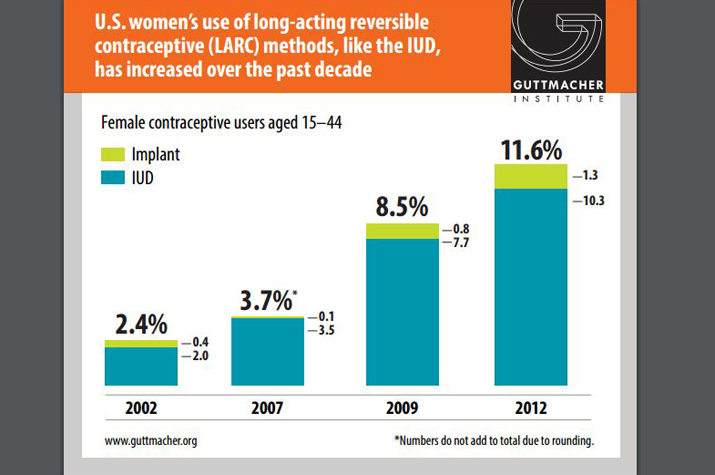
However, the researchers wrote that the "likely explanation for the decline ... is a change in the frequency and type of contraceptive use over time." They explained that research "shows that the overall use of any method of contraception among women and girls at risk for unintended pregnancy increased slightly between 2008 and 2012." More importantly, "the use of highly effective long-acting methods, particularly intrauterine devices, among U.S. females who used contraception increased from 4% to 12% between 2007 and 2012, and this increase occurred in almost all demographic groups." The researchers cited another study showing that "women and girls at high risk of unintended pregnancy who had free access to and used highly effective methods of contraception had much lower rates of unintended pregnancy than did those who used other methods."
According to the researchers, despite declines in the unintended pregnancy rate among demographic groups, "large disparities were still present in 2011." In particular, they wrote that "poor, black, and Hispanic women and girls continued to have much higher rates of unintended pregnancy than did whites and those with higher incomes." Pointing to the lower unintended pregnancy rate among all women in Western Europe, which is comparable to "the rate associated with higher incomes in the United States," the researchers wrote, "Much more progress can be made in eliminating ... disparities" in the United States.
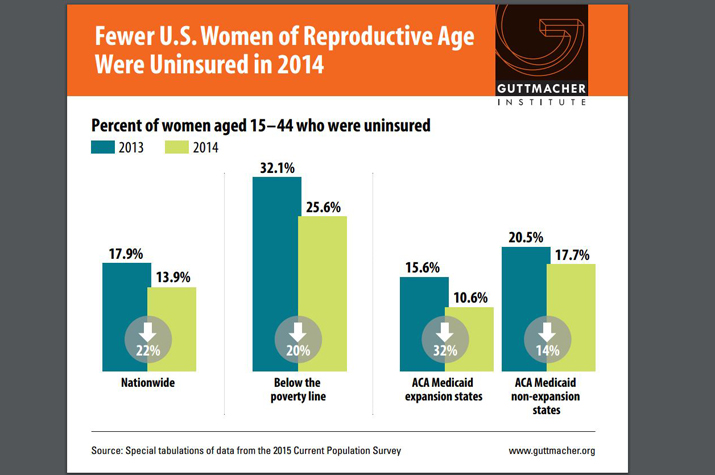
The researchers noted that the study findings "preceded the implementation of several provisions in the Affordable Care Act that should improve coverage for contraceptive services," which could further decrease the unintended pregnancy rate if the "provisions lead to greater use of contraception overall or to increased use of highly effective methods among those who want them."
The researchers concluded by noting that although their findings "show a substantial decline in the rate of unintended pregnancy in the United States between 2008 and 2011, to a historic low ... [N]early half of all pregnancies in 2011 were still unintended, and major disparities remained among women and girls according to socioeconomic status and race and ethnic group."