

Summary of "Impact of clinic closures on women obtaining abortion services after implementation of a restrictive law in Texas," Gerdts et al., American Journal of Public Health, May 2016.
"Recent studies have reported the effects of state-level abortion restrictions on abortion rates, out-of-state travel for abortion, and the consequences for women of being denied a[n] ... abortion because of clinic gestational age limits, but less is known about the burdens that women experience as a result of clinic closures," according to Caitlin Gerdts of Ibis Reproductive Health and colleagues.
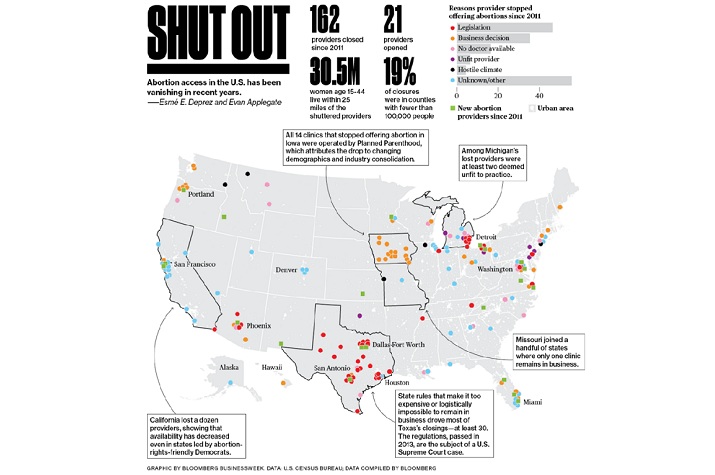
The researchers pointed to the clinic closures in Texas following partial implementation of an omnibus antiabortion-rights law (HB 2) passed in the summer of 2013. According to the researchers, HB 2 restricted abortion access by imposing a 20-week abortion ban, requiring clinics to meet the building standards of ambulatory surgical centers (ASCs), limiting medication abortion access and mandating that physicians have admitting privileges at a nearby hospital. Three of the provisions had taken effect by Nov. 1, 2013, while "the ASC requirement is currently enjoined pending a US Supreme Court decision, as is the admitting privileges requirement as it applies to 2 Texas facilities," the researchers wrote. As of July 2014, the state had 19 open clinics, a 54 percent drop in the number of facilities compared with April 2013.
The researchers wrote, "Evaluating the impact of a substantially reduced number of abortion clinics in Texas on hardships experienced by women who are in need of abortion services is essential to determining the constitutionality of HB2, as the legal thresholds for abortion restrictions center upon the magnitude and nature of these burdens on women."
For the study, the researchers "assess[ed] the impact of HB2 on women who obtained an abortion after the law was implemented" by "compar[ing] the experiences of women whose nearest clinic closed with those of women whose nearest clinic remained open." The researchers aimed "to assess the additional burdens experienced by women whose nearest clinic closed."
Methods
The researchers surveyed women seeking abortion care between May 2014 and August 2014 in Austin, Dallas, Fort Worth, Houston and San Antonio. The study included sampling in independent clinics as well as Planned Parenthood affiliates.
According to the researchers, eligible participants had to speak English or Spanish, be at least 18-years-old had have completed a pre-abortion ultrasound consultation. Study participants completed a 15-minute, self-administered survey that asked about "sociodemographic characteristics, reproductive history, and current pregnancy," as well as "several dimensions of access to abortion care, including accessibility (distance to clinics), availability (wait times for services, type of procedures offered), and affordability (out-of-pocket costs)."
The researchers sorted women into two groups: those whose nearest clinic remained open and those whose nearest clinic had closed "following the introduction of HB2." The researchers assessed clinics' status based on two "benchmark dates": April 2013, before the state Legislature started debating HB 2 and July 2014, which was "the midpoint of study data collection."
According to the researchers, the study calculated three measures of distance: "[T]he distance to each participant's nearest open in-state clinic in April 2013"; the distance to each participant's "nearest open in-state clinic in July 2014"; and "the distance to the clinic where the participant was interviewed while seeking abortion care." The researchers "also examined the geographical distribution of the increase in distance to the nearest clinic in 2014."
The researchers also assessed other burdens on abortion access that could affect a woman, including "(1) high out-of-pocket costs," such as childcare and lost wages, "(2) an overnight stay, (3) a delay in getting an abortion appointment, and (4) not obtaining her preferred type of abortion." The researchers then constructed two summary measures, one examining "the total number of hardships a woman had experienced" and the other "capturing the participant's own perception of burden." According to the researchers, "The final indicator of hardship was the gestational age at the time of the clinic visit based on ultrasound."
Prior to comparing the hardship experienced by women whose nearest clinic closed and those whose nearest clinic remained open, the researchers "compared women according to their social and demographic characteristics as the potential existed for systematic differences."
Results
The final sample included 398 participants. The researchers found that 151 women in the sample (38 percent) reported that their "nearest in-state abortion clinics to their zip code of residence" closed between 2013 and 2014. The researchers found "no significant differences in the distributions" of the selected sociodemographic characteristic variables between women "whose nearest clinic had closed and those whose nearest clinic remained open."
According to the researchers, "In 2013, before HB2, the average distance to the nearest abortion provider among all participants was 15 miles, with no significant difference between women whose nearest clinic remained open and women whose nearest clinic eventually closed." However, by July 2014, the "average distance to the nearest abortion facility increased by 20 miles," the researchers wrote, noting that the change "was attributable entirely to an increase in distance (on average 53 miles) to the nearest clinic among participants whose nearest clinic closed after HB2."
Among all study participants, the researchers found that the mean one-way distance to where women received abortion care was 46 miles. Among women whose nearest clinic had closed, the mean and median travel distance was 85 miles and 35 miles, respectively. In comparison, according to the researchers, the mean and median distance was 22 miles and 15 miles, respectively, for women whose nearest clinic stayed open.
The researchers noted, "Some respondents, especially those in South and West Texas, and the Panhandle, experienced a substantial increase in distance because of proximity to a clinic in 2013, but living much farther from an open clinic in 2014." In contrast, for study participants "living in the central, northern, and eastern parts of the state," the distance increase was often smaller "because the nearest clinic that closed after HB2 was only marginally closer than the nearest open clinic in 2014."
In terms of hardships women experienced, the researchers found that "the proportion of women having to travel more than 50 miles, stay overnight, and incur out-of-pocket expenses in excess of $100 were significantly greater in the nearest-clinic-closed group." The researchers also observed that "a greater proportion experienc[ed] frustrated demand for a medication abortion."
According to the researchers, 24 percent of women whose nearest clinic closed experienced at least three hardships, compared with 4 percent of women whose nearest clinic remained open. The researchers found a similar difference between the two groups regarding hardship as perceived by the woman, with 37 percent of women whose nearest clinic had closed reporting that accessing abortion care was "somewhat or very hard" compared with 16 percent of women whose nearest clinic stayed open.
The researchers also found that while the majority of women in both cohorts "were either less than 7 weeks pregnant or between 7 and 9 weeks pregnant at their ultrasound appointment ... [a] larger proportion of women whose nearest clinic closed had gestations of 10 weeks or more compared with those whose nearest clinic remained open." However, they noted that "the difference was only marginally significant."
Discussion
The study "demonstrate[s] a substantial additional travel burden experienced by women seeking abortion who live in areas of Texas where clinics closed after HB2 compared with those living in areas where clinics remained open," the researchers wrote. They explained that the average distance to the nearest clinic quadrupled for women whose nearest clinic closed, with the distance increasing to greater than 50 miles for 44 percent of those women. Further, according to the researchers, "The distance women traveled to obtain their abortion was also 4 times greater among women whose nearest clinic closed compared with the distance traveled by women whose nearest clinic remained open, and nearly 3 times the average distance (30 miles) traveled in a 2008 national survey of women seeking abortion."
Moreover, the researchers noted that "women whose nearest clinic closed had a higher probability of experiencing hardships ... than women whose nearest clinic remained open." The researchers wrote that the "only dimension of hardship in which there was no significant difference between the 2 groups was the gestational age at which women were able to receive abortion care." According to the researchers, the finding counters "previous research documenting a small but significant increase in the proportion of abortions performed after 12 weeks in the first 6 months after HB2 implementation." They suggested that the latest finding resulted because the researchers were "underpowered for this outcome" or because "increases in wait times to get an appointment affected women regardless of whether their nearest clinic closed."
The researchers wrote that the study "provide[s] a partial estimate of the burdens imposed on women by the clinic closures that followed the introduction and implementation of HB2, and extend previous research on the impact of [targeted regulation of abortion providers (TRAP)] laws, most of which has relied on projected or hypothetical analyses of the increases in distance that would result from anticipated, rather than actual, clinic closures." The researchers acknowledged several limitations on the study, "the most important of which is that it cannot provide a basis for estimating the number of women for whom the additional burdens imposed by HB2 were sufficiently great to prevent them from accessing an abortion that they would have sought in the absence of clinic closures and other restrictions." The study sample also did not include women who live in Texas but sought abortion care outside of the state or self-induced.
According to the researchers, the clinic closures following implementation of TRAP laws, such as HB 2, "can impose a substantial burden on women seeking abortion care by making them travel farther, making them spend more time and money, and causing them to undergo a different kind of procedure from the one they prefer." They concluded, "These burdens are in addition to any increase in wait times or costs that may be spread evenly over all women seeking abortion care and those that result in making legal abortion an unattainable option for some women."