

ANTIABORTION-RIGHTS MOVEMENT:
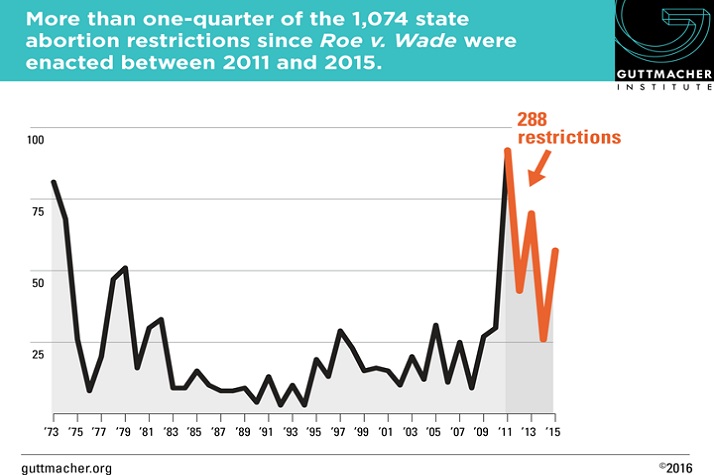
"Have you had an abortion? Missouri Republicans want to know. Planned Parenthood official could be arrested for not turning over names," Amanda Marcotte, Salon: Antiabortion-rights activists' "punitive and frankly creepy side is coming out in Missouri," where state lawmakers "are threatening to arrest Mary Kogut, the president and CEO of Planned Parenthood of the St. Louis Region and Southwest Missouri, because she won't turn over a list of names of women who got abortions," Marcotte writes. According to Marcotte, "Kogut's lawyers are citing federal law protecting patient privacy to keep this list out of the hands of ... legislators." She explains that "the lawmakers' effort is "part of the ongoing witch hunt started when anti-choice activists released a series of hoax videos" targeting Planned Parenthood. While investigations in several states -- including Missouri -- have "turned up no evidence of criminal wrongdoing," antiabortion-rights lawmakers "are still running pointless investigations," Marcotte writes, adding, "Under the circumstances, it's easy to see why Kogut and her colleagues at Planned Parenthood are wary of turning [over] a list of names of women who have had abortions." Marcotte cites Laurel Raymond of the Center for American Progress' "ThinkProgress," who noted that "'the [lawmakers'] document request makes no specifications about what would happen with the information after it is turned over, so there is no guarantee that the information could not be turned over to the public.'" Marcotte writes, "The anti-choice movement has a long history of both trying to access women's private information and, once they get it, using it as a weapon against women and providers." For example, she discusses "a similar witch hunt conducted against Dr. George Tiller of Kansas," who was murdered by an antiabortion-rights activist after "years of anti-choicers demagoguing about" an investigation into Tiller. She explains that through the investigation, which was "based on false accusations," Kansas authorities obtained private medical information about women who had received abortions. According to Marcotte, "Bill O'Reilly got his hands on those records" and "proceeded to share details from those personal records with Fox audiences while slamming the [women] for their reasons for abortion." Marcotte also cites the experience of Rolling Stone reporter Alex Morris, who "recently went to the Birmingham Planned Parenthood to research [a] story." Morris noted that within minutes of entering the clinic "'the protesters have figured out my name and address, and ... start calling them out.'" In addition, Marcotte points to antiabortion-rights crisis pregnancy centers, which deceive women into disclosing personal medical information "for the purpose of compiling lists of women who have or want abortions." Marcotte concludes, "Considering that Planned Parenthood is bound by federal law not to share private patient information, they are doing the right thing in refusing to hand over a bunch of private medical records to a bunch of" lawmakers "who are trying to justify their nosiness by citing hoax videos making false accusations" (Marcotte, Salon, 4/7).
ABORTION-RIGHTS MOVEMENT:
"The hardest abortion I've ever had to perform," Chavi Karkowsky, Daily Beast: Karkowsky, a physician, shares a story about an abortion she provided in response to conservative lawmakers "who have ideas about somehow punishing women who have abortions, or perhaps their doctors." According to Karkowsky, her patient's water broke at 19 weeks of pregnancy, making the "chances of getting to a gestational age -- 23 weeks, 24 weeks -- where she could have a live baby [who] would make [it] out of the [neonatal intensive care unit] ... slim to none." Karkowsky writes that she did not immediately offer an abortion, but instead "reviewed the scientific evidence for her," which "was very similar to offering her an abortion." Specifically, Karkowsky "reviewed the risks ... that might happen if [the woman] chose to stay pregnant," including "infection that can get into her body through her uterus," and told her that the "the safest thing would be to induce her labor and end her pregnancy." She notes, "What I offered her, then, was an induction of labor ... at a gestational age at which the fetus cannot survive, because it is so early." Karkowsky writes, "So really, isn't this an abortion? Should we talk about punishing her, now? Or perhaps just me? Which one of us should go to jail?" The woman initially refused, but five days later, she became "critically ill" and agreed to the procedure, Karkowsky writes. While preparing to administer the induction medication, Karkowsky realized that the woman already was dilated and quickly delivered a fetus that "never had a heartbeat." After delivery, the woman "ended up getting sicker and sicker and ended up in the ICU, so very sick because of those five days we had waited, letting the bacteria grow," Karkowsky writes. Noting that the woman, no longer pregnant, has begun to recover and will soon leave the hospital, Karkowsky concludes, "Who are we going to punish, today? Is it her, or is it me?" (Karkowsky, Daily Beast, 4/7).
What others are saying about the abortion-rights movement:
~ "I had an abortion because I love my son," Raina Johnson, The Establishment/Huffington Post blogs.
ZIKA VIRUS:
"When in pregnancy is Zika most dangerous?" Adrienne LaFrance, The Atlantic: The "waiting game" of pregnancy "can be especially intense for women now that the Zika virus is spreading, because scientists still don't know if there is a point in pregnancy when contracting the illness isn't potentially serious," LaFrance writes. "Early evidence is alarming," she notes, citing a "troubling" study that found "Zika appears to cause 'grave outcomes' for many fetuses, regardless of when in pregnancy the virus is contracted." Specifically, the study found that many of the fetuses of otherwise healthy women "who tested positive for Zika developed serious and sometimes fatal complications including growth problems, too-small heads, brain disorders, disruptions to the central nervous system, and abnormal blood flow," LaFrance writes. Further, according to LaFrance, the fetuses of two women, one of whom was infected at 25 weeks and the other at 32 weeks, died "after the 30-week mark, which is well into the third trimester." She notes that the findings counter "earlier theories that Zika ... might be most harmful to the fetuses of women in their first and second trimesters of pregnancy, but less of a threat as pregnancy progresses." According to LaFrance, health officials are calling for additional research into the virus, but, "[i]n the meantime, [they] say pregnant women and their partners should follow guidelines issued by global health leaders -- including using insect repellent, avoiding travel to places where Zika is locally transmitted, and practicing safe sex to prevent transmission of the virus" (LaFrance, The Atlantic, 4/5).
What others are saying about the Zika virus:
~ "What Zika researchers can learn from the rubella outbreak of 1964," The Atlantic, LaFrance, 4/6.