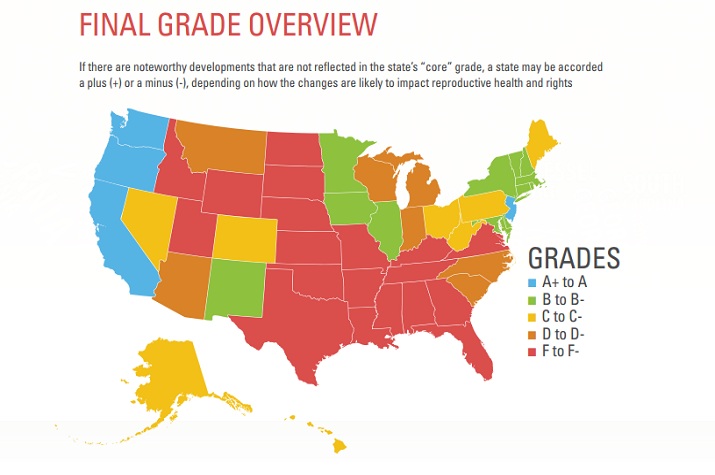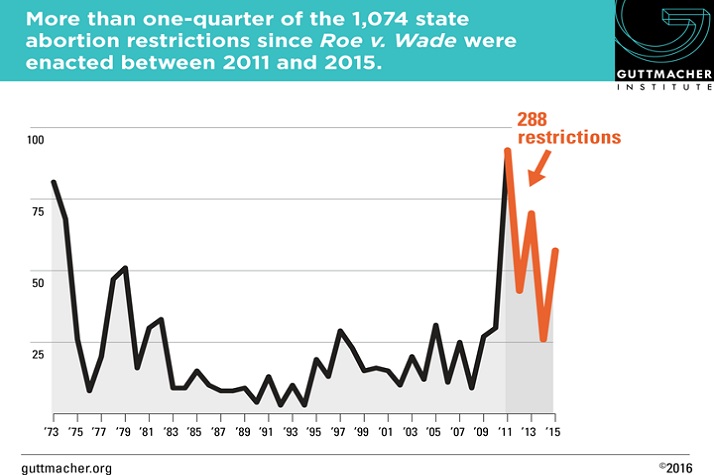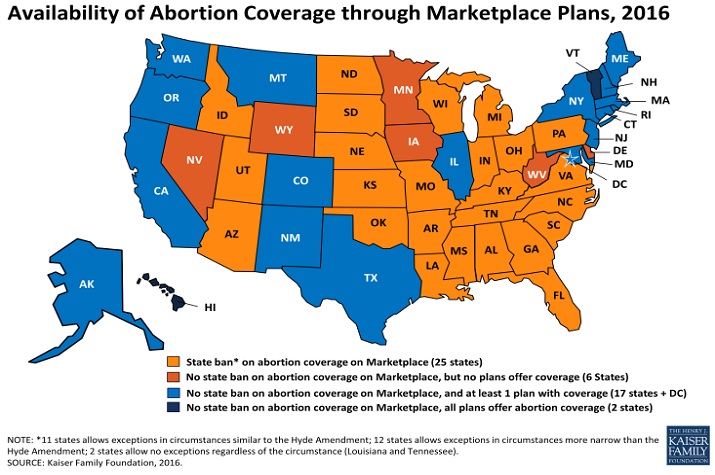


As states across the country restrict access to safe, legal abortion care, abortion-rights supporters have launched an outreach effort to help women who are unable to obtain abortion care from a medical professional access accurate information about self-induced medication abortion, the AP/Houston Chronicle reports.
According to advocates, many women seeking abortion care are kept from accessing professional health care because of fear, financial barriers or an inability to reach an abortion clinic. Advocates noted that a woman ideally should be able to access professional medical care, but that given the current barriers to abortion access, women need to be able to access accurate information about self-inducing an abortion (Crary, AP/Houston Chronicle, 4/16).
Clinic closures
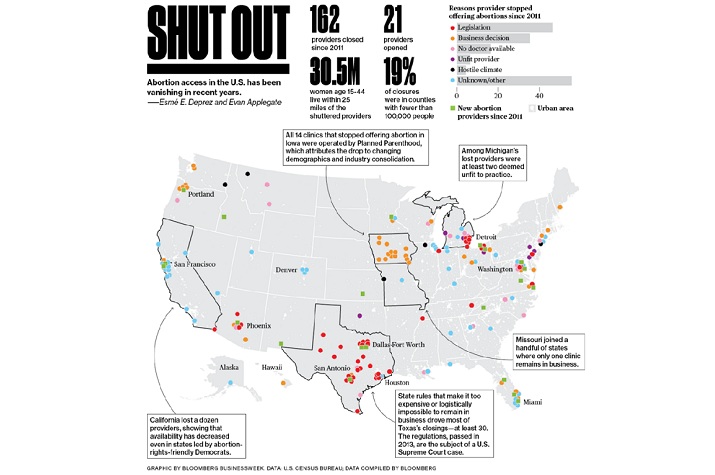
Since 2011, at least 162 abortion providers in 35 states have closed or stopped offering abortion care, according to a Bloomberg Business investigation published in February. Those states are home to more than 30 million women of reproductive age. Further, the investigation found that only 21 new abortion clinics have opened in the last five years and that the reopening of a clinic that had closed was even rarer.
Targeted regulation of abortion providers (TRAP laws) and similar abortion restrictions are among several factors driving the closures, according to the investigation (Women's Health Policy Report, 2/26).
Significant demand for self-induced abortion
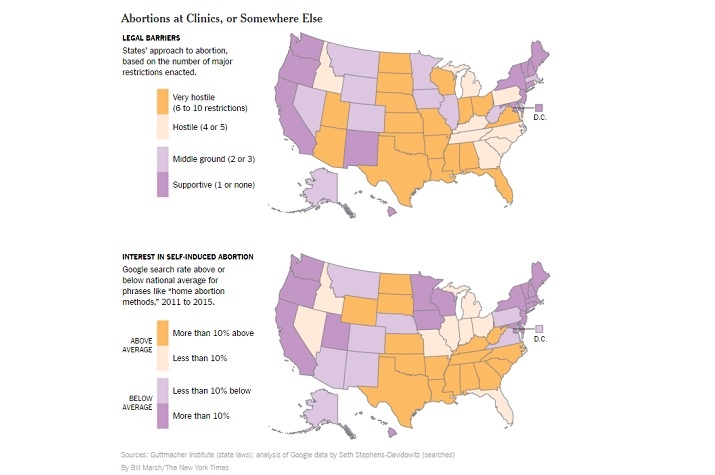
Separately, an analysis of Internet searches "show[s] a hidden demand for self-induced abortion reminiscent of the era before Roe v. Wade," economist Seth Stephens-Davidowitz wrote in an opinion piece that appeared in the New York Times in March. The analysis found "there were more than 700,000 Google searches looking into self-induced abortions in 2015."
According to Stephens-Davidowitz, the Guttmacher Institute categorizes eight of the 10 states with the highest rates of self-induced abortion searches as "hostile" or "very hostile" to abortion rights. In contrast, he notes that "[n]one of the 10 states with the lowest search rates for self-induced abortion are in either category" (Women's Health Policy Report, 3/7).
Outreach effort
Women from multiple legal organizations formed the Self-Induced Abortion Legal Team (SIALT) after consulting with reproductive-rights experts and advocates.
The team aims to end the prosecution of women who self-induce abortion and boost access to reliable information about how to obtain and complete medication abortion outside of the formal health care system. Specifically, the team wants to spread awareness that misoprostol is a safe method for terminating pregnancy within the first 12 weeks.
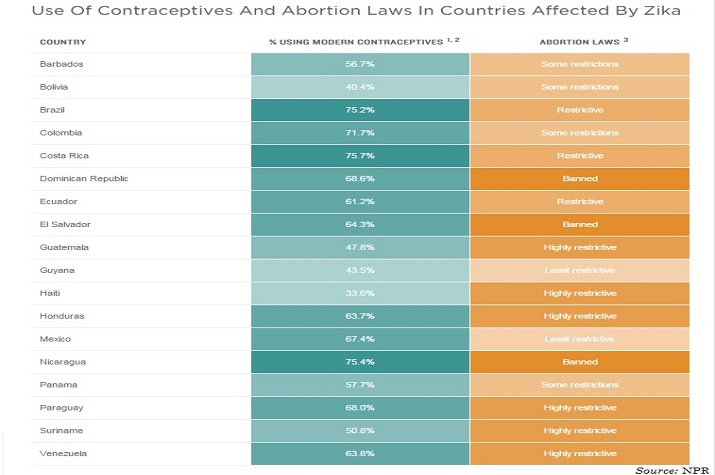
In the United States, only medical professionals can provide the drug. Typically, medical professionals who provide medication abortion use a combination regimen of misoprostol and mifepristone. The two-drug regimen is 95 percent effective. However, in many Latin American countries, misoprostol is available over the counter. The World Health Organization, which has circulated guidance on using misoprostol alone to terminate a pregnancy, said misoprostol used independently is effective in 75 to 90 percent of cases.
Comments
Jill Adams -- chief strategist for SIALT and executive director of the Center on Reproductive Rights and Justice at the University of California-Berkeley law school -- said, "There will always be people who need to do this for themselves, and they deserve to have the resources and information so they can do so safely and effectively, free from the threat of arrest." She added, "We're not here to incite unlawful activity, nor to reprimand anyone if they do step outside the law ... We're here to equip our friends and allies with the information they've been asking for."
Separately, Vicki Saporta, president of the National Abortion Federation, said, "There are all kinds of reasons why it's better for women to have access to professional medical care," adding, "But when that is not available, and there is a desperate situation, these drugs are very effective, and women can safely terminate a pregnancy" (AP/Houston Chronicle, 4/16).