

Read the week's best commentary from bloggers at Ms. Magazine blog, the National Partnership for Women & Families blog and more.
WHOLE WOMAN'S HEALTH v. HELLERSTEDT:
"Abortion is a constitutional right. We need to stop talking like it isn't," Bridgette Dunlap, Ms. Magazine blog: Noting that lawmakers who support abortion rights often express concerns about "Roe v. Wade being overturned or gutted," Dunlap calls on health advocates to "abandon the defeatist rhetoric." Dunlap continues, "Treating Roe being overturned as a credible threat has obscured the actual attacks on abortion in this country -- which are on its availability and affordability, not its legality. Worse, this story perpetuates the conservative narrative that there is something illegitimate about the right." She writes of "Roe alarmism," and that "[c]laiming that the right to abortion is on shakier legal ground than it actually is undermines established protections, because the way the Supreme Court interprets the Constitution tends to be consistent with how the public does." Citing the Supreme Court lawsuit over contested provisions in Texas' omnibus antiabortion-rights law (HB 2), Dunlap writes, "Commentators on the left tend to acknowledge that these [provisions] are bogus health regulations meant to shut down clinics, but treat whether they are constitutional under the [high] court's precedent as a close question. It is not." The Texas lawsuit "is an easy case," she writes, noting that "[l]egal scholars ... have explained that the [lower] court's decision upholding the challenged provisions of HB2 cannot be squared with [Planned Parenthood v. Casey]," under which "[e]ven a slight burden imposed by a health regulation that does not address a legitimate safety issue should be considered undue." Dunlap writes that rhetoric suggesting otherwise is problematic because "if the public believes that the [Supreme] [C]ourt upholding HB2 is a likely possibility, rather than the radical departure from precedent it would be, the justices have more room to maneuver." Under that public perception, "[i]t will look like a nice compromise to strike down HB2 because it is unusually flagrant and harmful, but fail to define the undue burden standard in a way that provides meaningful protection against an array of current and future attacks on abortion access," she states. Dunlap concludes, "For abortion to become an accessible medical service instead of a wedge issue, liberals need to stop calling the existence of the right into doubt. They should start talking about abortion like the well-established right 'central to personal autonomy and dignity' that the [Supreme] [C]ourt has held it is -- and demanding legal protections befitting of it" (Dunlap, Ms. Magazine blog, 3/2).
What others are saying about Whole Woman's Health v. Hellerstedt:
~ "The abortion law before the Supreme Court is based on a lie," Tara Culp-Ressler, Center for American Progress' "ThinkProgress."
~ "Meet the abortion provider facing off with Texas in the Supreme Court," Valerie Tarico, Huffington Post blogs.
~ "For undocumented women in Texas, HB 2 is 'life or death,'" Tina Vasquez, RH Reality Check.
~ "The 36-year-old abortion rights case emerging again in 'Whole Woman's Health,'" Jessica Mason Pieklo, RH Reality Check.
~ "One woman's Supreme Court abortion case sign flawlessly displays her feelings on the matter," Amee Latour, Bustle.
~ "Reactions: Texas abortion law at the Supreme Court," Sarah Toce, Huffington Post blogs.
ABORTION RESTRICTIONS:
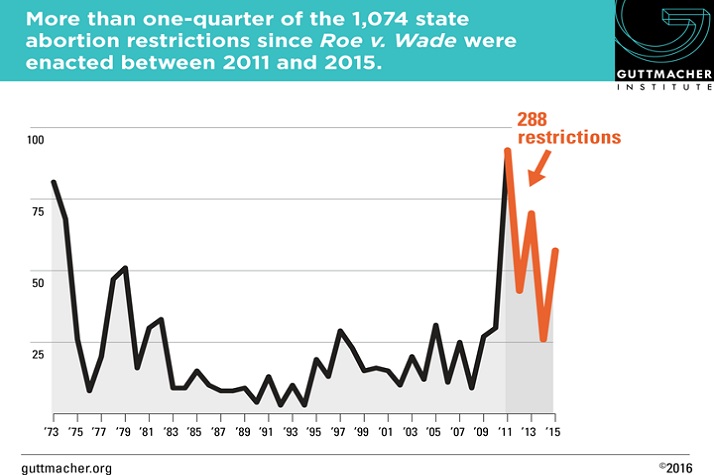
"What happens when abortion opponents turn lies into law?" Sarah Lipton-Lubet, National Partnership for Women & Families blog: Citing a new report from the National Partnership for Women & Families, Lipton-Lubet writes that abortion-rights opponents in recent years "have quietly passed hundreds of restrictive laws" that curb a woman's access to abortion care by "lying to her, delaying her care, requiring tests she doesn't need, making it cost more than it should, and shutting down reproductive health clinics." She notes that many of these "abortion restrictions are promoted under the guise of supporting 'women's health' or 'informed consent,' using lies about abortion, about women who decide on abortion and about the trusted health care professionals who provide abortion care." When such "lies are turned into laws, doctors are forced to lie to their patients, health care clinics are shut down, and women are denied care," she adds, citing Texas' HB 2, which has "caused incredible harm to women's health," as an example. According to Lipton-Lubet, the National Partnership's latest report found that "of the 353 anti-abortion restrictions introduced in state legislatures this year, 251 restrictions in 37 states are based on common anti-choice lies." Of those 251 restrictions, she notes that 150 "are based on fundamental lies about abortion and abortion providers," such as lies about "abortion safety and about the physical and mental health effects of abortion." Furthermore, 101 "are based on lies about women who decide to have abortion care -- the lie that a woman is not capable of making a private medical decision about abortion without state intervention, or that she will feel only regret." Lipton-Lubet concludes, "In states across the country, lie after lie is becoming law after law. It has to stop -- and it will only stop if we all demand that lawmakers end the lies about women's health" (Lipton-Lubet, National Partnership for Women & Families blog, 3/3).
What others are saying about abortion restrictions:
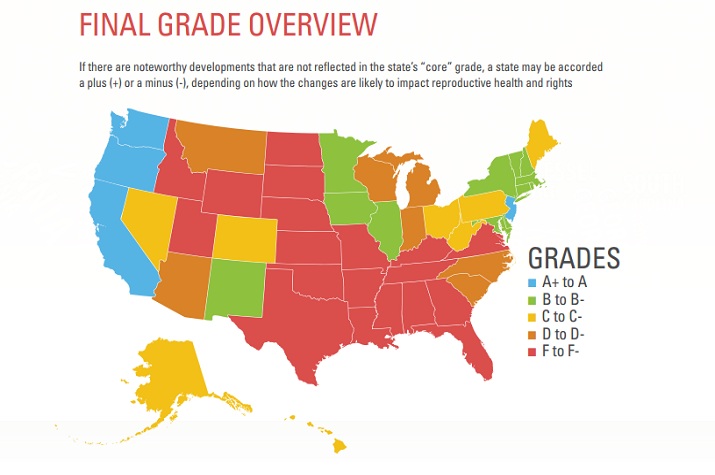
~ "Abortion access: Terrible in pretty much every Super Tuesday state," Stephanie Hallett, Ms. Magazine blog.
~ "The majority of all state abortion bills are based on lies, report finds," Alex Zielinski, Center for American Progress' "Think Progress."
~ "'Trapped' documentary shows us what abortion restrictions really mean," Verónica Bayetti Flores, Feministing.
~ "Study finds women who want abortions are often given misleading information," Alex Reed, TakePart.
ABORTION-RIGHTS MOVEMENT:
"How to transform future health-care providers into abortion rights advocates," Michalina Drejza/Cecilia Espinoza, RH Reality Check: Medical students in the United States and abroad have "limited opportunities to train in abortion procedures," largely because of "institutionalized stigma" against abortion care, which means that many of them "become doctors who cannot and will not perform the procedure, even in countries where it's legal," write Drejza and Espinoza. To address this situation, "the International Federation of Medical Students' Associations (IFMSA), one of the world's oldest and largest student-run organizations, has partnered with Ipas, a global NGO dedicated to ending deaths and injuries from unsafe abortion, to develop ... training for future health professionals on the importance of safe abortion access," the authors note. They explain that the partnership, launched in 2010, now "engages a network of more than one million medical students from 115 countries, and a total of approximately 4,000 students attend annual regional meetings held around the globe." According to the authors, "[W]e recognized that what many medical students need first is an opportunity to talk openly about the myths, misconceptions, and biases about abortion they've inherited from their respective cultures." The authors write that participants at the training sessions "explore how unsafe abortion affects women and societies," learn "how practicing health professionals can reduce the many barriers to abortion care," overcome stigma surrounding the "clinical aspects of abortion care with an overview of safe procedure methods and the importance of patient-centered care," develop "strategies for advancing abortion rights and access, and practice skills like advocacy and peer education." Noting that "[t]he first step to ending abortion stigma is education -- and making people conscious of the problem," Drejza and Espinoza conclude, "[W]e hope that region by region, year after year, we are laying the groundwork on a global scale for more pro-choice health systems with providers who advance, rather than restrict, women's sexual and reproductive health and rights" (Drejza/Espinoza, RH Reality Check, 3/2).
What others are saying about the abortion-rights movement:
~ "5 important abortion resources whose information will help you from A to Z," Erin Corbett, Bustle.
ANTIABORTION-RIGHTS MOVEMENT:
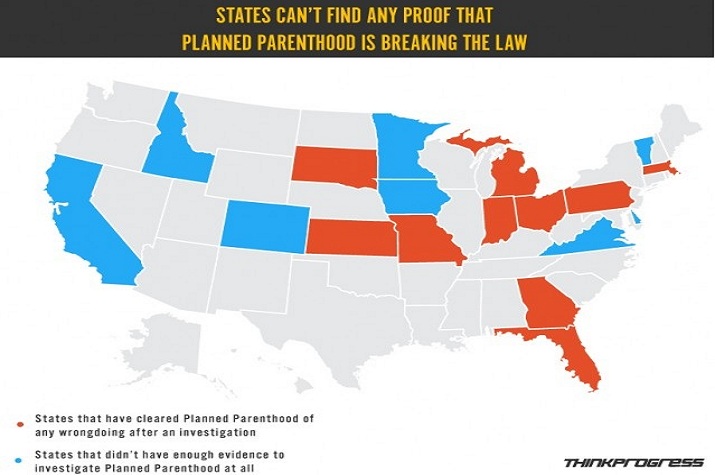
"Fetal tissue research threatened in battle over abortion," Zoe Greenberg, Our Bodies Ourselves' "Our Bodies, Our Blog": "Fetal tissue research, which has led to the near elimination of diseases like polio and measles, is increasingly threatened by political fighting over abortion, according to a recent analysis by the Guttmacher Institute," Greenberg writes. She explains that after the antiabortion-rights group Center for Medical Progress (CMP) released a series of misleading videos targeting Planned Parenthood's fetal tissue donation program last year, "lawmakers around the country proposed defunding Planned Parenthood, just as [CMP] intended." Greenberg quotes Dawn Laguens, the executive vice president of Planned Parenthood, who notes that abortion-rights opponents are using investigations into fetal tissue donations as "an angle to go after safe, legal abortion." Although "eleven states have investigated and subsequently cleared Planned Parenthood of wrongdoing," the "attack on fetal tissue research has had far-reaching consequences," Greenberg writes. Greenberg notes that "some fetal tissue donation programs have shuttered; tissue donations at labs across the country have decreased; and legislation has been introduced in nine states that could effectively end fetal tissue research." Greenberg states, "Scientists warn that ... we all stand to suffer if fetal tissue research is restricted." She concludes by quoting bioethicist R. Alta Charo, who in the New England Journal of Medicine wrote, "'Any discussion of the ethics of fetal tissue research must begin with its unimpeachable claim to have saved the lives and health of millions of people'" (Greenberg, "Our Bodies, Our Blog," Our Bodies Ourselves, 3/2).
What others are saying about the antiabortion-rights movement:
~ "Democrats say GOP is on a 'witch hunt' over Planned Parenthood fetal tissue subpoenas," Jamie Reich, Jezebel.
ACCESS TO CARE:
"Abortion waiting periods affect 6 in 10 women in the United States & that is a big problem," Emma Cueto, Bustle: Mandatory delay laws, "which require women wait a minimum amount of time between initially seeking an abortion and actually obtaining one, are becoming more and more common around the country," with "six in 10 women ... now subject" to such restrictions, according to a new analysis from the Daily Beast, Cueto writes. According to Cueto, "Florida became the 28th state to have a [mandatory delay] for abortion" when an appeals court last month lifted an injunction that had halted a 24-hour delay measure (HB 633), effectively increasing the number of women subject to mandatory delay laws in the United States "from 53 percent to 59 percent." She explains that while mandatory delays "are often pitched as being good for women," they in fact can make abortion access difficult or impossible for women, particularly those who have to travel long distances "to reach a clinic that offers abortion, low income women who can't afford to miss more than a day of work, or women who are in an abusive relationship and would be unsafe if their partner discovered they were pregnant or planning to terminate a pregnancy." Cueto concludes by adding, "[W]hen you consider that abortion clinics are being forced to close across the country, that [antiabortion-rights] crisis pregnancy centers receive state and federal funding, that there are still people looking to defund Planned Parenthood, and that 59 percent of women live in a state where [mandatory delays] are law ... well, it's not just a problem. It's a lot of problems. And they're problems that badly, badly need solving" (Cueto, Bustle, 3/3).