

Summary of: "Lessons from Texas: Widespread consequences of assaults on abortion access," Gold/Hasstedt, American Journal of Public Health, June 2016.
Amid a proliferation of state-level reproductive-rights restrictions, the Guttmacher Institute's Rachel Benson Gold and Kinsey Hasstedt highlight how the enactment of such measures in Texas has compromised women's health. Since publication of Gold and Kinsey's commentary, the Supreme Court struck down two provisions in Texas' 2013 omnibus antiabortion-rights law (HB 2), holding that both contested provisions violated the U.S. Constitution by imposing an undue burden on a woman seeking abortion care.
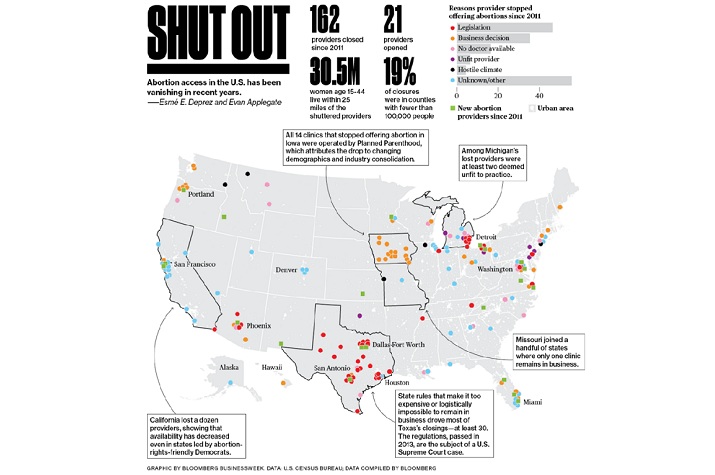
Gold and Hasstedt cited a recent analysis by Gerdts et al. that assessed how HB 2 "has complicated women's ability to obtain an abortion," focusing on the provisions considered by the Supreme Court. The researchers explained that among other restrictions, HB 2 includes two targeted regulation of abortion provider (TRAP) provisions: One requires abortion providers to have admitting privileges at a local hospital, while the other stipulates that abortion care facilities must "be the functional equivalent of ambulatory surgical centers."
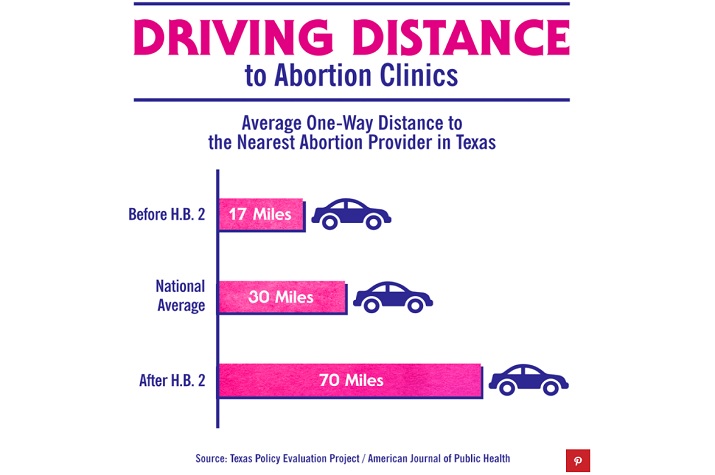
According to Gold and Hasstedt, Gerdts et al. "found such policy changes have a very real impact" on women's access to abortion care. Specifically, the analysis noted that when a woman sought abortion care after her nearest clinic had closed, she was more likely to have traveled 50 or more miles, spent $100 and incurred "various forms of hardship" than a woman whose nearest clinic had not closed. The researchers added, "Notably, women wanting but unable to reach an abortion provider could not be interviewed, leaving their experiences largely untold."
Restricting abortion access
"Texas is far from alone in pursuing these types of restrictions," Gold and Hasstedt wrote. As of April 1, four other states in addition to Texas required abortion providers to have admitting privileges and seven other states were considering such requirements. Moreover, five states besides Texas required abortion clinics to meet ambulatory surgical center-like building requirements, while seven additional states were considering similar measures.
Overall, according to Gold and Hasstedt, state lawmakers "adopted 288 new abortion restrictions" between 2011 and 2015, accounting for "more than one quarter of the 1074 abortion restrictions adopted by states" since Roe v. Wade was decided 43 years ago.
Attacking the family planning safety net
Gold and Hasstedt contended that "the assault on abortion access has grown into a widespread attack on safety-net family planning providers" that provide abortion care or are affiliated with abortion providers. For instance, they noted that Wisconsin earlier this year approved legislation (SB 237, AB 310) that bans the state from distributing family planning funding to abortion providers, while four other states as of April 1 were considering similar funding restrictions. Meanwhile, Ohio and Florida have taken "[b]roader approaches," wrote Gold and Hasstedt, citing a Florida law (HB 1411) that "would exclude most providers from Medicaid" and an Ohio law that "would bar providers from funds for a range of services from sex education to breast and cervical cancer screening."
Gold and Hasstedt also pointed to state and federal efforts to defund abortion providers. They cited a budget bill (HR 3762) -- passed by Congress in January and subsequently vetoed by President Obama -- that would have barred Planned Parenthood from receiving Medicaid payments. Moreover, following the release of a series of misleading videos, five states moved to cut Planned Parenthood from their Medicaid programs. While Gold and Hasstedt noted that state defunding attempts have been blocked by federal courts and CMS, they emphasized that such efforts could close clinics, "result[ing] in a significant gap in the family planning safety net."
Texas as a harbinger
"Texas serves as a harbinger of what happens when family planning funding is slashed and the provider network dismantled," Gold and Hasstedt wrote.
They noted that along with abortion-rights restrictions, state "lawmakers have enacted a raft of measures undermining reproductive health and turning the state's publicly funded family planning effort on its head." Gold and Hasstedt explained that Texas in 2011 "drastically cut" state funding for family planning and "severely limited the availability of these funds to health centers specializing in the delivery of these services." Moreover, lawmakers denied Medicaid funding allocated through the Texas Women's Health Program (TWHP) for family planning providers that offer abortion care or are affiliated with abortion providers, which caused the state to lose federal funding for the program.
Gold and Hasstedt cited state data "show[ing] that in 2013, the first year in which the [TWHP] was entirely state-run, far fewer women received contraceptive care." Moreover, they point to a separate analysis, which found that after Texas removed Planned Parenthood from its safety-net family planning provider network, "Medicaid claims declined for some methods of contraception, including long-acting reversible contraceptives and injectables." According to Gold and Hasstedt, the analysis also found that women who had been using injectables "were also less likely than before to consistently continue their chosen method and were more likely to have a Medicaid-funded birth."
Gold and Hasstedt stated, "Clearly, the animus directed at abortion services and the providers of that care is, as Gerdts et al. found, seriously impacting women confronting an unintended pregnancy." They continued, "But increasingly, this animus is extending beyond the provision of abortion services to women seeking contraceptive care, the family planning provider safety net, and now even to researchers looking to document the impact of policy changes." For example, Gold and Hasstedt noted, a senior Texas Health and Human Services Commission official stepped down from his position "in the face of intense pressure" after working on the analysis of the impact of cutting Planned Parenthood from the state's safety-net family planning provider network.
The researchers concluded, "[A]ll of that does not bode well for women and couples seeking to make the most basic decisions about childbearing."