

Florida Gov. Rick Scott (R) on Friday announced that four cases of Zika reported in Miami-Dade and Broward counties were likely transmitted by local mosquitoes, although no mosquitoes in the state have yet tested positive for the virus, CNBC reports.
The cases mark the first instances of transmission via local mosquitoes in the continental United States (Lovelace, CNBC, 7/29). According to CNN, the infected individuals had not traveled to Zika-affected regions or had sex with someone who had visited a Zika-affected region (Goldschmidt, CNN, 7/29).
Background on Zika virus
The Zika virus is not easily diagnosed, and it does not have a cure or vaccine. It is linked to the birth defect microcephaly, a condition in which an infant is born with an abnormally small head and brain. The condition is fatal for some infants, while others experience permanent disabilities.
The virus is most commonly transmitted by a bite from an infected mosquito, but it can also spread through sexual activity.
Earlier this month, Congress left for a seven-week recess without sending President Obama legislation to fund a response to the Zika virus. Existing funding for Zika response efforts is expected to run out in late July or early August, according to HHS Secretary Sylvia Mathews Burwell (Women's Health Policy Report, 7/26).
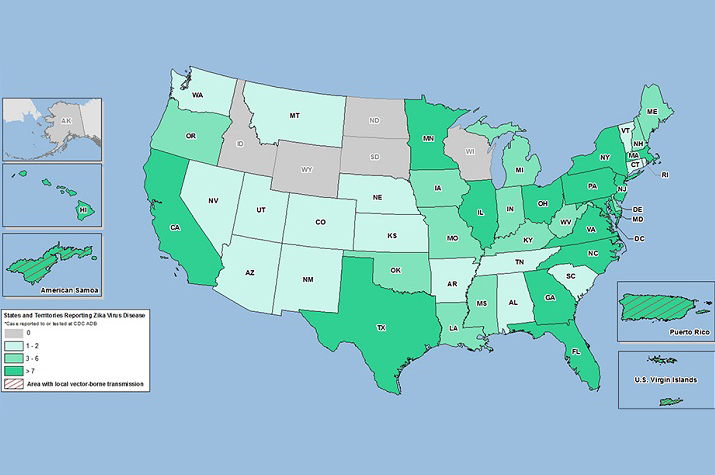
CDC reports that, as of July 27, there have been 1,658 cases of Zika in the continental United States and 4,750 cases in U.S. territories (Burton/Radnofsky, Wall Street Journal, 7/28).
Florida's response
In a news release, Scott said the Florida Department of Health (DOH) believes that active transmissions of the Zika virus are occurring in one area -- about one square mile -- in Miami-Dade County.
Among other action steps, Scott has directed DOH to immediately work with commercial pest control companies to increase mosquito spraying and other containment efforts in the affected area; allocate $620,000 to OneBlood, the primary blood collection organization in Florida, to help implement proper blood screening procedures; and to coordinate with OB-GYNs and reproductive health organizations in the area to distribute Zika prevention kits to pregnant women (Scott release, 7/29).
OneBlood said last week that it will begin screening donated samples for Zika on Monday (AP/New York Times, 7/28). According to the company, it has received FDA approval to use a tool to screen blood for Zika. The company will keep in place its prior guidelines on Zika, including donor-deferral guidance, an updated donor questionnaire that features Zika-related questions and education materials on the virus distributed to donors.
OneBlood stated that it will cease collections in ZIP codes where local Zika transmission is confirmed. The company noted that it will grant hospitals access to screened blood on a per-request basis for patients at high risk of complications related to the virus ("To Your Health," Washington Post, 7/28). In addition, OneBlood said it will maintain local blood donation supplies by transporting blood donations from areas that have not been affected by the virus (AP/New York Times, 7/28).
FDA asks affected counties to suspend blood donations
Earlier in the week, when Florida officials were still investigating the local Zika cases, FDA asked blood centers in Miami-Dade and Broward counties to temporarily suspend blood collections to curb the potential for Zika virus to enter the blood supply. The agency said the blood centers should "cease collecting blood immediately" until they are able to screen donations or until the centers implement a method for inactivating the virus in individual donations.
FDA officials said they were requesting a halt on blood donations "in consideration of the possibility of an emerging local outbreak of Zika virus, and as a prudent measure to help assure the safety of blood and blood products" (Sun, "To Your Health," Washington Post, 7/28).
FDA stated that nearby counties should adopt the same protocol "to help maintain the safety of the blood supply as soon as possible" (AP/New York Times, 7/28). In addition, the agency advised donors who live in other areas who have visited Miami-Dade or Broward County within the last four weeks to postpone donating blood ("To Your Health," Washington Post, 7/28).
According to the AP/New York Times, FDA has already advised blood centers not to accept donations from individuals who have recently traveled to countries affected by Zika (AP/New York Times, 7/28).
On Thursday, the agency said it was collaborating with companies developing blood-screening tests, which blood donation centers around the country can voluntarily participate in, even if there have been no reports of local Zika transmission in their areas ("To Your Health," Washington Post, 7/28).
Surgeon General's comments to pregnant women
Separately, U.S. Surgeon General Vivek Murthy on Thursday said the then-unconfirmed cases of local Zika transmission underscore the need for mosquito protection for pregnant women. Further, he said women who are considering becoming pregnant should speak with their doctor.
Murthy noted that health officials, as of Thursday, were not advising pregnant women avoid travel to South Florida. He said the administration and Florida health officials are working together to identify new Zika cases and determine the significance of cases under investigation (Wall Street Journal, 7/28).