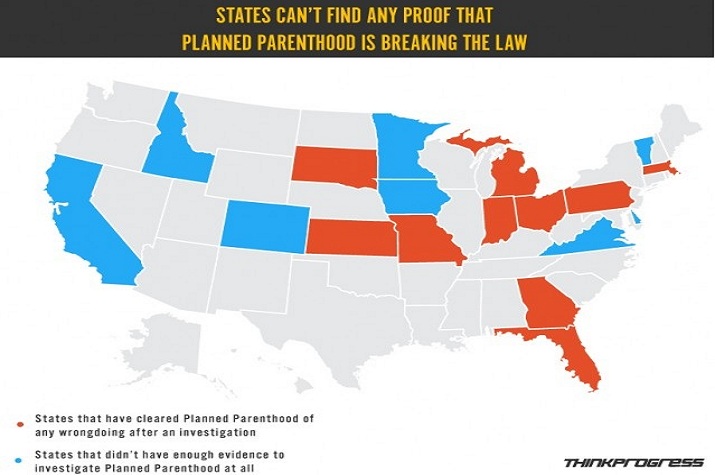


While state and congressional investigations into fetal tissue donation practices by Planned Parenthood have repeatedly "found no wrongdoing" by the organization, a conservative-led "House panel is undeterred in conducting its own investigation, or, more accurately, witch hunt," according to a Washington Post editorial.
The editorial states, "Even more troubling than the considerable time and money that will be wasted is the potential damage to health care and medical research." According to the editorial, the special committee "has made sweeping requests (including three subpoenas) for documents and information from more than 30 agencies and organizations that provide abortions or are involved in fetal tissue research." It notes, "Of particular concern is the panel's demand for the names of doctors, medical students and researchers involved in performing abortions or conducting research with fetal tissue," which liberal committee members say would "ris[k] individual privacy and safety without legitimate reason."
The editorial explains, "Rep. Marsha Blackburn (R-Tenn.), chair of the House panel, has defended the investigation as necessary because of lingering questions raised" by misleading videos targeting the organization's fetal tissue donation program, despite the videos having "been discredited" and their producers indicted. The editorial also cites a decision by U.S. District Court Judge William Orrick, who "grant[ed] a preliminary injunction prohibiting [the] release of illegally obtained recordings and materials in a decision that laid bare the fraud against Planned Parenthood" and noted "the alarming increase in incidents of harassment and violence directed against abortion providers since the videos were released last July."
According to the editorial, "The handful of Planned Parenthood clinics in which patients are able to donate fetal tissue adhered to the [federal] law that allows reasonable payment for costs associated with donations, but they have stopped accepting any reimbursement because of the controversy." The editorial states that Congress "legalized fetal tissue research in 1993 because of the potential for scientific advances in treating and curing illnesses."
The editorial concludes, "Congress has the prerogative to change that law, if it wants to undermine the kind of medical research that has led to breakthroughs such as the polio vaccine. But it has no call to engage in a reckless investigation with the potential to cause a great deal of harm" (Washington Post, 2/20).