

Pope Francis on Thursday implied that it might be acceptable for women in areas affected by the ongoing Zika virus outbreak to use contraception, the Washington Post reports (Boorstein et al., Washington Post, 2/18).
Background
The Zika virus is a mosquito-borne disease that has spread across Latin America over the past year. The virus is not easily diagnosed, and it does not have a cure or vaccine. It also could be linked to the birth defect microcephaly, a condition in which an infant is born with an abnormally small head and brain. The condition is fatal for some infants, while others experience permanent disabilities.
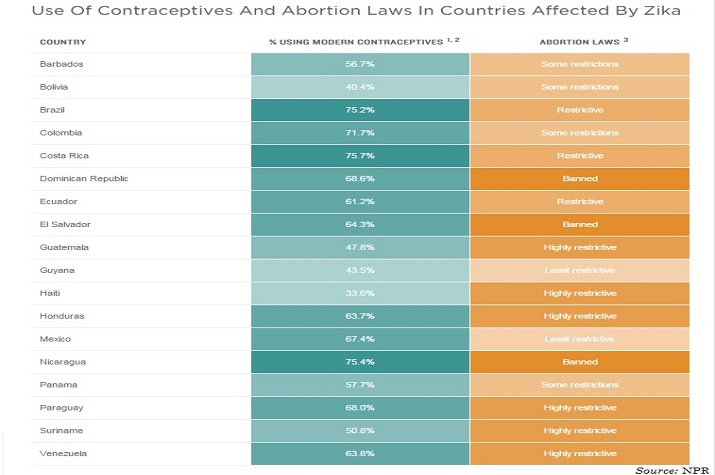
Officials in Brazil and Honduras have issued guidance recommending that women avoid pregnancy. El Salvador's recommendation is that women not get pregnant until 2018. However, many countries in Latin America restrict access to contraception and often ban abortion. In addition, women have been advised to protect themselves against mosquitos, but insect repellant can be unaffordable for low-income women.
The World Health Organization has declared the outbreak and its suspected link to a congenital condition in infants a public health emergency of international concern. Separately, the United Nations High Commissioner for Human Rights issued a statement directing nations affected by the Zika virus to remove bans on access to reproductive health care services (Women's Health Policy Report, 2/18).
Pope Francis' comments
According to the Post, Francis in remarks to the press on Thursday said "avoiding pregnancy" amid the Zika virus was "not an absolute evil." However, Francis maintained the Catholic Church's stance against abortion.
In his remarks, Francis referenced how Pope Paul VI in the 1960s permitted nuns located in the Belgian Congo to use artificial contraception to avoid becoming pregnant from rape. Francis said, "[A]voiding pregnancy is not an absolute evil ... In certain cases, as in this one (Zika), such as the one I mentioned of Blessed Paul VI, it was clear."
According to the Post, experts on the Catholic Church are debating whether Francis' comments condone modern birth control or instead refer to abstinence or fertility awareness-based methods. It is unclear how Francis' comments will affect contraceptive use in Catholic Latin American areas, the Post reports (Washington Post, 2/18).
Reaction
Sister Carol Keehan, president and CEO of the Catholic Health Association, said Francis' comments about contraception show that he "clearly appreciates the human factor in the Zika threat" (Rubenfire, Modern Healthcare, 2/18).
However, others questioned whether the comments would result in any significant changes to Catholic theology (Washington Post, 2/18).