
National Partnership for Women & Families

In the News

Mo. House approves 'personhood bill,' sending it to state Senate

The Missouri House voted 110-37 on Thursday to advance a measure (HJR 98) that would create a ballot proposal to extend state constitutional rights to fetuses, the St. Louis Post-Dispatch's "Political Fix" reports.

The measure now proceeds to the state Senate (Erickson/Suntrup, "Political Fix," St. Louis Post-Dispatch, 5/5). State lawmakers must act on the bill by May 13, the final day of the current legislative session.

Referendum details

The measure, proposed by state Rep. Mike Moon (R), would extend a provision in the state constitution that protects an individual's "right to life" to a fetus "at every stage of biological development." The measure does not include any exceptions for rape, incest or life endangerment.

If lawmakers pass the measure, state residents would vote on it on the Nov. 8 ballot. The measure does not need the governor's approval since it would amend the state constitution.

Efforts to grant state constitutional rights to fetuses have failed elsewhere. In North Dakota, voters in 2014 rejected a similar proposal, and the Oklahoma Supreme Court in 2012 ruled that a 'personhood' ballot measure constituted an improper ban on abortion care (Women's Health Policy Report, 5/4).

Comments

Opponents have said the bill, if enacted, would be struck down by courts as unconstitutional (Swedien, Springfield News-Leader, 5/5). According to opponents, the measure could not only restrict abortion access, but also affect access to certain forms of contraception and infertility treatment, as well as stem cell research (Hancock, AP/Kansas City Star, 5/5).

State Rep. Randy Dunn (D), speaking against the proposal, noted, "It is settled law that a woman has a right to an abortion."

Separately, state Rep. Deb Lavender (D) said, "The women of the state of Missouri don't need this body to tell them what life means" ("Political Fix," St. Louis Post-Dispatch, 5/5).

Alison Dreith, executive director of NARAL Pro-Choice Missouri, also spoke out against the bill, saying, "Missouri women and families deserve leaders who fight to solve real problems ... not political gamesmanship" (AP/Kansas City Star, 5/5).

According to the Springfield News-Leader, Moon and other bill supporters on Thursday drew criticism for comparing abortion to slavery. Calling the comparison "unbelievable," Cheryl Clay, president of Springfield NAACP, said that "there is no comparison whatsoever" between the two issues (Springfield News-Leader, 5/5).
Video Round Up

Ryan Braschler of WEHT's "Eyewitness News" covers Indiana University's (IU) lawsuit against fetal tissue restrictions included in an Indiana antiabortion-rights law (HEA 1337).

Video Round Up

WHNT 19 News' Kristen Conner explains what the Supreme Court's ruling striking down two provisions of a Texas omnibus antiabortion-rights law (HB 2) could mean for two antiabortion-rights measures in Alabama.

Video Round Up

KIRO 7's Essex Porter discusses the Supreme Court's decision not to review a 9th U.S. Circuit Court of Appeals ruling that upheld a Washington state regulation requiring pharmacies to dispense emergency contraception (EC).

Video Round Up

In this clip, MSNBC's Rachel Maddow speaks with Nancy Northup, the president and CEO of the Center for Reproductive Rights, about the ramifications of the Supreme Court's ruling in Whole Woman's Health v. Hellerstedt to strike down two contested provisions in Texas' omnibus antiabortion-rights law (HB 2).

Video Round Up

RTV6's Katie Heinz reports on arguments held Tuesday in federal court over an Indiana antiabortion-rights law (HEA 1337) that Planned Parenthood of Indiana and Kentucky has challenged.

Video Round Up

In this short documentary, filmmaker Dawn Porter profiles Yashica Robinson, one of the few physicians in Alabama who provides abortion care.

Video Round Up

In this clip, the New York Times explores the experiences of pregnant women in Brazil during the ongoing Zika outbreak, which "has been blamed for thousands of neurological birth defects across the country."

Video Round Up

The Wichita Eagle spotlights an abortion clinic set to open in Oklahoma City this summer.

Video Round Up

In this clip, 13 WJZ's Alex DeMetrick covers a new Maryland law (SB 848) that aims to help residents access contraception.

Video Round Up

This Fusion clip spotlights medical professionals' experiences providing abortion care to women in the face of harassment and threats of violence from abortion-rights opponents.

See All

Datapoints

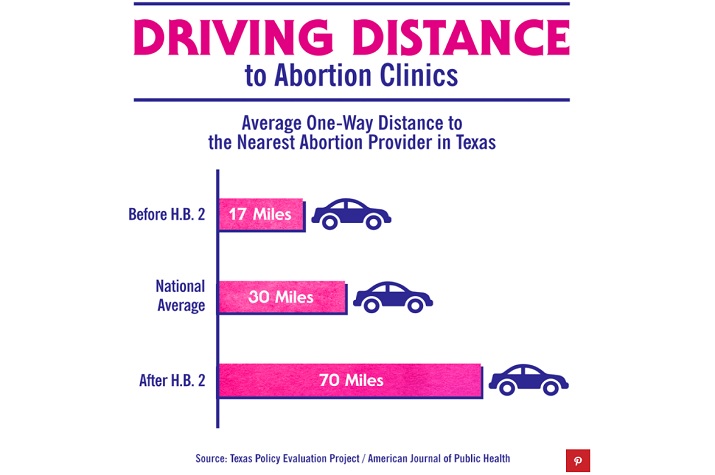
In this gif, Cosmopolitan shares research from the Texas Policy Evaluation Project showing that the average distance a woman in Texas must drive to access the nearest abortion clinic in the state has increased following the implementation of the state's omnibus antiabortion-rights law (HB 2).

Datapoints

In this map, the Kaiser Family Foundation spotlights five states and Washington, D.C., which have each enacted policies designed to facilitate access to contraception.

Datapoints

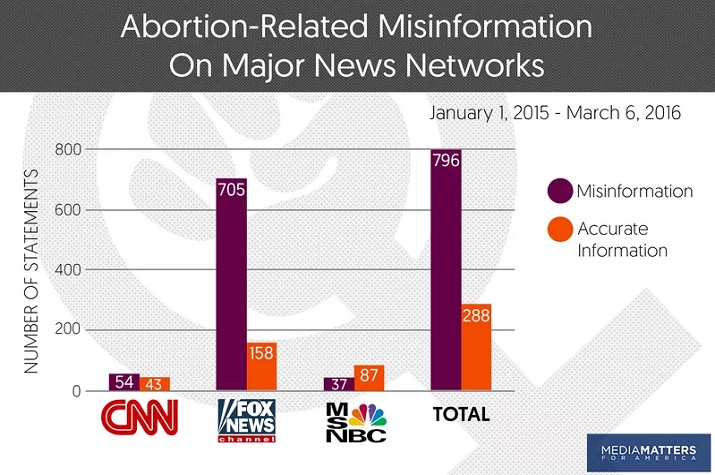
In this chart, Media Matters highlights the findings of a study showing how evening and primetime news programs airing on cable news conveyed more inaccurate than accurate statements about abortion.

Datapoints

In this infographic, the Guttmacher Institute highlights research showing how an increasing proportion of women who obtain abortion care in the United States are lower-income.

Datapoints

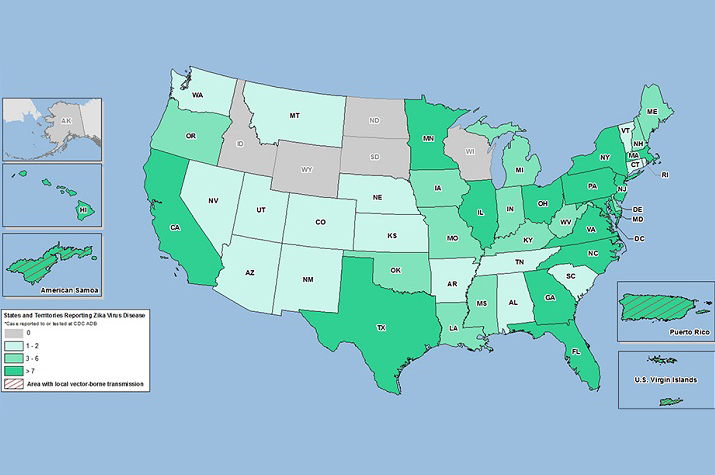
In this map, CDC documents the laboratory-confirmed cases of the Zika virus reported in the United States and U.S. territories.

Datapoints

This map, from the Center for Reproductive Rights (CRR), spotlights abortion laws around the world.

Datapoints

In this map, the New York Times highlights the regions in the United States where mosquitos carrying the Zika virus -- which has been linked to a fetal brain defect -- are most likely to spread during the upcoming spring and summer seasons.

Datapoints

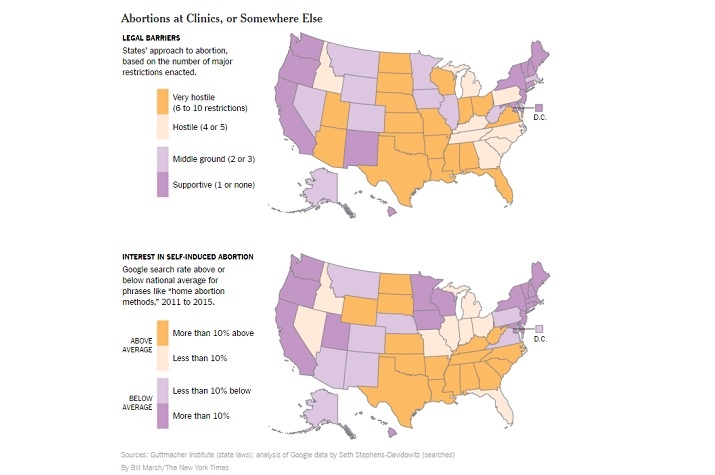
These maps, compiled using data from the New York Times and the Guttmacher Institute, underscore findings from a recent Times investigation, including that there were more than 700,000 searches for how to self-induce an abortion in 2015.

Datapoints

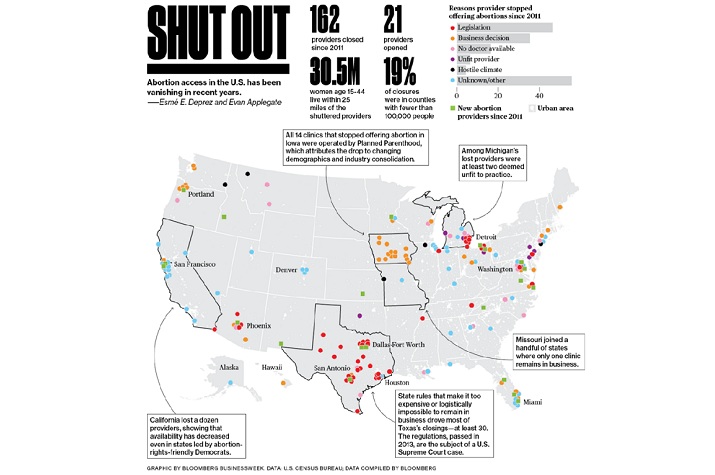
This map, from Bloomberg Business, highlights the rapid decline in abortion access in the United States since 2011.

Datapoints

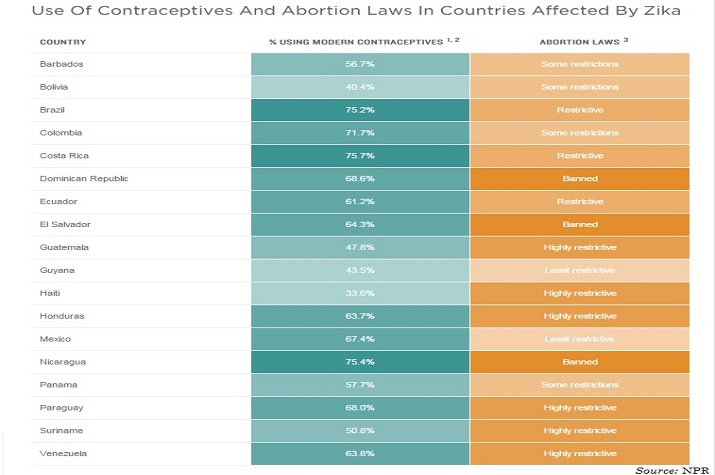
This chart, compiled by NPR, shows how the majority of countries affected by the Zika virus, which might be linked to a severe birth defect, curb access to contraception and abortion care.

See All

At a Glance

"A woman's ability to end her pregnancy too often depends on where she lives, her age and how much money is in her pocket."

— Marcela Howell of In Our Own Voice: National Black Women's Reproductive Justice Agenda, discussing ongoing disparities in women's access to abortion care on the 43rd anniversary of Roe v. Wade.

At a Glance

"If women are not free to make decisions about their own lives and health, they are not free. And if women are not free, none of us are."

— Abortion provider Warren Hern, in a STAT News opinion piece on why he continues to offer abortion care despite receiving harassment and death threats throughout his 42-year career.

At a Glance

"Not since before Roe v. Wade has a law or court decision had the potential to devastate access to reproductive health care on such a sweeping scale."

— Nancy Northup, president and CEO of the Center for Reproductive Rights, on a ruling from the 5th U.S. Circuit Court of Appeals that upheld major portions of a Texas antiabortion-rights law.