
National Partnership for Women & Families

In the News

Blogs comment on disparities in reproductive health care access, the Flint water crisis, more

Read the week's best commentary from bloggers at Huffington Post, Ebony and more.

ABORTION-RIGHTS MOVEMENT:

"Making equal access to reproductive health services a must for 2016," Marcela Howell, Huffington Post blogs: "As the country takes time this month to remember the contributions of Black leaders who have come before and fought so hard for equality ... we must not forget that the fight still continues when it comes to ensuring all Black women have access to the health care that is critical to achieving true equality," writes Howell, executive director of In Our Own Voice: National Black Women's Reproductive Justice Agenda. According to Howell, "The sad truth about American history is that Black women have long been denied the resources and services to make informed decisions about their health care." However, she notes that the Supreme Court this year "has the opportunity to ensure equal access to reproductive health care not just for Black women, but for millions of other women across the country" in Whole Woman's Health v. Hellerstedt, a challenge to portions of Texas' omnibus antiabortion-rights law (HB 2). She explains, "Central to the Texas law are new restrictions on abortion providers, which have been held as medically unnecessary -- and even considered harmful -- by leading medical groups," citing research that found that, since the law took effect, "women have been forced to travel hours to access care, only to face exceedingly long wait times just to be seen at a clinic -- as long as 23 days at some clinics." Noting that such "barriers disproportionately affect Black women" and that black women face "higher rates of unintended pregnancies than any other racial or ethnic group and are more likely to lack access to contraception and quality sex education," Howell writes that her organization, joined by 11 other black women-led reproductive justice groups, submitted an amicus brief to the Supreme Court in support of Whole Woman's Health "to highlight the barriers Black women face in accessing care and the impact on our families if laws like the Texas ... law are not stopped." Howell writes, "Let's hope the Supreme Court stands up for women's rights as they've done for more than 40 years and tells states, once and for all, that barriers to abortion access are unconstitutional. That decision will be an important step in Black women's fight for reproductive justice and equality" (Howell, Huffington Post blogs, 2/9).

What others are saying about the abortion-rights movement:

~ "Stop playing word games: Debate moderators must ask honest questions about abortion," Jodi Jacobson, RH Reality Check.

~ "After #ShoutYourAbortion, here are five golden rules of talking about abortion," Rebecca Wilkins, RH Reality Check.

~ "Judge extends restraining order against orchestrators of Planned Parenthood smear campaign," Imani Gandy, RH Reality Check.

FLINT WATER CRISIS & REPRODUCTIVE JUSTICE:

"#FlintWaterCrisis is a reproductive justice issue," Josie Pickens, Ebony: Pickens discusses the need to address the water crisis in Flint, Michigan, where the water has been tainted with lead, "as a Reproductive Justice issue, and thus a feminist issue." She cites SisterSong, which defines reproductive justice as "'(t)he human right to have children, not have children, and parent the children we have in safe and healthy environments,'" including the human right to bodily autonomy from any form of reproductive oppression.'" Pickens notes that while the mainstream media's discussion of reproductive justice often "centers on abortion and women's ability to have safe access to them as a human right," she questions "where the mainstream (and especially White) feminist leaders and organizations are when we talk about Flint." Sharing the story of Flint resident Nakeyja Cade, whose children have serious lead poisoning symptoms and whose government-issued water filter is ineffective, Pickens writes, "Who is standing up for Nakeyja (and women like her) who are losing their right to birth and mother healthy children?" She also highlights the long-term effects of lead poisoning on women's reproductive organs, which can result in "infertility, miscarriage, preeclampsia and pregnancy-induced hypertension, premature delivery, low birth weight and stillbirth." Pickens writes, "We must additionally focus on the women of Flint who might've had healthy children prior to being lead poisoned, but whose children have now ingested lead, and why, as much as we are trying, bottled water will not help" the irreversible symptoms of lead poisoning, including brain damage. Calling for intersectional feminism, Pickens concludes, "Let's take our understanding of Reproductive Justice and apply it fairly to the women and children of Flint, today" (Pickens, Ebony, 2/2).

What others are saying about the Flint water crisis and reproductive justice:

~ "Advocates reaffirm shared roots of Black Lives Matter, reproductive justice movements," Kanya D'Almeida, RH Reality Check.

~ "The Flint water crisis is a feminist issue," Amanda, National Women's Law Center's "Womenstake"/This Is Personal.

~ "Meet the Flint woman who blew the whistle on the city's water crisis," Lori Gliha, Al Jazeera America's "America Tonight."

Video Round Up

In part of a longer clip covering multiple topics, Reuters TV reports on an omnibus antiabortion-rights measure (HB 1411) recently signed into law by Florida Gov. Rick Scott (R) that bars local health departments from distributing funds for non-abortion-related care to organizations affiliated with abortion providers, among several other provisions.

Video Round Up

In this clip, Fox 17 News' Michele DeSelms covers legislation (HB 4787, HB 4830) passed last week in the Michigan House that would penalize individuals who coerce a woman into receiving an abortion.

Video Round Up

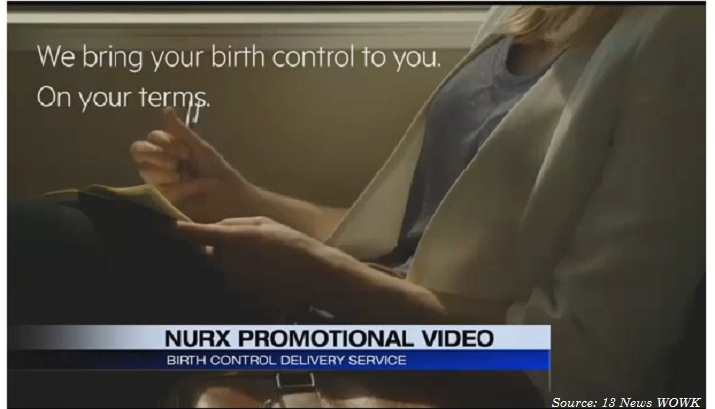
13 News WOWK reporter Alyssa Meisner interviews several women in West Virginia about Nurx, a smartphone application that helps women access birth control.

Video Round Up

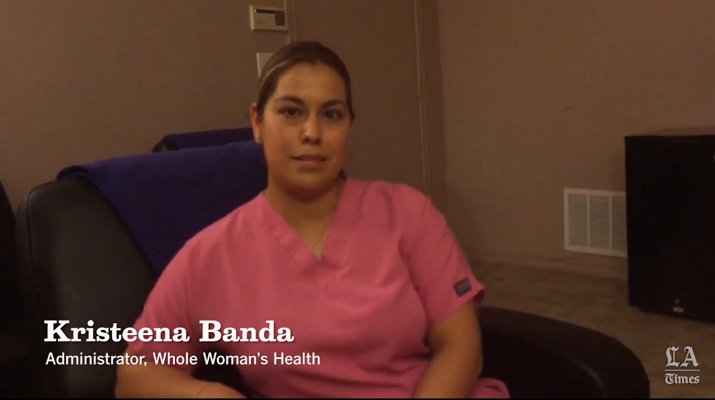
In this clip, Los Angeles Times reporter Molly Hennessy-Fiske hears from Kristeena Banda -- a clinic administrator at Whole Woman's Health, an abortion clinic in McAllen, Texas -- about what is at stake in a legal challenge to parts of Texas' omnibus antiabortion-rights law (HB 2).

Video Round Up

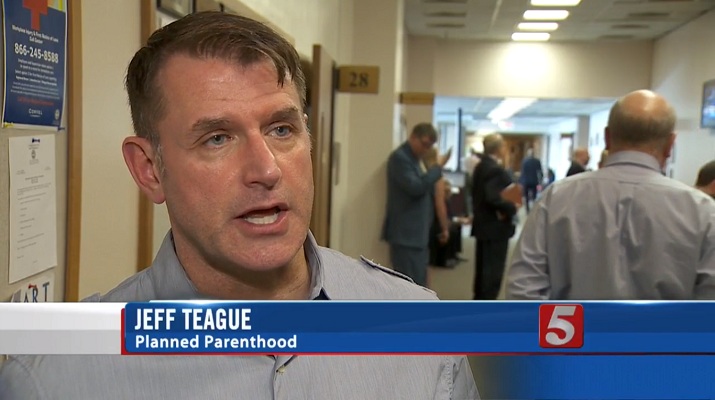
WTVF's Chris Conte reports on the outcome of a Tennessee House subcommittee hearing, which advanced one antiabortion-rights bill while deferring or withdrawing several others.

Video Round Up

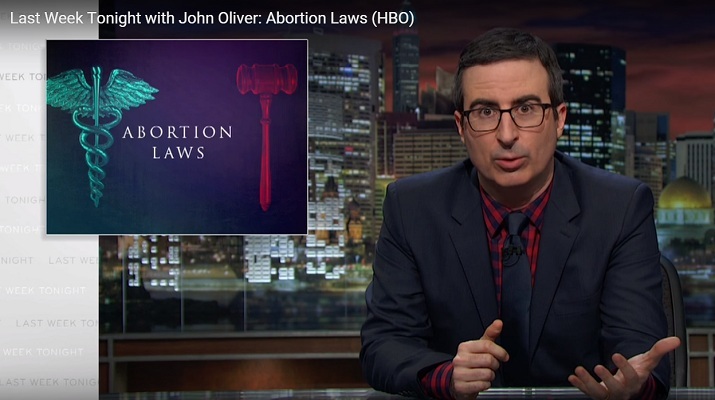
John Oliver on HBO's "Last Week Tonight with John Oliver" discusses the proliferation of attacks on abortion rights in the United States and comments on how such restrictions affect a woman's access to abortion care.

Video Round Up

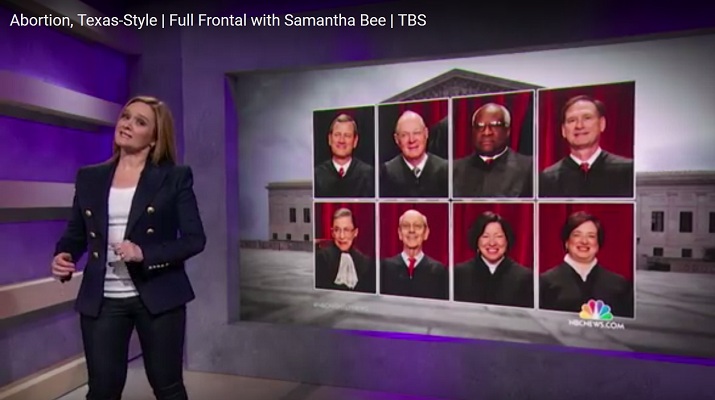
In a segment on HB 2, comedian Samantha Bee interviews Ilyse Hogue, president of NARAL Pro-Choice America, and Texas Rep. Dan Flynn (R), one of the bill's authors, for TBS' "Full Frontal with Samantha Bee," Vox reports.

Video Round Up

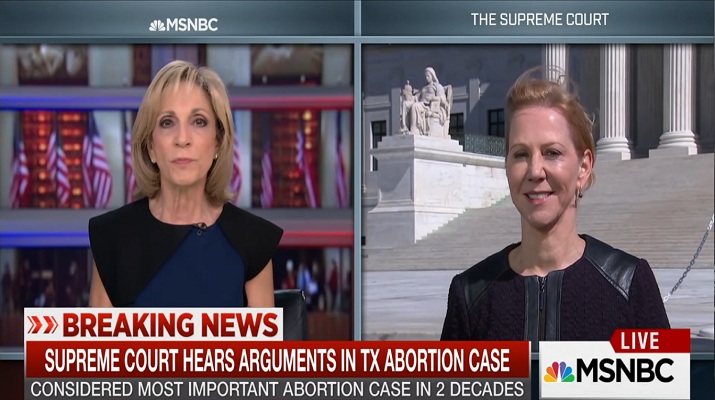
MSNBC's Andrea Mitchell hears from Nancy Northup, president of the Center for Reproductive Rights, about oral arguments before the Supreme Court in a case challenging provisions of Texas' omnibus antiabortion-rights law (HB 2).

Video Round Up

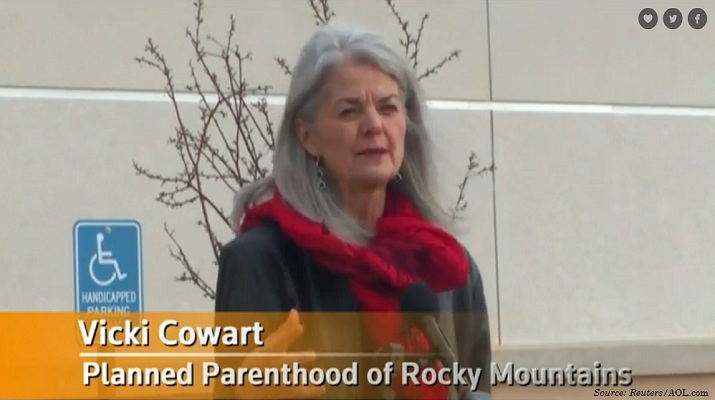
In this clip from Reuters/AOL.com, Vicki Cowart, CEO of Planned Parenthood of the Rocky Mountains, speaks about the reopening of a Planned Parenthood clinic in Colorado that was the site of a deadly shooting last November.

Video Round Up

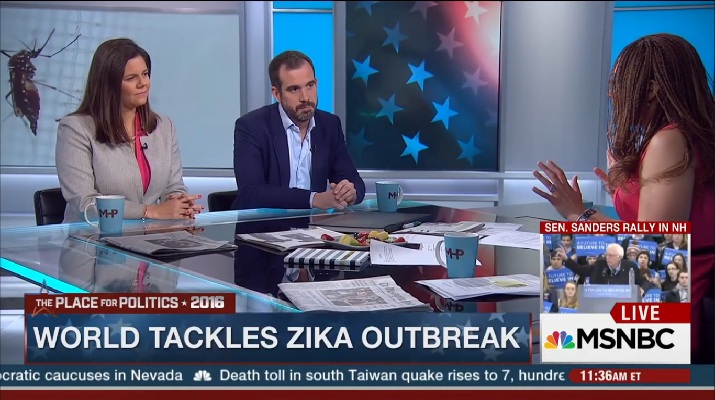
MSNBC's Melissa Harris-Perry hears from guests about the implications of the Zika virus outbreak for women in countries that have limited access to reproductive health care.

See All

Datapoints

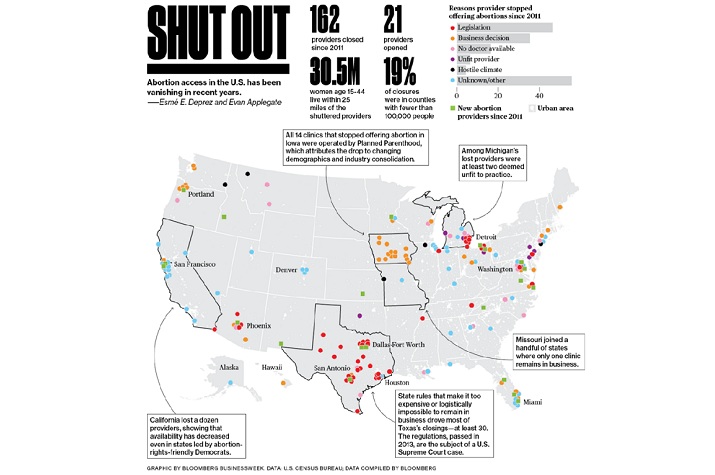
This map, from Bloomberg Business, highlights the rapid decline in abortion access in the United States since 2011.

Datapoints

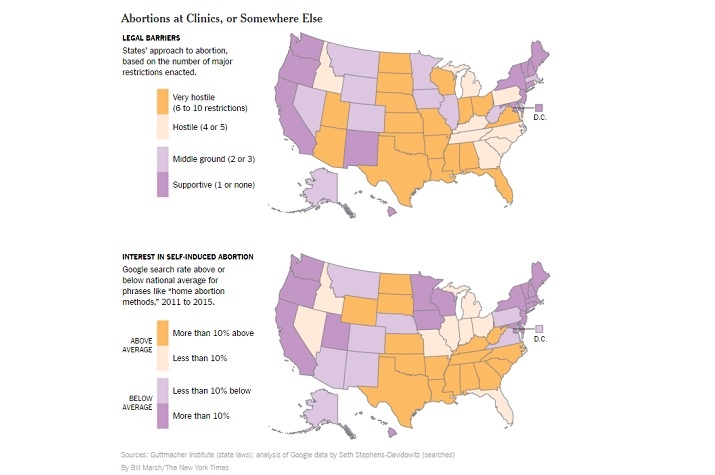
These maps, compiled using data from the New York Times and the Guttmacher Institute, underscore findings from a recent Times investigation, including that there were more than 700,000 searches for how to self-induce an abortion in 2015.

Datapoints

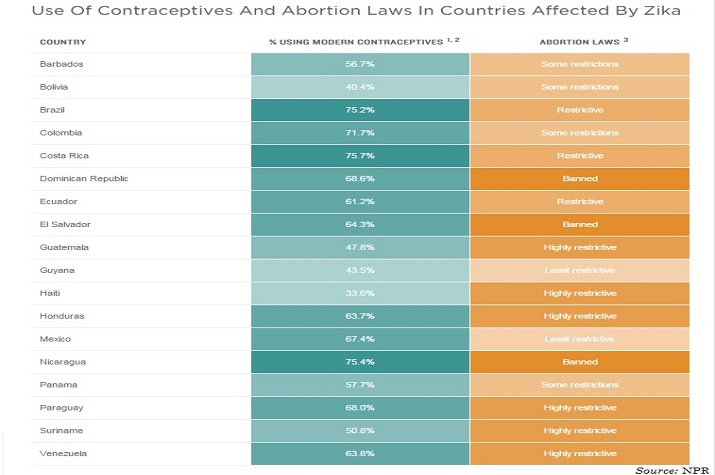
This chart, compiled by NPR, shows how the majority of countries affected by the Zika virus, which might be linked to a severe birth defect, curb access to contraception and abortion care.

Datapoints

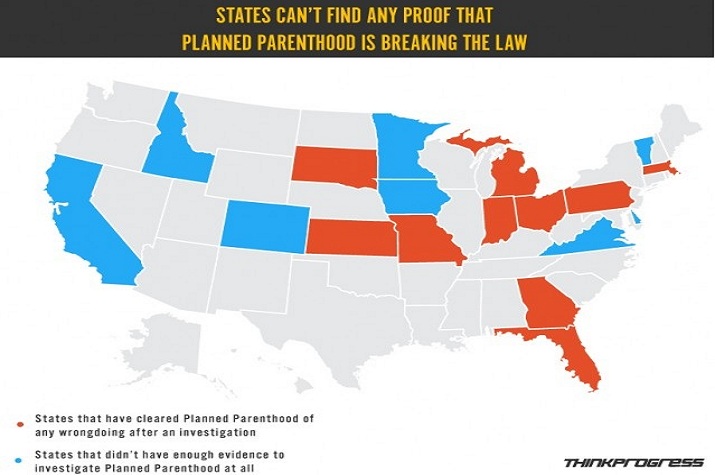
In this map, Center for American Progress' "ThinkProgress" spotlights the 12 states that have cleared Planned Parenthood of any wrongdoing after launching investigations into the organization.

Datapoints

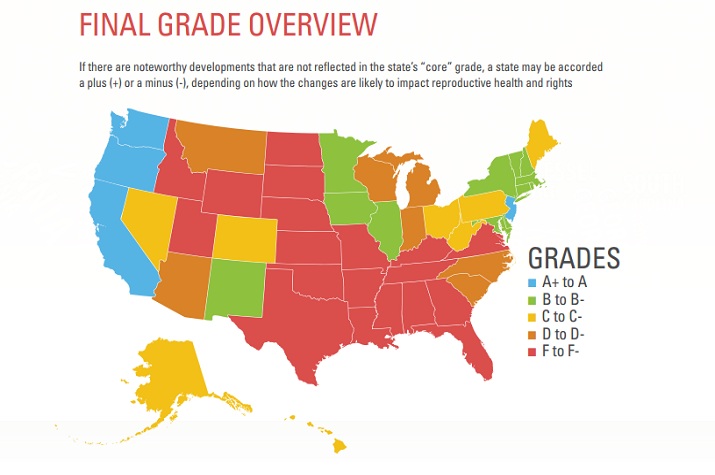
In its latest report card, the Population Institute provides a snapshot of the condition of reproductive rights and health in each state in 2015.

Datapoints

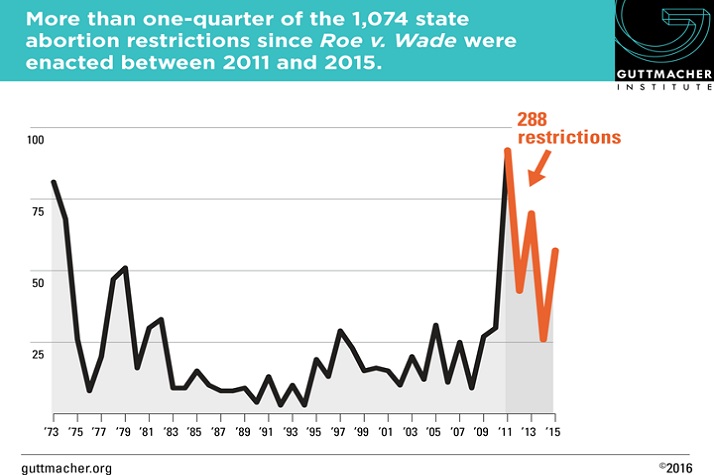
The Guttmacher Institute in this graph shows the rapid increase in the number of state abortion restrictions over the past few years.

Datapoints

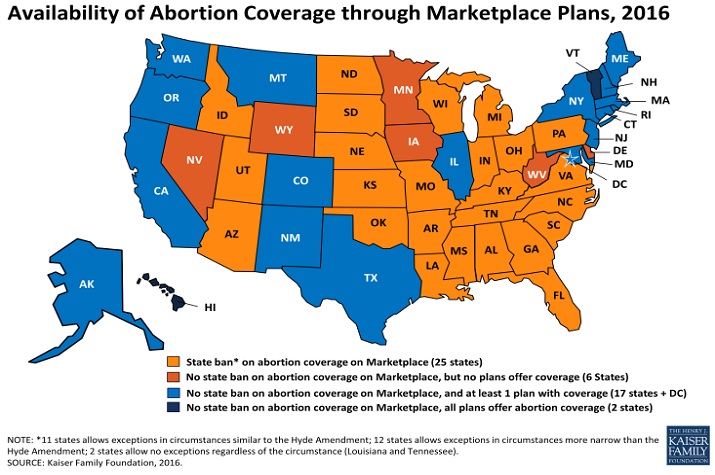
In this map, the Kaiser Family Foundation shows how widely abortion coverage varies from state to state in insurance plans sold through the Affordable Care Act's (PL 111-148) insurance marketplaces.

Datapoints

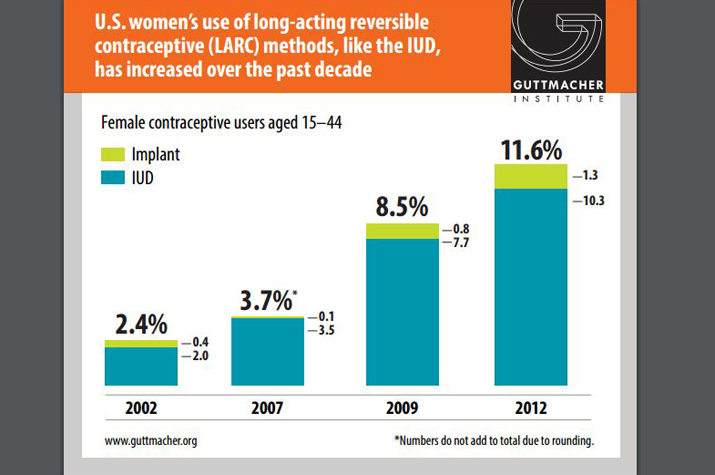
This infographic, released with a new Guttmacher Institute study, shows the increase in use of long-acting reversible contraception among U.S. women between 2002 and 2012.

Datapoints

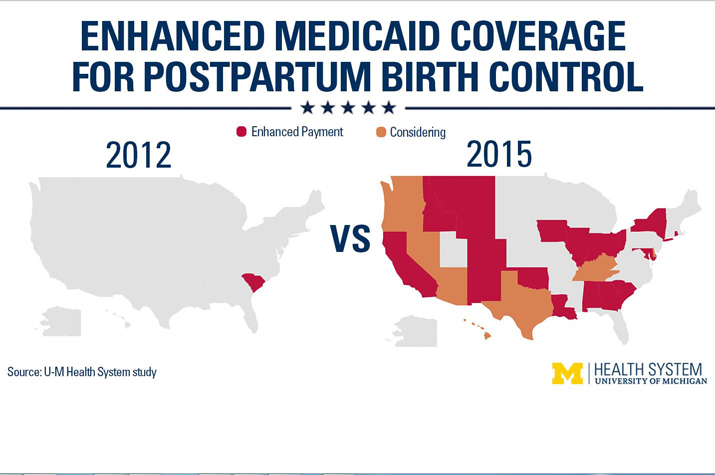
This map, released with a study from the University of Michigan Health System, shows how an increasing number of state Medicaid programs over the last three years are providing reimbursement for immediate postpartum LARC provision.

Datapoints

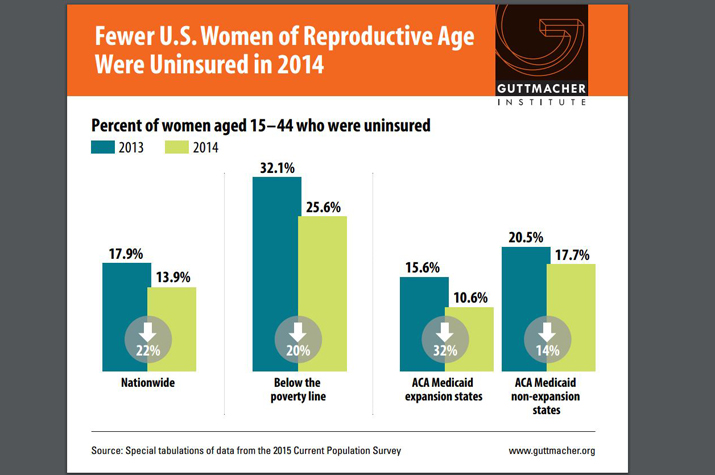
In this infographic, the Guttmacher Institute shows how the proportion of uninsured reproductive-age women in the U.S. declined from 17.9% in 2013 to 13.9% in 2014, the first year in which the Affordable Care Act was implemented fully.

See All

At a Glance

"A woman's ability to end her pregnancy too often depends on where she lives, her age and how much money is in her pocket."

— Marcela Howell of In Our Own Voice: National Black Women's Reproductive Justice Agenda, discussing ongoing disparities in women's access to abortion care on the 43rd anniversary of Roe v. Wade.

At a Glance

"If women are not free to make decisions about their own lives and health, they are not free. And if women are not free, none of us are."

— Abortion provider Warren Hern, in a STAT News opinion piece on why he continues to offer abortion care despite receiving harassment and death threats throughout his 42-year career.

At a Glance

"Not since before Roe v. Wade has a law or court decision had the potential to devastate access to reproductive health care on such a sweeping scale."

— Nancy Northup, president and CEO of the Center for Reproductive Rights, on a ruling from the 5th U.S. Circuit Court of Appeals that upheld major portions of a Texas antiabortion-rights law.