

Read the week's best commentary from bloggers at the Center for American Progress' "ThinkProgress," International Women's Health Coalition's "Akimbo" and more.
ANTIABORTION-RIGHTS MOVEMENT:
"GOP congressman: The relentless investigation into Planned Parenthood is a waste of time and money," Laurel Raymond, Center for American Progress' "ThinkProgress": This week, "for the first time, a [conservative] congressman crossed party lines and voted to end the congressional investigation" into Planned Parenthood, Raymond writes. According to Raymond, Rep. David Jolly (R-Fla.) voted in favor of an appropriations amendment -- which eventually was defeated in a 28-20 vote --that would have defunded the special House subcommittee's investigation. In defending his vote, "Jolly said that the committee is an unnecessary use of millions of taxpayer dollars and of Congress' time," Raymond writes. She quotes Jolly, who said, "'The truth is, we already have had three panels look into the matter and we don't need a fourth.'" Raymond explains that the subcommittee "was convened following allegations made last summer by the Center for Medical Progress' widely-debunked sting videos" targeting Planned Parenthood's fetal tissue donation program. She notes that not only have the claims against Planned Parenthood failed to be "substantiated despite numerous state and federal investigations," but the individuals behind the videos have been indicted. "Across the aisle, many [liberal lawmakers] in Congress have already denigrated the ongoing investigation as a waste of time and money," Raymond writes, noting that nearly 100 liberal lawmakers in April sent a letter to the committee's chair and House Speaker Paul Ryan (R-Wis.) "urging that the committee be disbanded, saying it's a waste of taxpayer dollars and is serving 'no other purpose than to carry out politically-motivated attacks on Planned Parenthood.'" Raymond continues, "However, the House panel continues to operate, going after not only Planned Parenthood but also the scientists who use fetal tissue for medical research, searching for the cure to debilitating diseases such as Alzheimer's and Parkinson's." She concludes, "Though repeated investigations have turned up no credible evidence of wrongdoing, 24 states have moved forward with attempts to cut off Planned Parenthood funding anyway," actions the Obama administration cautioned last month could violate federal law and "a move that, since Planned Parenthood does not use federal funding to provide abortions, in reality means cutting off federal funding for family planning services like birth control, [testing for sexually transmitted infections], and cancer screenings" (Raymond, "ThinkProgress," Center for American Progress, 5/19).
GLOBAL ISSUES:
:"How U.S. policy continues to threaten women's reproductive rights globally," Françoise Girard, International Women's Health Coalition's "Akimbo": "[T]he right to a safe abortion remains elusive for too many," Girard, president of the International Women's Health Coalition, writes. She explains that "[a]n estimated 20 million women and girls undergo an unsafe abortion each year, the overwhelming majority in developing countries," with "[a]n estimated 47,000 women and girls [dying] every year as a result." Girard writes, "The United States bears significant responsibility for this state of affairs. U.S. laws and funding restrictions -- and the very way we talk about abortion -- are incredibly damaging globally." She explains that "U.S. policies and rhetoric fail to recognize that safe abortion is an integral component of reproductive health care and that it is a human right," preferring "to stick to 'safer' issues like family planning, skirting the fact that abortion is part of the full spectrum of sexual and reproductive health and rights." In addition, according to Girard, "U.S. policies fail to recognize that abortion should be available in all circumstances." She cites the Helms Amendment, which "prohibits U.S. foreign aid funding for abortion 'as a method of family planning,'" noting that "the Obama Administration has continued to misinterpret this restriction as a blanket prohibition on funding all abortion overseas -- even in cases of rape, incest, or when the life of the woman is in danger." According to Girard, "This is crucial because the United States is the largest single funder of women's health programs globally; what it says and does matters." Finally, Girard states that "the United States has failed to recognize that abortion should be legal everywhere and for everyone," noting that "U.S. policymakers -- and even many international women's health activists -- limit themselves to improving access to abortion 'where it is not against the law.'" Citing the growing number of countries that are working to ease abortion restrictions, Girard writes, "Not only does the United States ignore this important trend, but every year Congress passes the Siljander Amendment to appropriations, to bar the use of any U.S. foreign assistance funds from being used to advocate on abortion." She questions, "On any other human rights issue, we would not accept national laws as an excuse for violations, but would support domestic activists working to change the situation. Why should abortion be different?" At Women Deliver -- a major international conference taking place this week that focuses on the health, rights and well-being of women and girls -- "activists have highlighted diplomacy as a way the United States can show leadership without running afoul of congressional restrictions on abortion," Girard writes. She concludes, "The U.S. government should use its voice to support, at all levels, abortion rights and access" (Girard, "Akimbo," International Women's Health Coalition, 5/19).
What others are saying about global issues:
~ "We can -- and must -- meet contraceptive needs in developing regions," Cynthia Summers, Ms. Magazine blog.
ZIKA VIRUS:
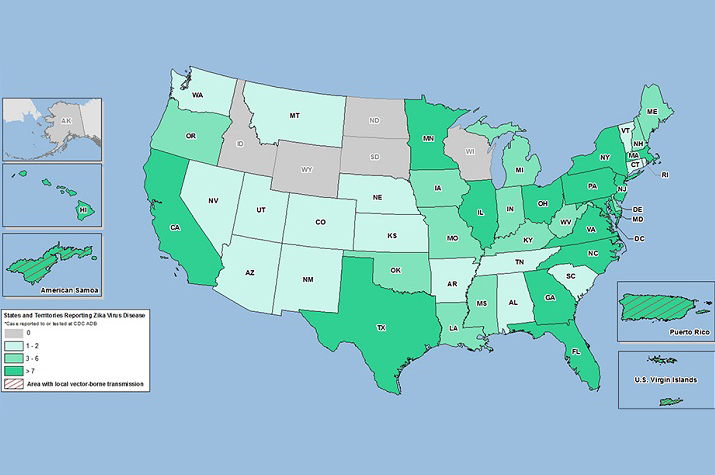
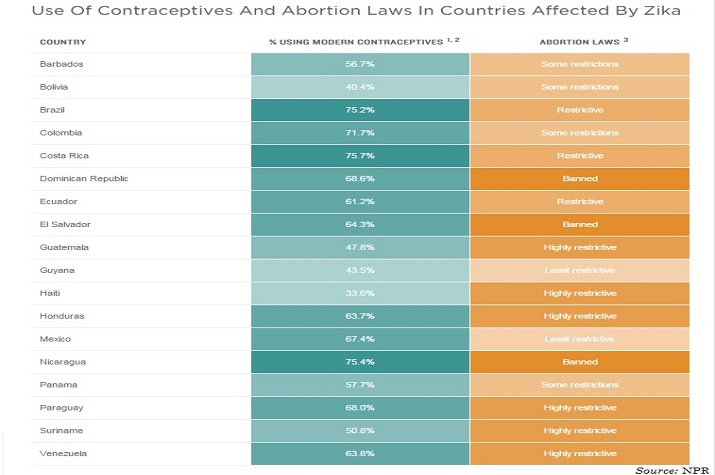
"[Conservatives] really need to stop withholding Zika funding," Nora Caplan-Bricker, Slate's "XX Factor": If conservative lawmakers have "been keeping informed" about the Zika virus, "it would seem that only unmitigated disregard for the health of pregnant women ... could explain the plans that conservatives on Capitol Hill put forward this week" to fund efforts to address the Zika virus, Caplan-Bricker writes. According to Caplan-Bricker, "The scale of the problem came through loud and clear" this week when CDC Director Thomas Frieden "called Zika 'an unprecedented situation," noting that the country "[n]ever before [has] ... seen a mosquito-borne infection that could result in a serious birth defect'" and called on the United States "to start protecting pregnant women from Zika -- for economic reasons as well as humane ones.'" Caplan-Bricker writes that the "White House has said it needs $1.9 billion to effectively protect Americans from Zika," a budget that Frieden this week said "would cover developing a vaccine and better diagnostic tools, containing the relevant strain of mosquito, running multiyear studies of Zika-infected women 'to understand what the range of complications is and work to reduce that,' and more." However, conservative lawmakers "made it clear this week that the administration is not getting its hands on all of those much-needed funds -- or, at least, not any time soon," she explains. For example, conservative lawmakers in the House on Monday "unveiled a plan to reallocate $622 million from other federal health programs -- much of it from the government's Ebola budget -- and put it toward the fight against Zika," Caplan-Bricker explains. However, she notes, the Obama administration "had already responded to Congress' refusal to grant emergency funds by redirecting more than $500 million from its Ebola response." Also this week, the Senate voted "to pass a larger budget for the Zika response -- though that, too, fell considerably short of the White House's request," she writes. She notes that while the Senate bill "would give the White House $1.1 billion to work with," the "number could be shaved down further when the House and Senate try to reach a compromise on their differing bills." Caplan-Bricker writes, "In the meantime, mosquito season is upon us," and "Frieden [has] urged pregnant women to avoid areas where Zika is likely to spread and urged their sexual partners to use condoms if there's a chance that they've been exposed to the virus." She concludes by quoting Frieden, who said CDC is "'working intensively with health departments and environmental departments to track cases and reduce that risk ... And for that, additional resources are very important'" (Caplan-Bricker, "XX Factor," Slate, 5/18).
ABORTION RESTRICTIONS:
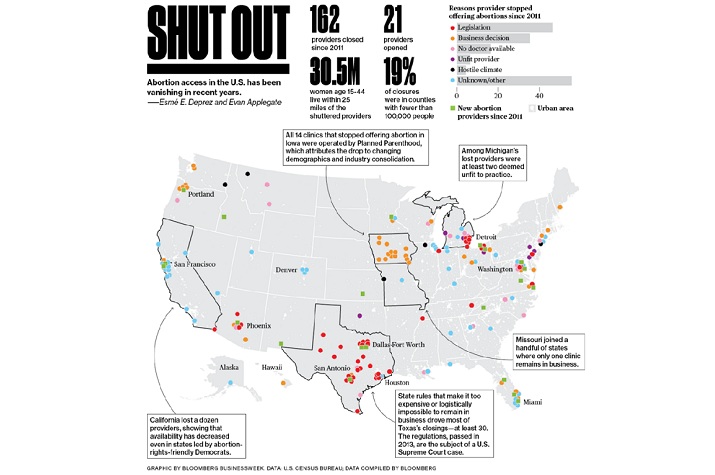
"Oklahoma's nightmarish anti-abortion bill could be the tip of the iceberg," Erin Corbett, Bustle: The Oklahoma House on Thursday voted 33-12 to pass "a bill [SB 1552] that would make performing an abortion a felony, and would also make it legal to revoke the medical licenses of any physician who does so," Corbett writes. According to Corbett, the bill, which now heads to Gov. Mary Fallin (R), also "would make performing an abortion punishable by up to three years in prison." Citing abortion-rights advocates, Corbett explains that the bill is unconstitutional, noting, "After all, this would be a statewide criminalization of abortion, not only punishing individuals who seek this service but also punishing anyone who assists in providing the service, which would make it extremely difficult for people seeking abortions to receive the care they deserve." Corbett quotes officials from the Center for Reproductive Rights, who in April denounced the bill as unconstitutional, stating that "'women have a constitutional right to decide whether to end or continue a pregnancy and states cannot ban abortion prior to viability.'" Corbett adds that the measure "would be the most restrictive anti-abortion bill in the country to date. And that's exactly what anti-abortion groups want," as abortion-rights opponents have said they hope the bill, if enacted, "could lead to a legal case to overturn Roe v. Wade." Corbett quotes Maggie Jo Buchanan, associate director of the Women's Health and Rights Program at the Center for American Progress, who in urging a veto on the bill stated, "'This bill would have a devastating impact on women and health care providers in the state, especially low-income women and women of color. And while a wealthy few may be able to afford the expense of travel to get safe abortion care outside of Oklahoma, all women deserve access to timely and safe care.'" Corbett concludes, "Abortion is one of the safest and most commonly performed gynecological procedures in the United States. Women deserve the autonomy to make the reproductive health decisions that they need to, without the risk of being criminalized for it" (Corbett, Bustle, 5/19). What others are saying about abortion restrictions:
~ "How South Carolina is turning abortion lies into law," Samantha Allen, The Daily Beast.
~ "South Carolina pro-lifers just passed a ban on abortion at 20 weeks -- and they're not done yet," Nora Caplan-Bricker, Slate's "XX Factor."