
National Partnership for Women & Families

In the News

Ala. Senate committee advances antiabortion-rights bills

The Alabama Senate Health Committee on Wednesday approved two antiabortion-rights measures, the Montgomery Advertiser reports.

Both bills now advance to the full state Senate.

'Heartbeat' ban

The committee voted 7-1 to approve a bill (SB 9) that would ban abortion care as early as five weeks into pregnancy. Under the bill, a physician could not provide abortion care to a woman once the fetal heartbeat is detectable. The ban includes exceptions for instances in which the woman's life is in danger or in the case of fatal fetal anomalies. It does not include exceptions for cases of rape or incest.

Physicians who violate the ban could be charged with a Class C felony, which carries a punishment of up to 10 years imprisonment and a fine of $15,000.

At the hearing on Wednesday, JoAnn Cummings, an Alabama resident, questioned whether the state could afford the high legal costs of defending a law that would almost certainly be struck down in federal court. According to the Advertiser, federal courts have struck down similar bans in North Dakota and Arkansas. The U.S. Supreme Court declined to hear an appeal of the ruling against the North Dakota measure (HB 1456).

Another state resident, Xandi Andersen, also voiced concerns about the measure, noting that no stage of pregnancy "makes the woman's body anybody's but her own."

According to the Advertiser, Alabama Rep. Terri Collins (R) has proposed a similar bill (HB 21) in the state House. At a hearing last month, Collins indicated that supporters are willing to defend the legislation if it is challenged in court.

Fetal tissue restrictions

The Alabama Senate Health Committee on Wednesday also advanced a bill (HB 45) that would ban fetal tissue sales in the state. The bill passed in the state House last month (Lyman, Montgomery Advertiser, 3/9).

The measure follows the release this summer of misleading videos targeting Planned Parenthood's fetal tissue donation program. Planned Parenthood denied any wrongdoing, and multiple state and federal investigations into the organization have not found that the organization committed any of the actions alleged in the videos (Women's Health Policy Report, 1/26).

During the committee meeting, state Sen. Billy Beasley (D) questioned the reasoning behind the bill, asking, "As a matter of record, there's been no sale of body parts in the state of Alabama, is that correct?" State Sen. Bill Hightower (R) responded that he was unaware of any such incident (Montgomery Advertiser, 3/9).

Video Round Up

In this clip, the New York Times explores the experiences of pregnant women in Brazil during the ongoing Zika outbreak, which "has been blamed for thousands of neurological birth defects across the country."

Video Round Up

The Wichita Eagle spotlights an abortion clinic set to open in Oklahoma City this summer.

Video Round Up

In this clip, 13 WJZ's Alex DeMetrick covers a new Maryland law (SB 848) that aims to help residents access contraception.

Video Round Up

This Fusion clip spotlights medical professionals' experiences providing abortion care to women in the face of harassment and threats of violence from abortion-rights opponents.

Video Round Up

NJTV News' Briana Vannozzi reports on New Jersey legislation (S 1073, S 2060) that would allow pharmacists to dispense oral contraception to a woman without a doctor's prescription.

Video Round Up

KJRH's Brian Sanders discusses an Oklahoma bill (SB 1552) that "would prohibit any doctor who performs an abortion from obtaining or renewing [his or her] medical license, essentially eliminating legal abortions in the state."

Video Round Up

In this clip, Advancing New Standards in Reproductive Health draws on the Global Turnaway Study to profile women's challenges accessing abortion care in six countries: Bangladesh, Columbia, Nepal, South Africa, Tunisia and the United States.

Video Round Up

WILX News 10's Faith Miller reports on new legislation (SB 897, SB 898) in Michigan aimed at ending the so-called "tampon tax."

Video Round Up

WCCO's Pat Kessler reports on Planned Parenthood's recent response to a slate of antiabortion-rights legislation in Minnesota, which Planned Parenthood is calling "the most aggressive attack against [the] organization in years."

Video Round Up

Broadly shares a behind-the-scenes clip from "Across the Line," a virtual reality documentary that uses video and audio recordings from antiabortion-rights protests at U.S. clinics to show viewers what many women experience when trying to access abortion care.

See All

Datapoints

In this infographic, the Guttmacher Institute highlights research showing how an increasing proportion of women who obtain abortion care in the United States are lower-income.

Datapoints

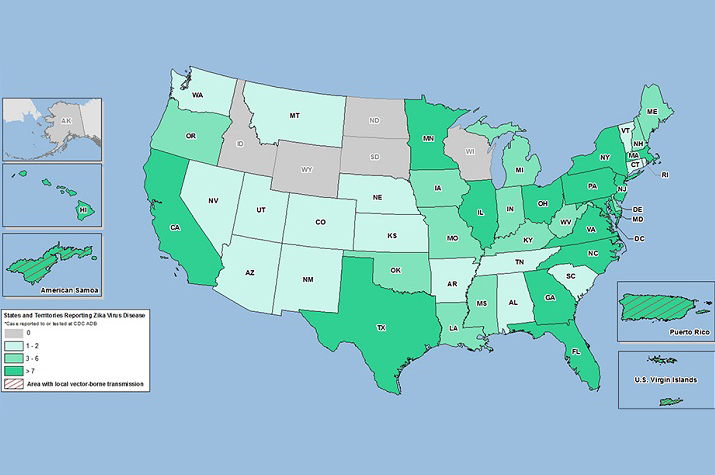
In this map, CDC documents the laboratory-confirmed cases of the Zika virus reported in the United States and U.S. territories.

Datapoints

In this map, the New York Times highlights the regions in the United States where mosquitos carrying the Zika virus -- which has been linked to a fetal brain defect -- are most likely to spread during the upcoming spring and summer seasons.

Datapoints

This map, from the Center for Reproductive Rights (CRR), spotlights abortion laws around the world.

Datapoints

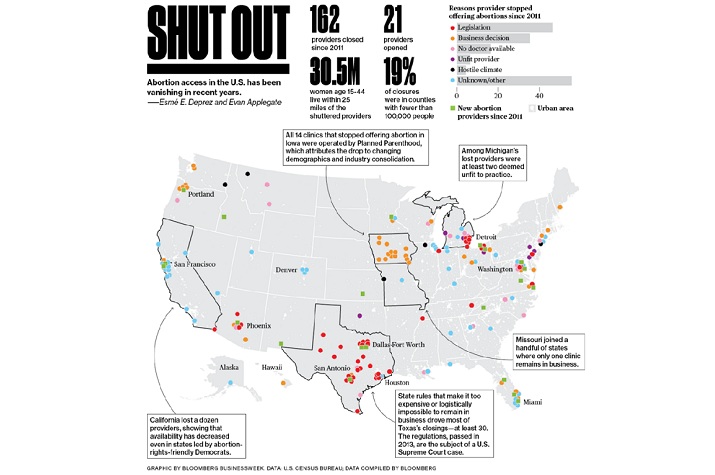
This map, from Bloomberg Business, highlights the rapid decline in abortion access in the United States since 2011.

Datapoints

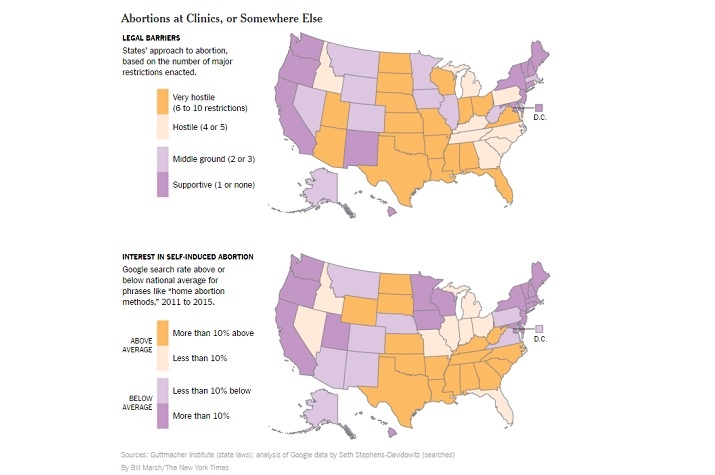
These maps, compiled using data from the New York Times and the Guttmacher Institute, underscore findings from a recent Times investigation, including that there were more than 700,000 searches for how to self-induce an abortion in 2015.

Datapoints

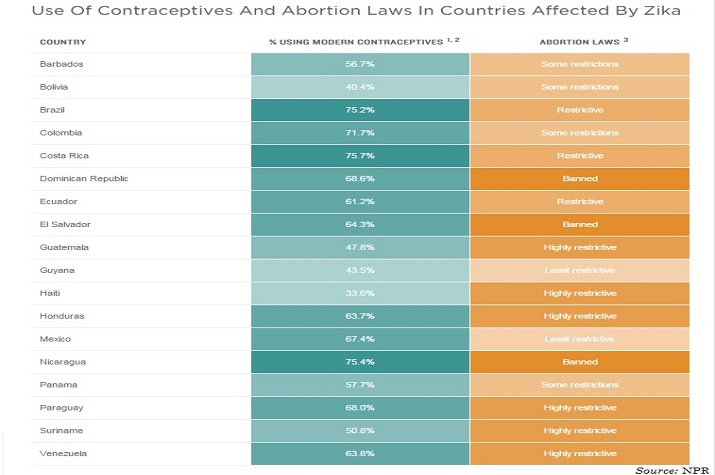
This chart, compiled by NPR, shows how the majority of countries affected by the Zika virus, which might be linked to a severe birth defect, curb access to contraception and abortion care.

Datapoints

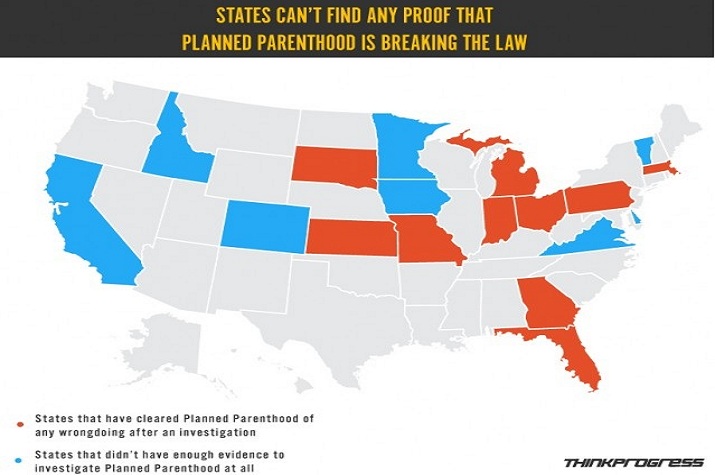
In this map, Center for American Progress' "ThinkProgress" spotlights the 12 states that have cleared Planned Parenthood of any wrongdoing after launching investigations into the organization.

Datapoints

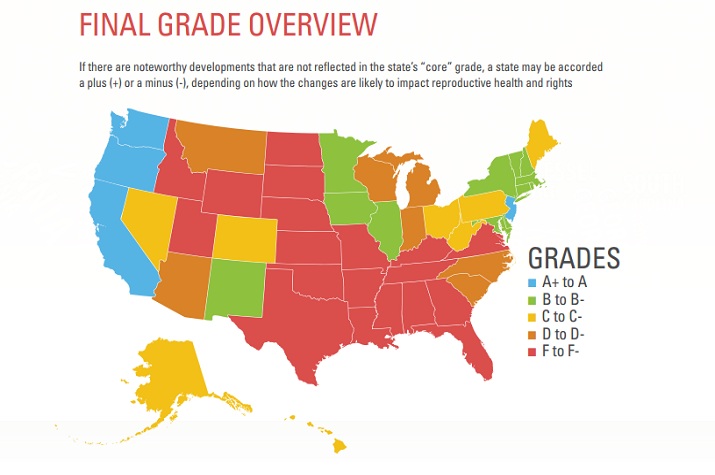
In its latest report card, the Population Institute provides a snapshot of the condition of reproductive rights and health in each state in 2015.

Datapoints

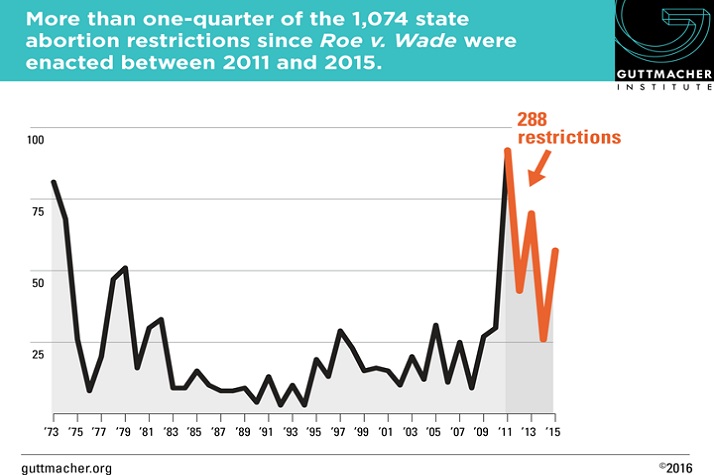
The Guttmacher Institute in this graph shows the rapid increase in the number of state abortion restrictions over the past few years.

See All

At a Glance

"A woman's ability to end her pregnancy too often depends on where she lives, her age and how much money is in her pocket."

— Marcela Howell of In Our Own Voice: National Black Women's Reproductive Justice Agenda, discussing ongoing disparities in women's access to abortion care on the 43rd anniversary of Roe v. Wade.

At a Glance

"If women are not free to make decisions about their own lives and health, they are not free. And if women are not free, none of us are."

— Abortion provider Warren Hern, in a STAT News opinion piece on why he continues to offer abortion care despite receiving harassment and death threats throughout his 42-year career.

At a Glance

"Not since before Roe v. Wade has a law or court decision had the potential to devastate access to reproductive health care on such a sweeping scale."

— Nancy Northup, president and CEO of the Center for Reproductive Rights, on a ruling from the 5th U.S. Circuit Court of Appeals that upheld major portions of a Texas antiabortion-rights law.