

Summary of: "Turning Back the Clock on Women's Health in Medically Underserved Communities," Rosenbaum/Wood, Women's Health Issues, Oct. 20, 2015.
Despite the coverage expansions enacted under the Affordable Care Act, "the struggle continues in the ongoing effort to turn promise into reality, and unfortunately, [low-income] women have been a main casualty during 5 long years of crushing implementation battles," according to Sara Rosenbaum and Susan Wood of the Department of Health Policy and Management at George Washington University's Milken Institute School of Public Health.
Citing ongoing debates over the ACA's Medicaid expansion and contraceptive coverage rules, the authors noted that "despite these bumps in the road, the nation seems to be on a path to universal coverage, with its strong protections for women's health." Yet "for [low-income] women who live in medically underserved communities, achieving health equity does not entail insurance reform alone," the authors continued, as "[c]omplementary interventions are needed to ensure" access to care for more than 60 million U.S. residents who live in such communities. The authors explained, "Where women's health is concerned, the marriage of health insurance coverage with access-creating programs rests on two iconic federal health care safety net programs: Community health centers and Title X-funded family planning centers."
Community health center funding "enable[s] the anchoring of comprehensive, affordable primary health care in medically underserved urban and rural communities," the authors wrote, noting, "Family planning is a required service of all health centers." About six million U.S. women of childbearing age received care at community health centers in 2014. Meanwhile, Title X, part of the Public Health Service Act (PL 91-572), "support[s] the development and operation of clinics that ensure access to family planning and other preventive reproductive health services." According to the authors, Title X funding recipients include "state health agencies, freestanding family planning clinics such as those operated by Planned Parenthood, and community health centers that participate in both [community health center and Title X] programs to augment their family planning programs."
The authors wrote that "in some communities, Title X clinics and community health centers work alongside one another and in tandem," but that "[i]n far more ... a general shortage of primary health care in poorer communities means that one program may be present while the other is not." Moreover, the authors noted that their research has demonstrated that although community health centers offer family planning, "the scope of those services may be limited and variable," depending on the center. Further, while community health centers have seen "rapid growth over the past 20 years, for every patient served another three people continue to need access to affordable care and remain in communities without a community health center," the authors added.
"Title X-funded clinics fulfill a critical need by providing affordable, preventive women's health services where they would not otherwise exist," the authors continued. For example, according to the authors, "[i]n 2010, 72% of U.S. counties, representing 94% of women in need of subsidized care, had at least one Title X-funded clinic; together these clinics served more than 4 million women in 2013." The authors added, "Four out of every 10 women served report that reproductive health-focused clinics ... represent their only source of care." Further, they noted that Title X-funded clinics in 2013 "helped to avert more than 1 million [unintended] pregnancies."
However, the authors wrote that while "20.1 million women [are] in need of publicly funded family planning services, funding for Title X ... continues to sink relative to need, and the program has been threatened with outright extinction next year, with zero funding recommended by the House Appropriations Committee and a significant cut by Senate appropriators for fiscal 2016."
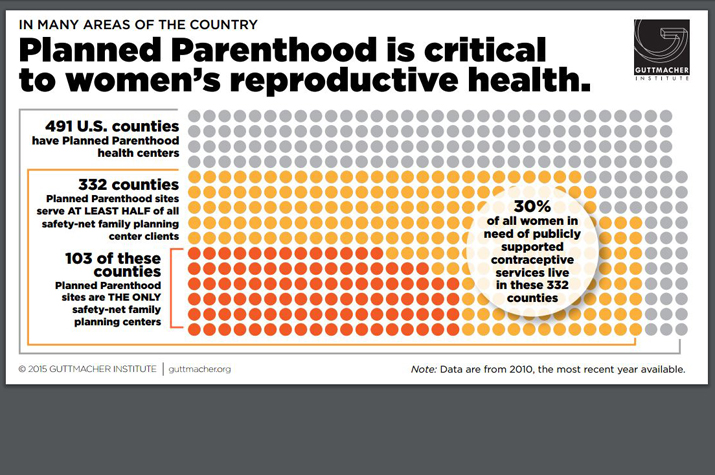
The authors continued, "Planned Parenthood [is] ... crucial to the success of Title X," citing Guttmacher Institute research finding that "in two-thirds of the 491 counties in which they are located, Planned Parenthood-affiliated centers provide care for at least one-half of all women who depend on the health care safety net for publicly funded contraceptive services." Moreover, "in one-fifth of the counties in which they are located, Planned Parenthood-operated clinics are the sole source of safety net family planning care."
The authors also described some federal lawmakers' efforts "to shut down the government this fall unless Planned Parenthood is completely barred from federal programs such as Title X and Medicaid." According to the authors, "Planned Parenthood opponents dismiss any talk of catastrophic health results for women and loss of access to family planning and other preventive services" and claim "that community health centers can pick up the slack, using funds that previously went to Planned Parenthood." The authors also noted that, "These opponents, of course, seem to overlook the fact that the House ... is proposing a complete elimination of the Title X program."
The authors wrote, "Anyone with any basic knowledge of the U.S. health care system knows how dangerously foolish such claims are." They explained, "Even were Title X funding to continue at current levels, and even were all health centers to apply for Title X funding ... they could no more offset the impact of eliminating Planned Parenthood from Title X than they could compensate the loss of other major safety net providers for any population health need, young or old."
Further, while "[c]ommunity health centers have been credited with enormous patient and population health gains," the centers "in many locales already are stretched to the limit," the authors noted. They wrote, "Simply hiring and training the staff needed to respond to the additional flood of women" seeking the services Planned Parenthood could otherwise provide "would take an extended amount of time." Meanwhile, banning Planned Parenthood from Title X and Medicaid would mean "clinic closures would start overnight," the authors added.
The authors noted how "Texas experienced a 9% decrease in family planning program enrollees, a 26% decrease in Medicaid claims, and a 54% decline in contraceptive claims" after the state "eliminated Planned Parenthood as a participating family planning provider." Citing this as an example of "damaging policy," they wrote, "If Title X funding is permitted to erode further or disappear altogether, or if Planned Parenthood is barred from Title X and Medicaid, the results for millions of women will be catastrophic." According to the authors, "to expect [community] health centers to save women of childbearing age and their families from this catastrophic failure of public policy is to demand the impossible" and "simply eliminates a crucial source of health care for the women who need it the most."