
National Partnership for Women & Families

In the News

N.H. House Rejects Bill To Allow Murder Charge for Death of Fetus

The New Hampshire House on Wednesday voted 219-122 to reject a bill (HB 1644) that would have allowed prosecutors to file murder, manslaughter or negligent homicide charges for intentionally or unintentionally ending the life of a fetus, the AP/Boston Herald reports. According to the AP/Herald, opponents of the bill described it as an attempt to define the term "unborn child" in statute with the goal of restricting abortion rights.

State Rep. Beth Rodd (D) said the bill would establish conception as the legal definition of the beginning of life. She called the bill "a wolf in sheep's clothing and an assault on reproductive freedom." Rodd also noted that a state law already exists that permits prosecution for intentionally harming a pregnant woman and causing a miscarriage or stillbirth. State Rep. Gary Richardson (D) said that under the bill, a woman could be charged with homicide even if she did not know she was pregnant and the pregnancy ended unintentionally.

Proponents of the bill said it excluded abortion and was needed to address a problem with the state's use of a 14th century common law doctrine that defines when a person is considered legally alive.

Bill Stems From Court Case

The bill was prompted by a case in which a cab driver, who was seven months pregnant, was injured when her car was struck by a drunk driver. After being delivered via caesarean section, the infant was not breathing and had no detectable heartbeat. The infant was revived and placed on life support but died two weeks later. A passenger in the cab also was killed. The drunk driver was convicted in the death of the passenger, but the state Supreme Court overturned a conviction in the infant's death. According to the AP/Herald, New Hampshire law "does not consider a fetus a person unless the baby shows evidence of life at birth, such as breathing or moving, spontaneously."

In its ruling, the court said, "Should the Legislature find the result in this case as unfortunate as we do, it should follow the lead of many other states and revisit the homicide statutes as they pertain to a fetus," the court said. The court added that 30 states have abandoned the legal definition of "alive" that is used in New Hampshire and 17 other states (Love, AP/Boston Herald, 2/17).
Video Round Up

In this short documentary, filmmaker Dawn Porter profiles Yashica Robinson, one of the few physicians in Alabama who provides abortion care.

Video Round Up

RTV6's Katie Heinz reports on arguments held Tuesday in federal court over an Indiana antiabortion-rights law (HEA 1337) that Planned Parenthood of Indiana and Kentucky has challenged.

Video Round Up

The Wichita Eagle spotlights an abortion clinic set to open in Oklahoma City this summer.

Video Round Up

In this clip, the New York Times explores the experiences of pregnant women in Brazil during the ongoing Zika outbreak, which "has been blamed for thousands of neurological birth defects across the country."

Video Round Up

This Fusion clip spotlights medical professionals' experiences providing abortion care to women in the face of harassment and threats of violence from abortion-rights opponents.

Video Round Up

In this clip, 13 WJZ's Alex DeMetrick covers a new Maryland law (SB 848) that aims to help residents access contraception.

Video Round Up

In this clip, Advancing New Standards in Reproductive Health draws on the Global Turnaway Study to profile women's challenges accessing abortion care in six countries: Bangladesh, Columbia, Nepal, South Africa, Tunisia and the United States.

Video Round Up

KJRH's Brian Sanders discusses an Oklahoma bill (SB 1552) that "would prohibit any doctor who performs an abortion from obtaining or renewing [his or her] medical license, essentially eliminating legal abortions in the state."

Video Round Up

NJTV News' Briana Vannozzi reports on New Jersey legislation (S 1073, S 2060) that would allow pharmacists to dispense oral contraception to a woman without a doctor's prescription.

Video Round Up

WILX News 10's Faith Miller reports on new legislation (SB 897, SB 898) in Michigan aimed at ending the so-called "tampon tax."

See All

Datapoints

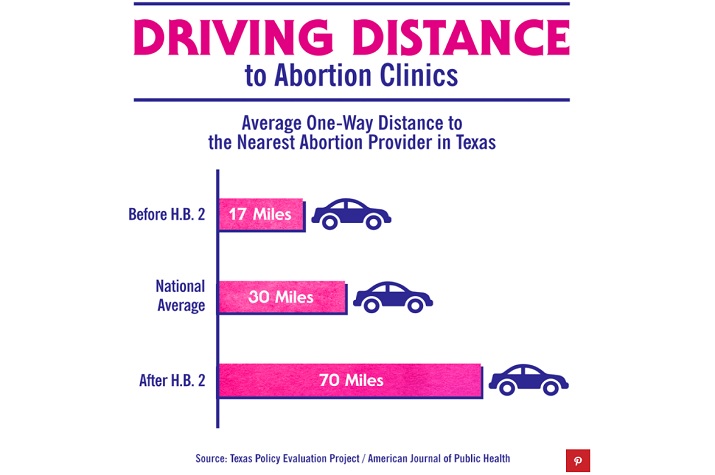
In this gif, Cosmopolitan shares research from the Texas Policy Evaluation Project showing that the average distance a woman in Texas must drive to access the nearest abortion clinic in the state has increased following the implementation of the state's omnibus antiabortion-rights law (HB 2).

Datapoints

In this map, the Kaiser Family Foundation spotlights five states and Washington, D.C., which have each enacted policies designed to facilitate access to contraception.

Datapoints

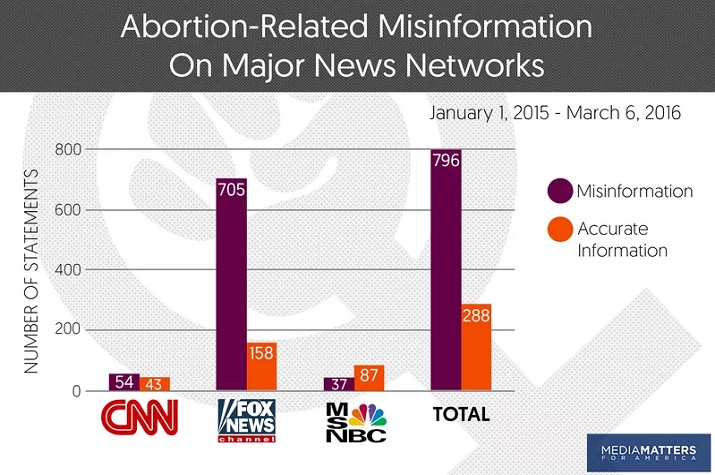
In this chart, Media Matters highlights the findings of a study showing how evening and primetime news programs airing on cable news conveyed more inaccurate than accurate statements about abortion.

Datapoints

In this infographic, the Guttmacher Institute highlights research showing how an increasing proportion of women who obtain abortion care in the United States are lower-income.

Datapoints

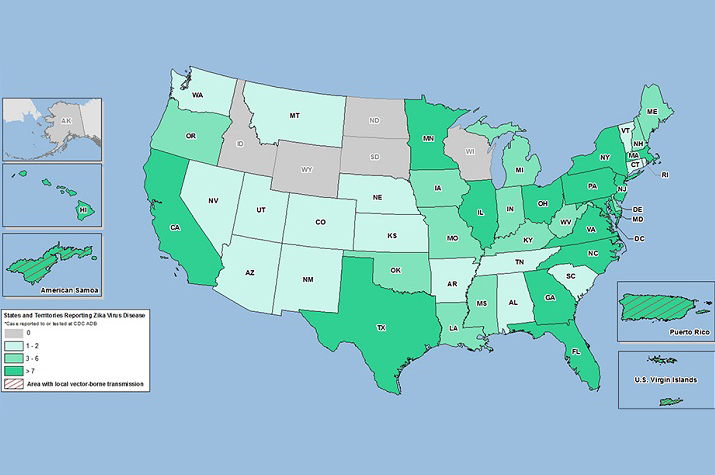
In this map, CDC documents the laboratory-confirmed cases of the Zika virus reported in the United States and U.S. territories.

Datapoints

This map, from the Center for Reproductive Rights (CRR), spotlights abortion laws around the world.

Datapoints

In this map, the New York Times highlights the regions in the United States where mosquitos carrying the Zika virus -- which has been linked to a fetal brain defect -- are most likely to spread during the upcoming spring and summer seasons.

Datapoints

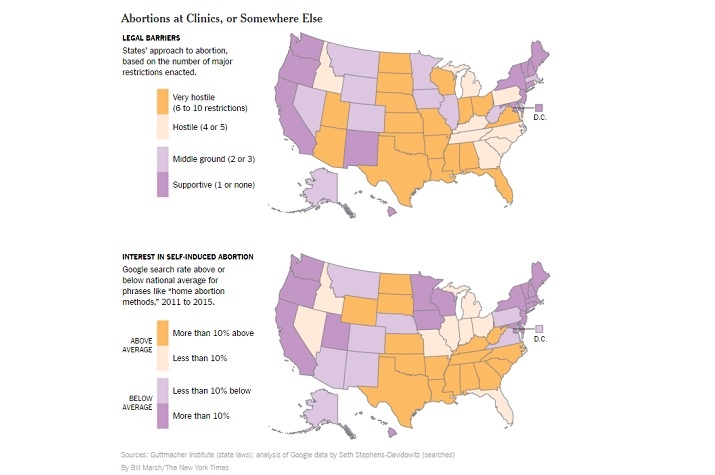
These maps, compiled using data from the New York Times and the Guttmacher Institute, underscore findings from a recent Times investigation, including that there were more than 700,000 searches for how to self-induce an abortion in 2015.

Datapoints

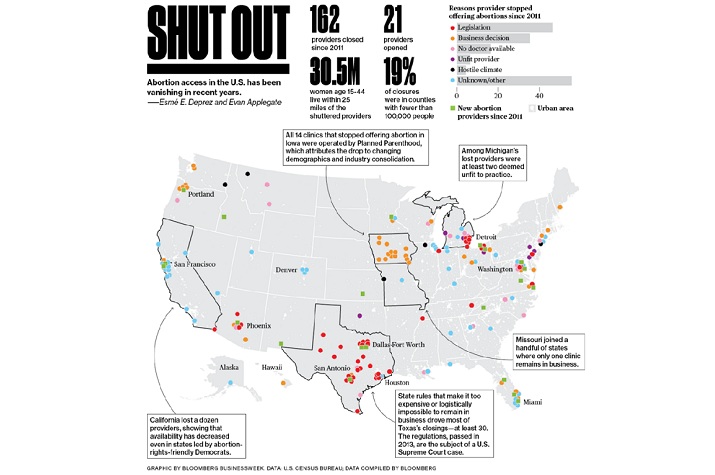
This map, from Bloomberg Business, highlights the rapid decline in abortion access in the United States since 2011.

Datapoints

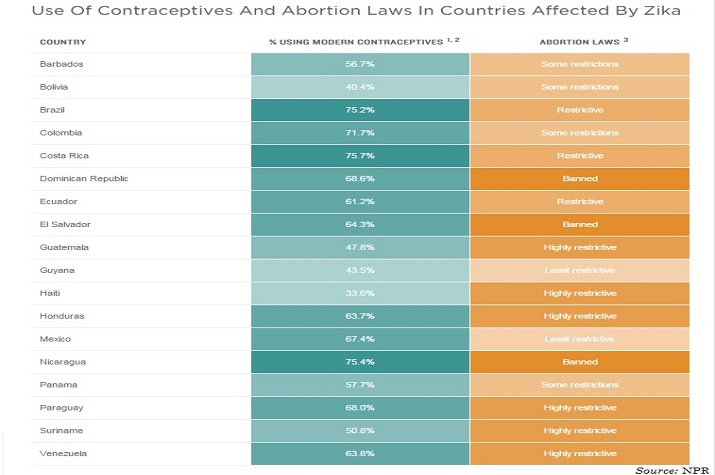
This chart, compiled by NPR, shows how the majority of countries affected by the Zika virus, which might be linked to a severe birth defect, curb access to contraception and abortion care.

See All

At a Glance

"A woman's ability to end her pregnancy too often depends on where she lives, her age and how much money is in her pocket."

— Marcela Howell of In Our Own Voice: National Black Women's Reproductive Justice Agenda, discussing ongoing disparities in women's access to abortion care on the 43rd anniversary of Roe v. Wade.

At a Glance

"If women are not free to make decisions about their own lives and health, they are not free. And if women are not free, none of us are."

— Abortion provider Warren Hern, in a STAT News opinion piece on why he continues to offer abortion care despite receiving harassment and death threats throughout his 42-year career.

At a Glance

"Not since before Roe v. Wade has a law or court decision had the potential to devastate access to reproductive health care on such a sweeping scale."

— Nancy Northup, president and CEO of the Center for Reproductive Rights, on a ruling from the 5th U.S. Circuit Court of Appeals that upheld major portions of a Texas antiabortion-rights law.