
National Partnership for Women & Families

In the News

ACOG: OB-GYNs' primary medical responsibility is to the woman, not the fetus

OB-GYNs should respect the right of pregnant women to refuse recommended treatment, even if the lack of treatment is detrimental to the fetus, according to a committee opinion from the American College of Obstetricians and Gynecologists (ACOG), MedPage Today reports.

Members of ACOG's Committee on Ethics published the opinion in Obstetrics and Gynecology.

In the opinion, the authors affirmed that an OB-GYN treating a pregnant woman has a primary obligation to treat the woman, not the fetus, and the woman has the right to refuse treatment. Specifically, the authors wrote that while OG-GYNs have "beneficence-based motivations towards the fetus of a woman who presents for obstetric care," they have "a beneficence-based obligationto the pregnant woman who is the patient."

For example, according to the opinion, an OB-GYN might recommend that a woman with a condition that makes pregnancy life-threatening, such as severe cardiopulmonary disease, have an abortion. Such a recommendation affirms the primacy of the woman as the OB-GYN's patient, not the fetus.

Co-author Mary Faith Marshall wrote in a statement, "This reinforces ACOG's longstanding support of a patient's right to consent to or refuse medical treatment, and the principle that pregnancy is not an exception to this fundamental right." She continued, "Respecting this right is vital to the patient's relationship with her physician, and prevents coercive interventions and incursions against bodily integrity, which are always ethically impermissible."

The authors also wrote that OB-GYNs should not force a patient to undergo a medical procedure, nor should they comply with court-ordered medical interventions that "violate their professional norms of conscience." The authors lower-income women, women of color and women whose first language is not English are more often subjected to court-ordered inventions, including mandated cesareans. Moreover, according to the authors, nearly one-third of lawsuits seeking court-ordered interventions are based on erroneous medical judgment. The authors added that court-ordered interventions also could discourage women from seeking care.

The authors stated, "Forced compliance -- the alternative to respecting a patient's refusal of treatment -- raises profoundly important issues about patient rights, respect for autonomy, violations of bodily integrity, power differentials, and gender equality."

The authors advised OB-GYNs to instead offer "directive counseling." According to the authors, such an approach involves an OB-GYN providing the patient with his or her recommended course of action without issuing threats or attempting to force the patient to comply. The authors further recommended that an OB-GYN offering directive counseling do so with a team of medical professionals -- such as ethics consultants and staff in relevant medical fields -- and loved ones involved in the woman's care. The authors added that if a woman opts against recommended treatment and experiences an adverse outcome, the OB-GYN should continue providing support to the woman, including counseling if desired.

Committee Chair Sigal Klipstein said, "While such situations can cause distress to both the patient and her physician, it is imperative that the pregnant woman be supported and that her wishes be respected" (Walker, MedPage Today, 5/24).
Video Round Up

In this short documentary, filmmaker Dawn Porter profiles Yashica Robinson, one of the few physicians in Alabama who provides abortion care.

Video Round Up

RTV6's Katie Heinz reports on arguments held Tuesday in federal court over an Indiana antiabortion-rights law (HEA 1337) that Planned Parenthood of Indiana and Kentucky has challenged.

Video Round Up

The Wichita Eagle spotlights an abortion clinic set to open in Oklahoma City this summer.

Video Round Up

In this clip, the New York Times explores the experiences of pregnant women in Brazil during the ongoing Zika outbreak, which "has been blamed for thousands of neurological birth defects across the country."

Video Round Up

This Fusion clip spotlights medical professionals' experiences providing abortion care to women in the face of harassment and threats of violence from abortion-rights opponents.

Video Round Up

In this clip, 13 WJZ's Alex DeMetrick covers a new Maryland law (SB 848) that aims to help residents access contraception.

Video Round Up

In this clip, Advancing New Standards in Reproductive Health draws on the Global Turnaway Study to profile women's challenges accessing abortion care in six countries: Bangladesh, Columbia, Nepal, South Africa, Tunisia and the United States.

Video Round Up

KJRH's Brian Sanders discusses an Oklahoma bill (SB 1552) that "would prohibit any doctor who performs an abortion from obtaining or renewing [his or her] medical license, essentially eliminating legal abortions in the state."

Video Round Up

NJTV News' Briana Vannozzi reports on New Jersey legislation (S 1073, S 2060) that would allow pharmacists to dispense oral contraception to a woman without a doctor's prescription.

Video Round Up

WILX News 10's Faith Miller reports on new legislation (SB 897, SB 898) in Michigan aimed at ending the so-called "tampon tax."

See All

Datapoints

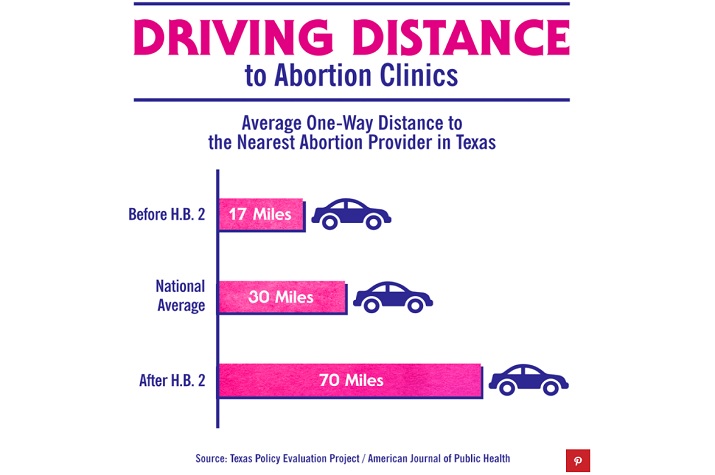
In this gif, Cosmopolitan shares research from the Texas Policy Evaluation Project showing that the average distance a woman in Texas must drive to access the nearest abortion clinic in the state has increased following the implementation of the state's omnibus antiabortion-rights law (HB 2).

Datapoints

In this map, the Kaiser Family Foundation spotlights five states and Washington, D.C., which have each enacted policies designed to facilitate access to contraception.

Datapoints

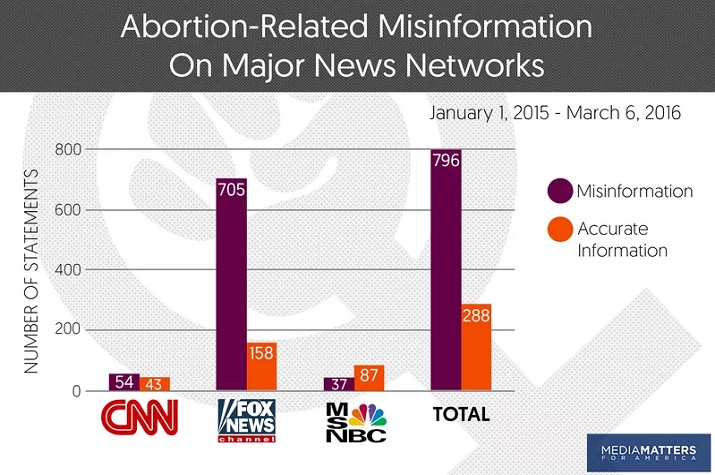
In this chart, Media Matters highlights the findings of a study showing how evening and primetime news programs airing on cable news conveyed more inaccurate than accurate statements about abortion.

Datapoints

In this infographic, the Guttmacher Institute highlights research showing how an increasing proportion of women who obtain abortion care in the United States are lower-income.

Datapoints

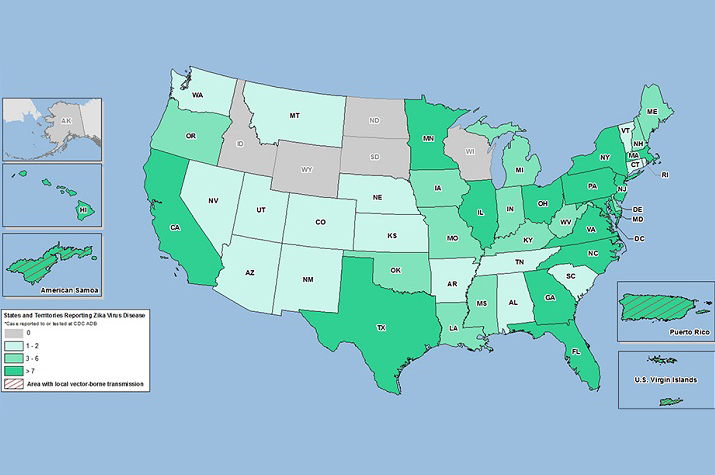
In this map, CDC documents the laboratory-confirmed cases of the Zika virus reported in the United States and U.S. territories.

Datapoints

This map, from the Center for Reproductive Rights (CRR), spotlights abortion laws around the world.

Datapoints

In this map, the New York Times highlights the regions in the United States where mosquitos carrying the Zika virus -- which has been linked to a fetal brain defect -- are most likely to spread during the upcoming spring and summer seasons.

Datapoints

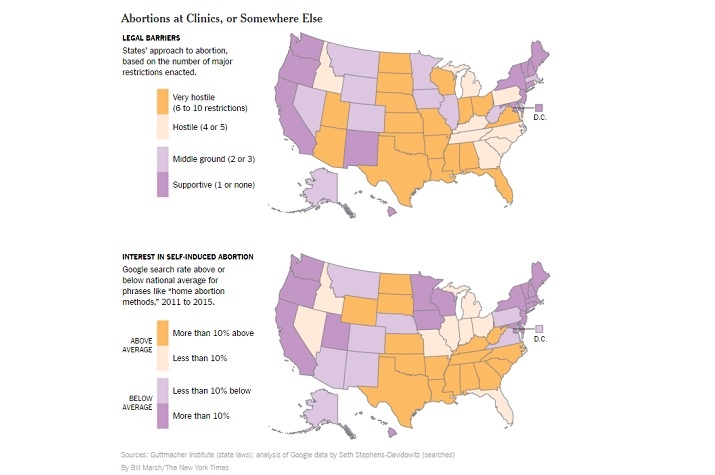
These maps, compiled using data from the New York Times and the Guttmacher Institute, underscore findings from a recent Times investigation, including that there were more than 700,000 searches for how to self-induce an abortion in 2015.

Datapoints

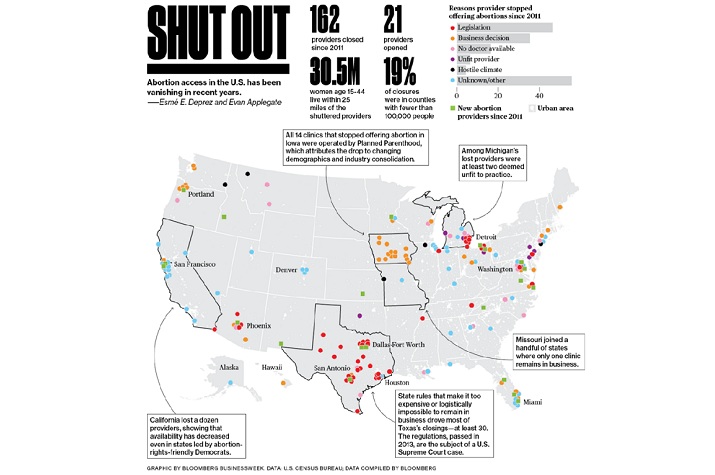
This map, from Bloomberg Business, highlights the rapid decline in abortion access in the United States since 2011.

Datapoints

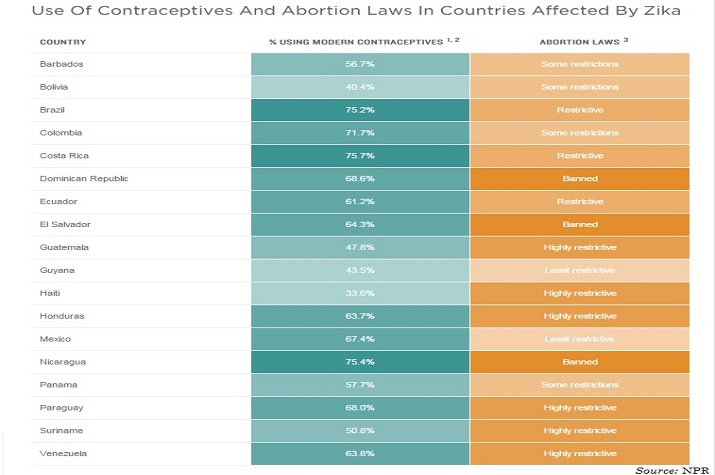
This chart, compiled by NPR, shows how the majority of countries affected by the Zika virus, which might be linked to a severe birth defect, curb access to contraception and abortion care.

See All

At a Glance

"A woman's ability to end her pregnancy too often depends on where she lives, her age and how much money is in her pocket."

— Marcela Howell of In Our Own Voice: National Black Women's Reproductive Justice Agenda, discussing ongoing disparities in women's access to abortion care on the 43rd anniversary of Roe v. Wade.

At a Glance

"If women are not free to make decisions about their own lives and health, they are not free. And if women are not free, none of us are."

— Abortion provider Warren Hern, in a STAT News opinion piece on why he continues to offer abortion care despite receiving harassment and death threats throughout his 42-year career.

At a Glance

"Not since before Roe v. Wade has a law or court decision had the potential to devastate access to reproductive health care on such a sweeping scale."

— Nancy Northup, president and CEO of the Center for Reproductive Rights, on a ruling from the 5th U.S. Circuit Court of Appeals that upheld major portions of a Texas antiabortion-rights law.