
National Partnership for Women & Families

In the News

Ariz. House sends three antiabortion-rights bills to gov.

The Arizona House on Thursday voted to give final approval to three antiabortion-rights measures, the Arizona Republic reports.

Gov. Doug Ducey (D) has five days to take action on the bills. He can sign them into law, veto them or let them become law without his signature (Beard Rau, Arizona Republic, 3/24). According to the AP/KSL, Ducey has not commented on the bills, but he has signed abortion restrictions in the past (Christie, AP/KSL, 3/24).

Bill details

One bill (SB 1324), which was approved on a 32-26 vote, would restrict medication abortion (Conover, Arizona Public Media, 3/24). Specifically, the bill would prohibit a woman who is more than seven weeks' pregnant from obtaining a medication abortion. Abortion providers in the state currently offer medication abortion through nine weeks of pregnancy. Physicians also would be required to administer both drugs in the medication abortion regimen on site, necessitating an extra office visit, and at the dosage listed on the FDA label, which is higher than the dosage typically used in practice. A similar state law (HB 2036) was ruled unconstitutional in October 2015 (Women's Health Policy Report, 3/24).

The second bill (SB 1485), which was approved on a 35-23 vote, would remove Planned Parenthood from a list of organizations to which state employees can donate via the state government's charitable campaign.

A third bill (SB 1474), which was approved on a 41-17 vote, would bar abortion providers from selling or transferring fetal tissue for research purposes (Arizona Public Media, 3/24). The bill, sponsored by state Sen. Nancy Barto (R), was introduced in response to a series of misleading videos targeting Planned Parenthood's fetal tissue donation program. Investigations in several states have found no evidence of wrongdoing by Planned Parenthood, which has stated it has not engaged in illegal activity.

The bill would effectively prohibit nearly all research on fetal tissue resulting from abortion. Under the measure, researchers would be able to use such tissue only to diagnose medical problems in the fetus or the woman, or to conduct pathological research on whether the fetus has a disease. The state government also would be able to investigate the use of fetal tissue even if the government's actions intrude on the doctor-patient relationship (Women's Health Policy Report, 3/24).

Comments

According to AP/KSL, four conservative lawmakers joined liberal members of the state House in opposing the medication abortion bill.

During a House debate on the bills Wednesday, state Rep. Regina Cobb (R) said, "I would ask when you all consider today when you take this vote, are we putting the safety of women in the No. 1 priority, are we taking away the doctor patient relationship? Is this constitutional? And I don't think it is any of those things."

State Rep. Eric Meyer (D) also raised concerns about court challenges. He said, "[W]hat we're doing, because of our political beliefs, we're imposing our beliefs on the practice of medicine and the right for women to choose what they want to do with their bodies, and that is wrong" (AP/KSL, 3/24).

In addition, Meyer, a physician, called SB 1324 a "bad precedent." He said, "We're legislating health care and decisions that are made between a physician and a woman about their health care" (Arizona Public Media, 3/24).
Video Round Up

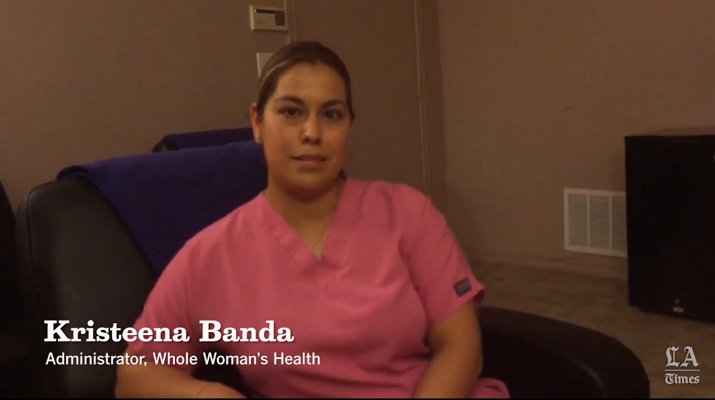
In this clip, Los Angeles Times reporter Molly Hennessy-Fiske hears from Kristeena Banda -- a clinic administrator at Whole Woman's Health, an abortion clinic in McAllen, Texas -- about what is at stake in a legal challenge to parts of Texas' omnibus antiabortion-rights law (HB 2).

Video Round Up

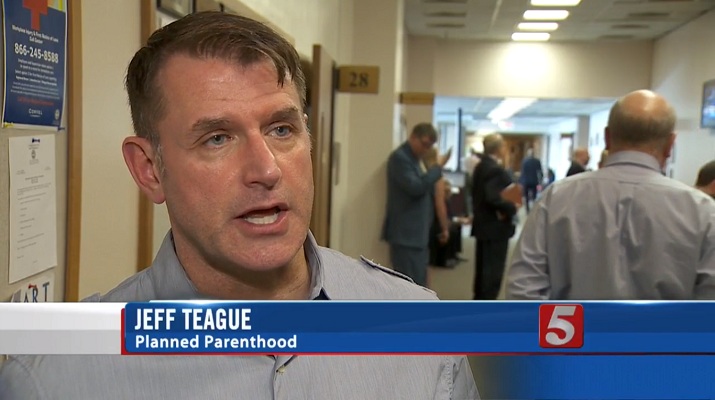
WTVF's Chris Conte reports on the outcome of a Tennessee House subcommittee hearing, which advanced one antiabortion-rights bill while deferring or withdrawing several others.

Video Round Up

13 News WOWK reporter Alyssa Meisner interviews several women in West Virginia about Nurx, a smartphone application that helps women access birth control.

Video Round Up

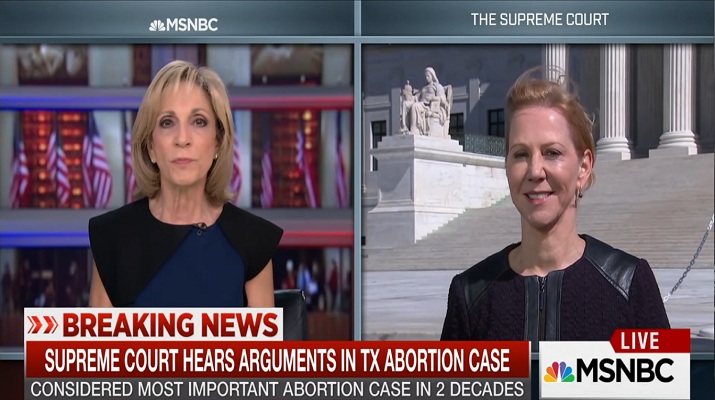
MSNBC's Andrea Mitchell hears from Nancy Northup, president of the Center for Reproductive Rights, about oral arguments before the Supreme Court in a case challenging provisions of Texas' omnibus antiabortion-rights law (HB 2).

Video Round Up

John Oliver on HBO's "Last Week Tonight with John Oliver" discusses the proliferation of attacks on abortion rights in the United States and comments on how such restrictions affect a woman's access to abortion care.

Video Round Up

In a segment on HB 2, comedian Samantha Bee interviews Ilyse Hogue, president of NARAL Pro-Choice America, and Texas Rep. Dan Flynn (R), one of the bill's authors, for TBS' "Full Frontal with Samantha Bee," Vox reports.

Video Round Up

In this clip from Reuters/AOL.com, Vicki Cowart, CEO of Planned Parenthood of the Rocky Mountains, speaks about the reopening of a Planned Parenthood clinic in Colorado that was the site of a deadly shooting last November.

Video Round Up

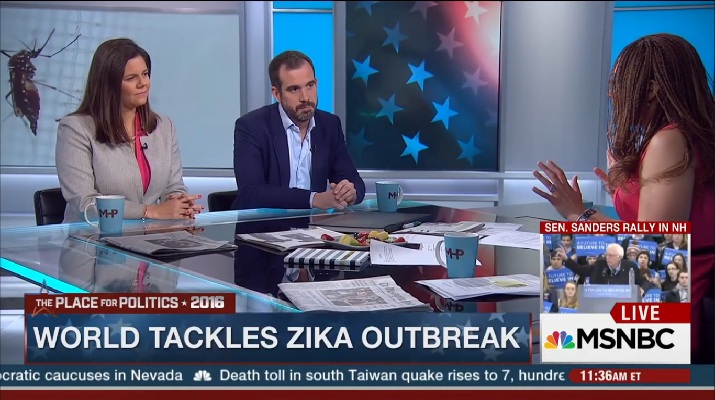
MSNBC's Melissa Harris-Perry hears from guests about the implications of the Zika virus outbreak for women in countries that have limited access to reproductive health care.

Video Round Up

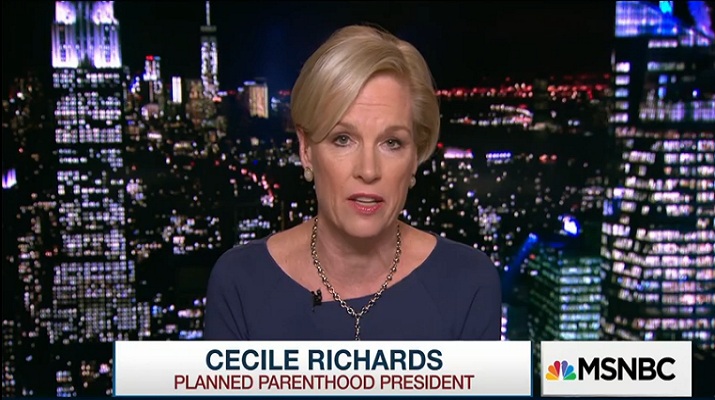
Planned Parenthood president Cecile Richards speaks with MSNBC's Chris Matthews about a Texas grand jury investigation into Planned Parenthood that cleared the organization of wrongdoing and instead resulted in indictments for two abortion-rights opponents involved in filming misleading videos targeting Planned Parenthood.

Video Round Up

In a short film presented by Refinery29 in partnership with Planned Parenthood, several women share personal abortion stories.

See All

Datapoints

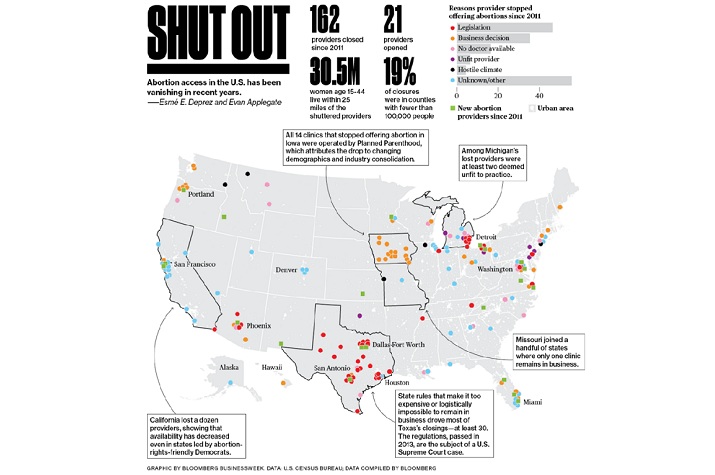
This map, from Bloomberg Business, highlights the rapid decline in abortion access in the United States since 2011.

Datapoints

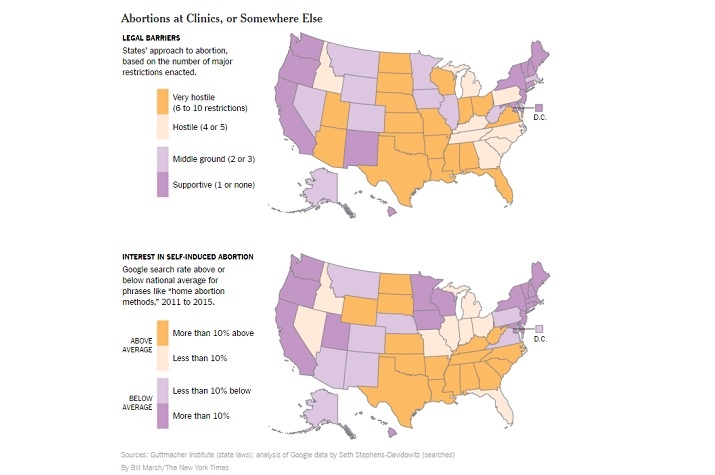
These maps, compiled using data from the New York Times and the Guttmacher Institute, underscore findings from a recent Times investigation, including that there were more than 700,000 searches for how to self-induce an abortion in 2015.

Datapoints

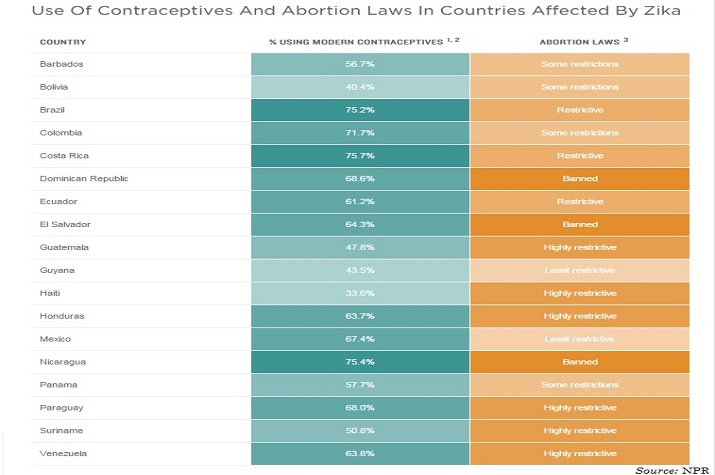
This chart, compiled by NPR, shows how the majority of countries affected by the Zika virus, which might be linked to a severe birth defect, curb access to contraception and abortion care.

Datapoints

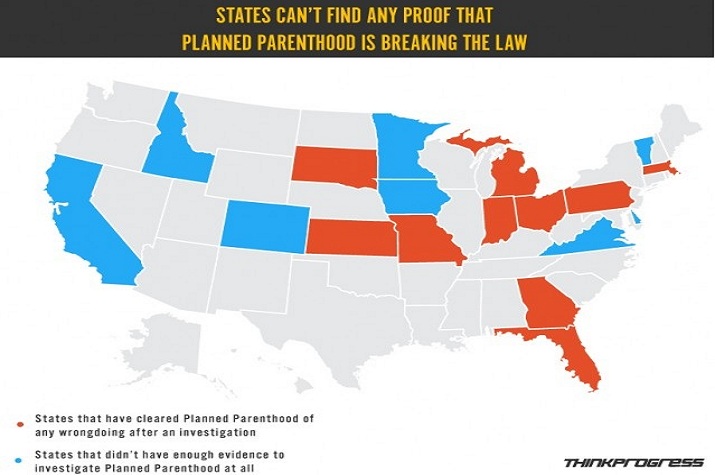
In this map, Center for American Progress' "ThinkProgress" spotlights the 12 states that have cleared Planned Parenthood of any wrongdoing after launching investigations into the organization.

Datapoints

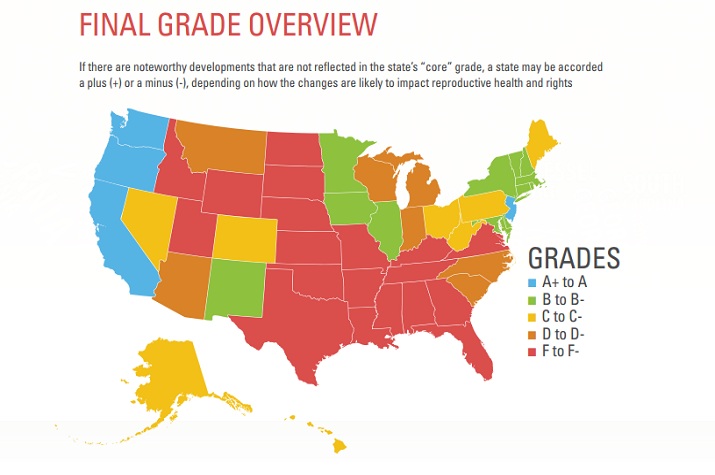
In its latest report card, the Population Institute provides a snapshot of the condition of reproductive rights and health in each state in 2015.

Datapoints

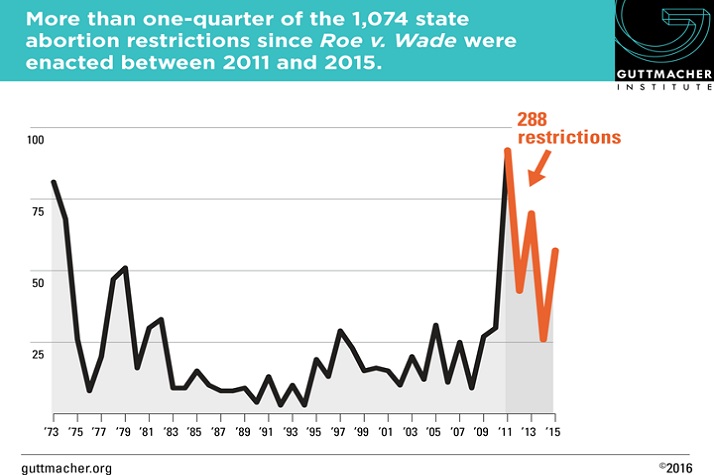
The Guttmacher Institute in this graph shows the rapid increase in the number of state abortion restrictions over the past few years.

Datapoints

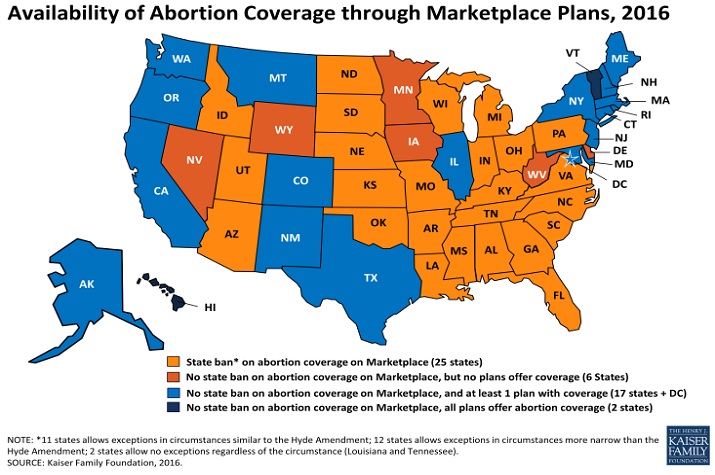
In this map, the Kaiser Family Foundation shows how widely abortion coverage varies from state to state in insurance plans sold through the Affordable Care Act's (PL 111-148) insurance marketplaces.

Datapoints

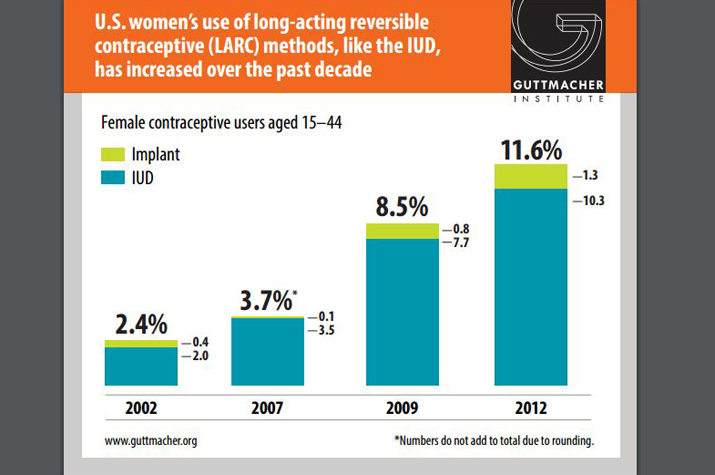
This infographic, released with a new Guttmacher Institute study, shows the increase in use of long-acting reversible contraception among U.S. women between 2002 and 2012.

Datapoints

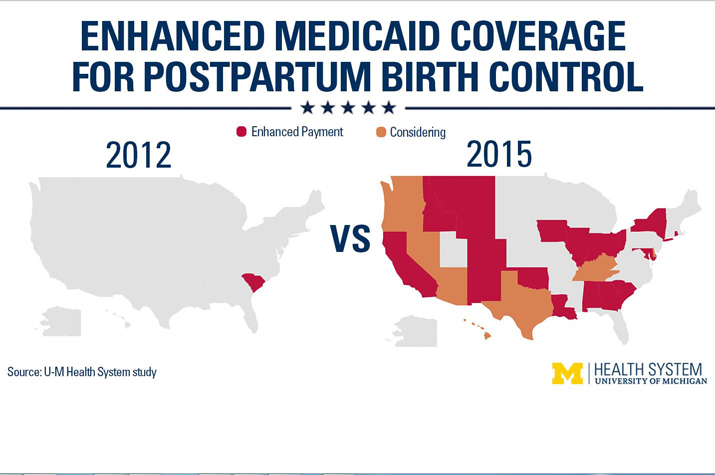
This map, released with a study from the University of Michigan Health System, shows how an increasing number of state Medicaid programs over the last three years are providing reimbursement for immediate postpartum LARC provision.

Datapoints

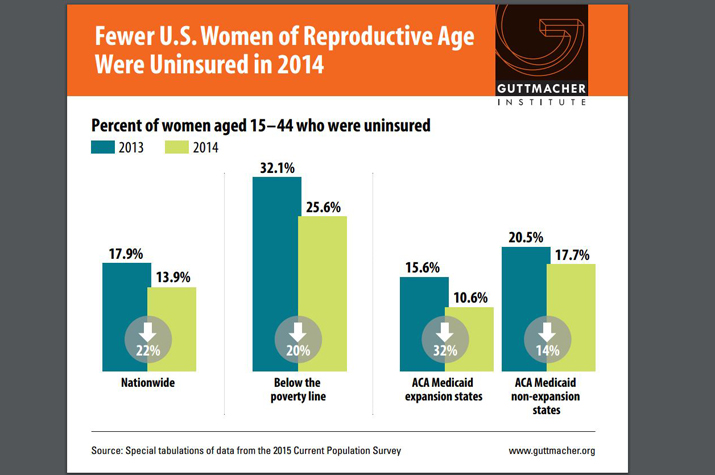
In this infographic, the Guttmacher Institute shows how the proportion of uninsured reproductive-age women in the U.S. declined from 17.9% in 2013 to 13.9% in 2014, the first year in which the Affordable Care Act was implemented fully.

See All

At a Glance

"A woman's ability to end her pregnancy too often depends on where she lives, her age and how much money is in her pocket."

— Marcela Howell of In Our Own Voice: National Black Women's Reproductive Justice Agenda, discussing ongoing disparities in women's access to abortion care on the 43rd anniversary of Roe v. Wade.

At a Glance

"If women are not free to make decisions about their own lives and health, they are not free. And if women are not free, none of us are."

— Abortion provider Warren Hern, in a STAT News opinion piece on why he continues to offer abortion care despite receiving harassment and death threats throughout his 42-year career.

At a Glance

"Not since before Roe v. Wade has a law or court decision had the potential to devastate access to reproductive health care on such a sweeping scale."

— Nancy Northup, president and CEO of the Center for Reproductive Rights, on a ruling from the 5th U.S. Circuit Court of Appeals that upheld major portions of a Texas antiabortion-rights law.