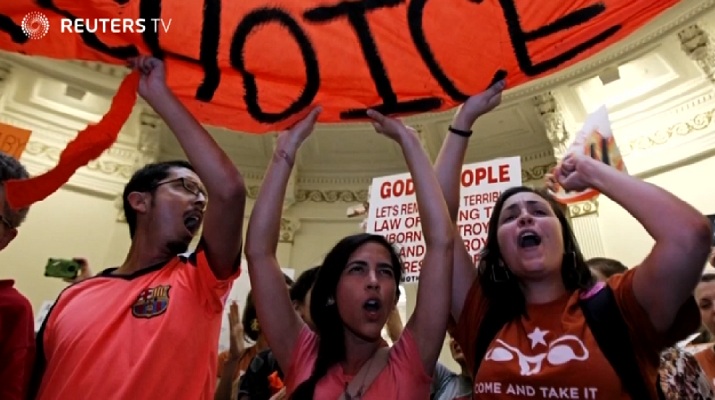


On Monday, abortion-rights supporters filed 45 amicus briefs urging the Supreme Court to strike down contested provisions in Texas' omnibus antiabortion-rights law (HB 2), the Texas Tribune reports.
According to the Tribune, abortion-rights opponents are expected to submit amicus briefs in support of the law within the next few weeks (Ura, Texas Tribune, 1/5).
Background
The Supreme Court will hear arguments in the case on March 2, which puts it on track to issue a final ruling in June. HB 2 has already closed about half of the abortion clinics in Texas.
The case, Whole Woman's Health v. Cole, centers on two provisions. One requires abortion clinics in the state to meet the same building standards as ambulatory surgical centers, and the other requires abortion providers to have admitting privileges at local hospitals.
The Center for Reproductive Rights, which is representing the group of abortion providers challenging the law, argues that HB 2 is unconstitutional, creates an undue burden for Texas women who live far away from the nearest clinic and does not promote the state's interest in improving health. If the court rules for the state, the number of clinics will fall to about 10, compared with about 40 before the law took effect.
In June, the 5th U.S. Circuit Court of Appeals upheld the law's ambulatory surgical centers provision and admitting privileges requirements except in the case of one clinic, Whole Woman's Health in McAllen, Texas. Later that month, CRR asked the 5th Circuit to stay the decision while the clinics appeal to the Supreme Court. The 5th Circuit rejected the request. CRR then filed an emergency request with the Supreme Court, and in late June the high court temporarily blocked HB 2's ambulatory surgical center requirement. There was debate about whether the high court's order also blocked the law's admitting privileges requirement (Women's Health Policy Report, 1/5).
Details of Briefs
According to the Tribune, the amicus briefs refute Texas' argument that HB 2 improves women's health. In addition to the Obama administration's brief, other submissions included filings by abortion-rights advocates, the American Civil Liberties Union, the American Medical Association, legal experts, 163 members of Congress and several health care providers (Texas Tribune, 1/5).
To humanize the topic, several women shared personal stories of their decision to have an abortion. According to USA Today, the effort to personalize the issue could be particularly important considering Justice Anthony Kennedy's claim in a 2007 ruling upholding a ban on a certain type of abortion that "some women come to regret their choice to abort."
In response to that claim, one amicus brief submitted by a group of 10 professional women stated that they "have never regretted their decisions to have an abortion." The brief continued, "To the contrary, [the women] strongly believe that the right to access an abortion was and is crucial to their and every woman's ability to define her own existence, determine her future, achieve her dreams and aspirations, and be an equal participant in our society."
Another amicus brief was filed on behalf of 113 law students and professionals who had obtained abortion care. According to the brief, all of them are "united in their strongly held belief that they would not have been able to achieve the personal or professional successes they have achieved were it not for their ability to obtain safe and legal abortions" (Wolf, USA Today, 1/5).
In addition, former Texas Sen. Wendy Davis (D) -- who sought to block HB 2 with a filibuster when it was initially proposed -- signed an amicus brief with other current and former female lawmakers who have shared their abortion experiences. She said, "We joined in this brief to help the court understand the very real human stories behind abortion in this country and for them to hopefully consider this issue in those terms and outside of the abstract legal terms that are sometimes talked about" (Texas Tribune, 1/5).
Separately, CRR President Nancy Northup said, "Individual women have stepped forward, not anonymously but by using their own names." She added, "They are fighting the stigma that surrounds the subject of abortion" (USA Today, 1/5).
During a press call, Cecile Richards, president of Planned Parenthood Federation of America, said the remaining facilities in Texas would not be able to meet demand if the court upholds the contested provisions. She added, "Texas paints a grim picture of what will become a reality across the U.S. if the Supreme Court upholds this clinic shutdown law" (Texas Tribune, 1/5).