

Read the week's best commentary from bloggers at Slate's "XX Factor," RH Reality Check and more.
ABORTION RESTRICTIONS:
"Of this year's 353 abortion-restriction bills, 70 percent are based on lies," Christina Cauterucci, Slate's "XX Factor": "More than 70 percent of the abortion restrictions introduced in state legislatures so far this year are based on false information, according to a new report from the National Partnership for Women & Families," Cauterucci writes. According to Cauterucci, "Because most of the bills cloak their desired outcome -- limiting women's access to abortion -- in pretexts about protecting women's health, legislators have had to justify their proposals on debunked medical claims and assumptions about abortion regret." Specifically, she notes the report found that "[m]edical lies crop up in 150 of the bills," such as a New York measure that requires providers to tell a woman seeking abortion care that the medically discredited statement that abortion can cause breast cancer. Further, "101 of the abortion restrictions proposed this year are based on deceptive, paternalistic claims about women's decision-making capabilities," Cauterucci continues, pointing to proposed legislation, such as mandatory delays and ultrasound requirements, that "infer that women cannot be trusted to make informed choices about their own bodies and futures without legal interference." She concludes, "The National Partnership's analysis is ominous, but it's even more frightening to consider how soon it'll be outdated" (Cauterucci, "XX Factor," Slate, 3/4).
What others are saying about abortion restrictions:
~ "These 'bad medicine' laws are making it nearly impossible to get an abortion," Sarah Lipton-Lubet, Ms. Magazine.
~ "Searches on self-induced abortions are rising in the United States as reproductive rights are limited, which tells us more than you might think," Suzannah Weiss, Bustle.
~ "'Bad Medicine': Anti-choice laws ignore medical evidence," Nicole Knight Shine, RH Reality Check.
~ "The Supreme Court shamed the most anti-abortion court in the country with just 14 words," Ian Millhiser, Center for American Progress' "ThinkProgress."
WHOLE WOMAN'S HEALTH V. HELLERSTEDT:
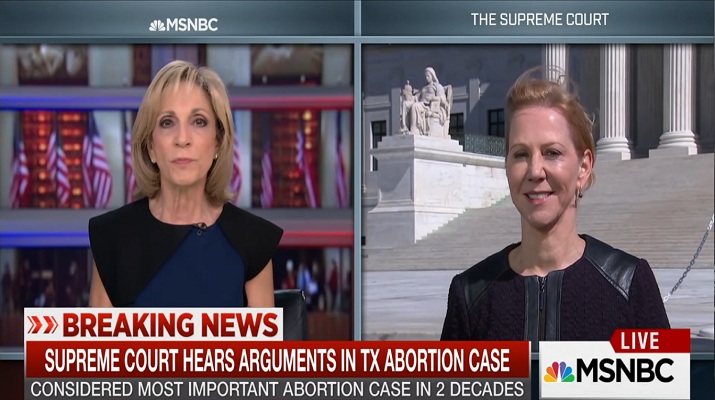
"The future of abortion rights could be decided in this election," Jessica Mason Pieklo, RH Reality Check: Mason Pieklo highlights the key role of the upcoming presidential election will play in selecting a successor for Justice Antonin Scalia by outlining the ideological divide among the current justices, particularly as demonstrated during Wednesday's oral arguments in Whole Woman's Health v. Hellerstedt, the legal challenge against provisions in Texas' omnibus antiabortion-rights law (HB 2). Mason Pieklo writes, "President Obama's nominees, Justice Sonia Sotomayor and Justice Elena Kagan, ... with their liberal colleagues Justices Ruth Bader Ginsburg and Stephen Breyer, shredded both the conservative justices' questions and the State of Texas' entire case," Mason Pieklo writes. She points out how Kagan during oral arguments affirmed the "link between [HB 2's] provisions and clinic closures," while Sotomayor "show[ed] just how dubious Texas' claims are that either [of the contested provisions in HB 2] is about patient health." Noting that conservative lawmakers "refus[e] to approve any new Supreme Court appointments ... until after the presidential election becomes a little clearer," Mason Pieklo writes that the election will either allow conservatives "to keep control over the highest court in the land for decades" or enable "progressives ... to wrestle the Court back to center from its rightward drift through the 1980s and today." Noting that "[t]he repercussions [of HB 2] would ripple beyond Texas, affecting Louisiana, which would likely be left with only one clinic in the state, while Mississippi would have none left at all," and that "legislators everywhere else would feel emboldened to pass similarly restrictive laws to cut off abortion care," she writes that "quite literally everything [is] on the line for [abortion-rights] advocates in this case." She concludes, "So as much as progressives need Justice Kennedy's vote, what we need even more is another progressive woman on the bench" (Mason Pieklo, RH Reality Check, 3/4).
What others are saying about Whole Woman's Health v. Hellerstedt:
~ "The 11 crucial things every woman in America needs to know about the 2016 Supreme Court abortion case," Kicker/Huffington Post blogs.
~ "HB2: The wolf in sheep's clothing driving women away from clinical abortion care in Texas," Jill Adams, American Constitution Society blog.
~ "Hey hey, ho ho, HB 2 has got to go," Linda Flanagan, Huffington Post blogs.
ABORTION-RIGHTS MOVEMENT:
"Filmmakers use virtual reality to depict abortion clinic protests," Sofia Resnick, RH Reality Check: "Across the Line," a new virtual reality film from Planned Parenthood Federation of America (PPFA) and several production groups, depicts a woman's experience seeking abortion care, Resnick writes. According to Resnick, in the film, "filmmakers have taken what they say is real documentary audio and video footage from abortion clinic protests and used virtual reality, 360-degree video technology, and computer-generated imagery (CGI) to bring a patient's experience to life." Kelli Fitzsimmons, one of the film's producers, "said she believes these immersive technologies will help tap into viewers' sense of 'empathy' and 'self-compassion,' by placing viewers directly in the shoes of patients trying to enter a health center to obtain an abortion," Resnick writes. According to Resnick, the film depicts the experience of a woman who while traveling to an abortion clinic first sees protesters holding graphic signs and then encounters an abortion-rights opponent who "tries to convince the woman to follow him to a so-called crisis pregnancy center, designed to dissuade pregnant people from seeking abortion care, often using misinformation." In the final part of the film, Resnick writes, the viewer "is the person trying to enter the reproductive health clinic, walking toward the waiting arms of a clinic escort," while protesters "begin shouting insults." She notes, "Across the Line is part of ongoing efforts by Planned Parenthood and other sexual and reproductive health organizations to reduce stigma and change the conversation around safe and legal abortion." According to Resnick, PPFA will show "Across the Line," which premiered at the Sundance Film Festival in January, "at other film festivals, and community and theatrical screenings across the country" (Resnick, RH Reality Check, 3/7).
CONTRACEPTION:
"What do children's doctors and nuns have in common? They both support women's access to contraception," Brigitte Amiri, American Civil Liberties Union's "Speak Freely": The amicus briefs filed in support of the government with the Supreme Court in a challenge to federal contraceptive coverage rules "explain why the employers' arguments are just plain wrong, and they highlight the high stakes in this case," Amiri of the American Civil Liberties Union's (ACLU) Reproductive Freedom Project writes. She explains that an accommodation to the rules permits not-for-profits that hold themselves out as religious and oppose contraception to avoid providing contraceptive coverage "if they fill out a simple one-page form stating their religious objection." However, according to Amiri, "these employers argued that filling out the form violates their religious beliefs, and they don't want the government to require the insurance companies to cover contraception, even in a separate plan." Amiri highlights several amicus briefs countering this argument, such as one from the American Academy of Pediatrics that explains "that the Supreme Court's decision could have repercussions far beyond the issue of contraception." Similarly, the National Coalition of American Nuns and Catholics for Choice filed a brief "urg[ing] 'this Court to recognize that women's reproductive rights and religious liberty should not be defeated by a religious exemption that leaves contraceptive coverage unavailable to women employees and their families.'" Further, "even those who support the Hobby Lobby decision ... argue that the employers' argument in this case goes too far," Amiri notes, citing a brief from professor Douglas Laycock and the Baptist Joint Committee. According to Amiri, "ACLU also filed a brief, along with other civil rights organizations such as the Leadership Conference on Civil and Human Rights and the NAACP Legal Defense Fund, to highlight an important lesson of history: As our society has moved toward greater equality for racial minorities and women, it has increasingly and properly rejected the idea that religion can be used as justification for discrimination in the marketplace" (Amiri, "Speak Freely," American Civil Liberties Union, 3/7).